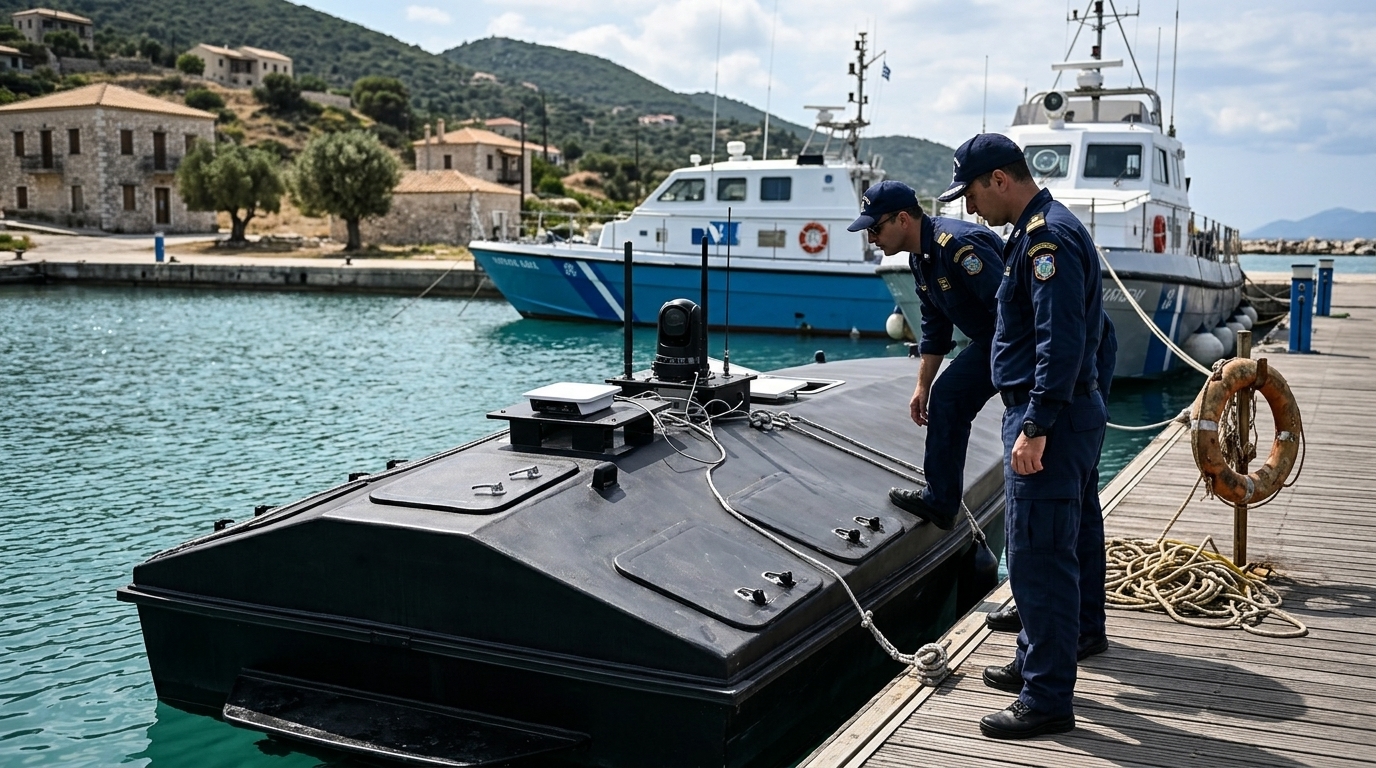
The news of the discovery of a Ukrainian maritime drone (USV) on the turquoise shores of Lefkada was not just a bizarre news item, but a stark reminder that 21st-century geopolitical conflicts know no borders and are not confined to the narrow limits of the battlefield. The Ministry of Foreign Affairs of Ukraine, in a move combining diplomatic courtesy with the raw reality of war, expressed its regret over the incident, attributing the presence of the unmanned vessel in Greek waters solely to Russian aggression.
The Chronicle of an Unlikely Journey
The unmanned surface vehicle, identified as part of the arsenal used by Kyiv to strike the Russian fleet in the Black Sea, appears to have traveled a vast distance before washing up in the Ionian Sea. Analysts estimate that the drone, likely due to a technical malfunction or loss of signal, drifted with the currents, passed through the Bosphorus and Dardanelles straits, crossed the Aegean, and finally rounded the Peloponnese to reach the western coast of Greece. This "unintentional odyssey" highlights the resilience of these machines, as well as the risks they pose to free navigation.
Kyiv's official position was clear: "We regret the inconvenience caused to our Greek partners. However, it must be understood that if it weren't for the Russian invasion, such defense tools would never have been in the seas." This statement is not just an apology, but a strategic reminder to the international community that the consequences of the war in Ukraine have a global and often unpredictable impact.
Security and Tourism Stability
For Greece, the appearance of military equipment in a quintessential tourist destination like Lefkada is a sensitive issue. Although the drone was found inactive and without an explosive payload posing an immediate threat, the psychological impact on residents and visitors is real. The Greek government maintained a low profile, seeking not to disrupt diplomatic relations with Ukraine—which it has actively supported since the beginning of the invasion—while simultaneously intensifying Coast Guard patrols.
- The need for enhanced maritime surveillance in the Mediterranean is becoming imperative.
- Drone technology makes detection difficult for conventional radar systems.
- Cooperation among NATO countries for tracking such assets must be upgraded.
Lefkada, famous for its idyllic beaches, suddenly found itself at the center of a national security debate. The fact that such a vessel could traverse half of Greek maritime space undetected raises serious questions about the effectiveness of early warning systems. While this case involved a "friendly" asset, the possibility of similar penetration by hostile entities cannot be ignored.
The New Reality of Autonomous Weapons
The incident in Lefkada serves as a case study for the new era of warfare. USVs (Unmanned Surface Vehicles) have changed the game in the Black Sea, allowing Ukraine to challenge Russian dominance without possessing a large conventional navy. However, the autonomy of these weapons brings the risk of loss of control. When a weapon designed for destruction ends up drifting unmanned in international waters, it turns into a modern "sea mine" threatening commercial shipping and civilian safety.
"The war in Ukraine is not a local conflict. It is a tectonic shift that sends waves across the world, sometimes literally, as we saw in the case of Lefkada," says an international security analyst.
In conclusion, Ukraine's apology is a necessary diplomatic move, but the essence remains: The Mediterranean, a sea that has historically been a crossroads of civilizations, is now also becoming a field where the "ghosts" of a war that refuses to end appear. Greece is called to balance between supporting its allies and the absolute protection of its own sovereign rights and the safety of its citizens.