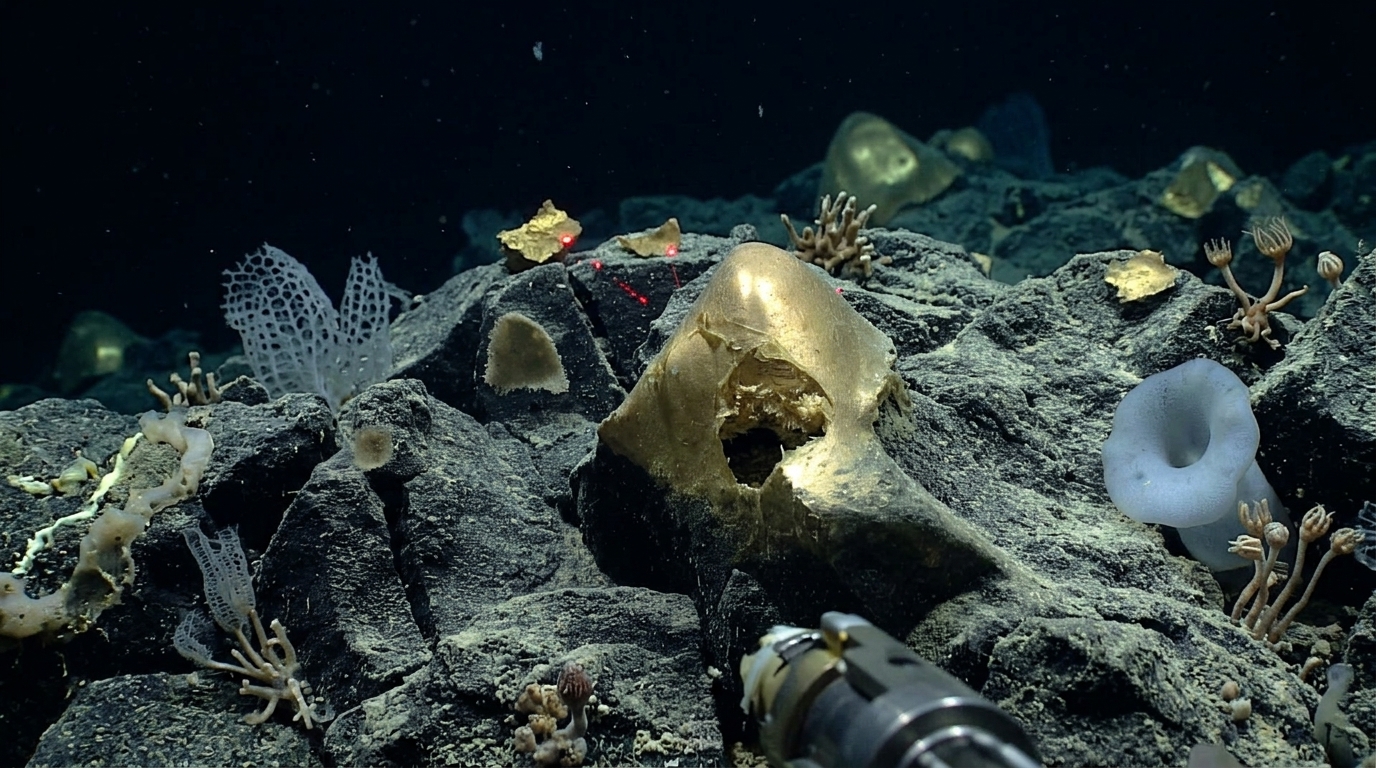
In the dark and frigid depths of the Gulf of Alaska, where water pressure is crushing and sunlight never penetrates, a mission by the U.S. National Oceanic and Atmospheric Administration (NOAA) encountered something that seemed to have emerged from a science fiction film. A shiny, golden, dome-shaped object with a mysterious hole in its surface was found attached to a rock at a depth of 3,300 meters. This discovery, initially dubbed the 'golden egg,' sparked a wave of speculation ranging from extraterrestrial origins to remnants of ancient civilizations.
However, the scientific reality, though perhaps less 'space-age,' is proving to be far more captivating. Recent DNA analyses and laboratory studies have confirmed that the object is biological in origin. It is not a metal or an artifact, but the remains of an animal that science has yet to fully classify. This case highlights the vast gap in our knowledge of marine biology and the urgent need to protect abyssal ecosystems.
The Science Behind the Shine
When the mission's remotely operated vehicle (ROV), part of the 'Seascape Alaska' expedition, approached the object, scientists were struck by its texture. While it appeared metallic on camera, it proved to be soft and flexible to the touch, similar to skin tissue or a sponge. The hole in its surface suggests that either something attempted to enter it to feed, or something hatched and emerged from within.
NOAA researchers, using advanced genomic sequencing techniques, are now attempting to identify the species. Initial results indicate that the 'golden orb' likely belongs to a new category of sponges or is the egg casing of a previously unknown species of cephalopod or another marine organism. The fact that science cannot immediately categorize it into a known family underscores how little we understand life at great depths. According to biologists, the 'golden' hue may be the result of the ROV's lights reflecting off specific proteins or pigments that protect the organism from the hostile environment of the abyss.
The Ocean as the Final Frontier
It is a frequently repeated cliché that we know more about the surface of the Moon and Mars than we do about the floor of our oceans. This discovery confirms this in the most emphatic way. The abyss represents the planet's largest ecosystem, yet less than 25% of the ocean floor has been mapped with high resolution, and an even smaller percentage has been visually explored.
The importance of such research goes beyond mere curiosity. Organisms living under conditions of extreme pressure and lack of light have developed unique biochemical properties. Studying them could lead to revolutionary discoveries in medicine, such as new antibiotics or anti-cancer drugs, as well as in biotechnology. Furthermore, understanding deep-sea biodiversity is critical for addressing the climate crisis, as oceans act as the primary carbon regulator on the planet.
Political and Ethical Implications
The discovery of the 'golden orb' comes at a critical juncture, as the debate over deep-sea mining intensifies globally. Multinational corporations and governments view the seabed as a rich source of cobalt, nickel, and other materials essential for the 'green' transition and electric vehicle batteries. However, discoveries like the one in Alaska remind us that we risk destroying entire ecosystems before we even know they exist.
The International Seabed Authority (ISA) is under pressure to establish strict regulations. Scientists warn that mining will cause irreparable damage to species that, like the 'golden orb,' are links in a chain of life we are only beginning to grasp. Protecting these uncharted areas is not just a matter of ecological sensitivity, but also of scientific survival. Every unknown species lost is a lost opportunity to understand the evolution of life on Earth.
"Nature always has a way of reminding us that we are mere visitors in a world that does not belong entirely to us," says one of the expedition researchers.
In conclusion, the mystery of the Gulf of Alaska is not just about a strange object. It is about our relationship with the unknown and our responsibility toward the planet. The return of the sample to the laboratory is just the beginning of a long process that will teach us much, not only about biology but also about the humility we must show toward the wonders of nature.