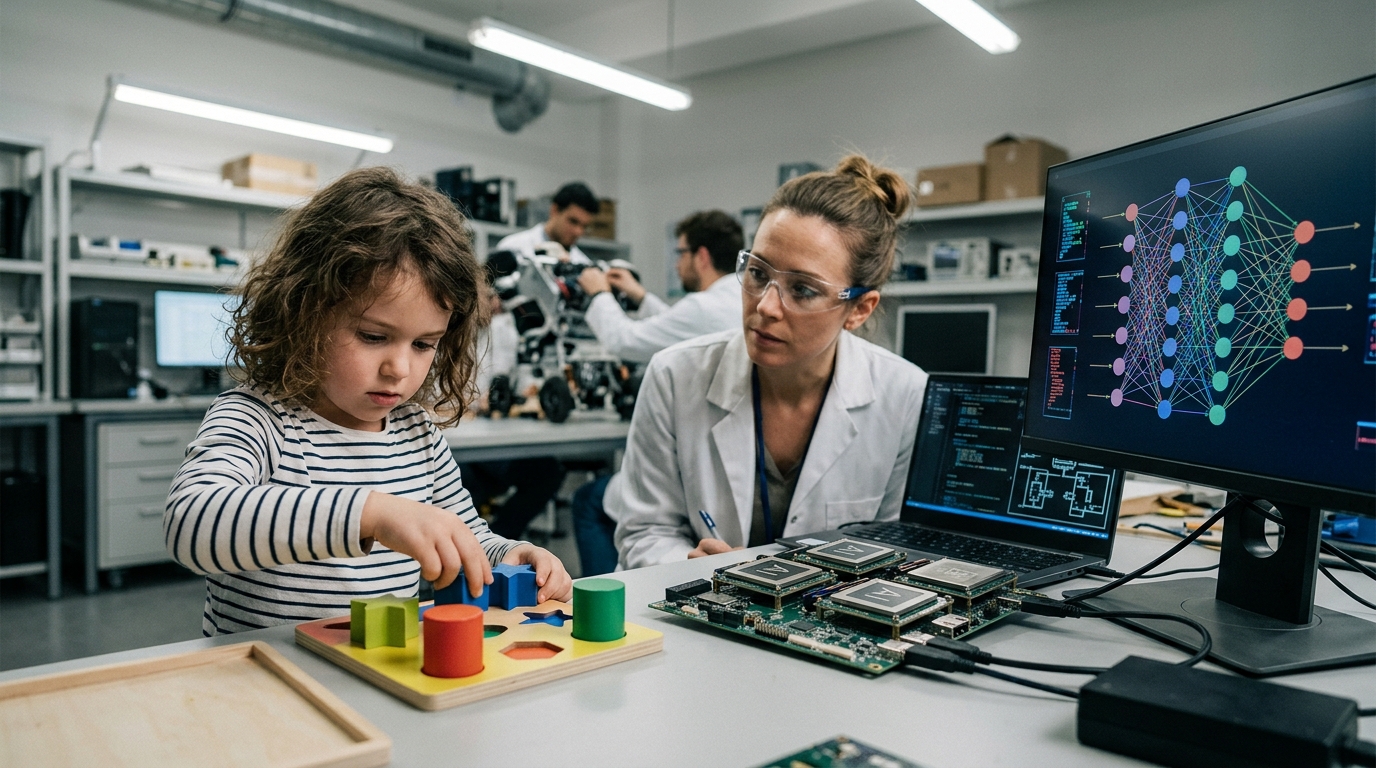
In the high-stakes world of technology, 2026 is emerging as the year of "The Great Realization." While investments in Artificial Intelligence (AI) have reached astronomical levels, a series of new studies—centered around the notorious ARC-AGI benchmark—serve as a stark reminder of something biology has known for millennia: knowledge is not the same as intelligence. ChatGPT, despite its ability to compose sonnets or write code in seconds, still hits a wall when faced with problems that a preschooler solves with intuitive ease.
The ARC-AGI Benchmark: The Mirror of True Intelligence
The Abstraction and Reasoning Corpus (ARC), created by Google researcher François Chollet, is not your typical knowledge test. Unlike bar exams or medical certifications, which LLMs (Large Language Models) ace because they have effectively "read" the entire internet, the ARC requires something fundamentally different: the ability to learn something entirely new in a very short time. The tasks consist of grids with colored squares. The user is shown a few examples of a transformation (e.g., "fill the interior of the shape with the color found on its border") and must apply that rule to a new, unseen grid.
While the average human scores above 85%, the most advanced AI models, even with specialized fine-tuning, struggle to break the 30-40% barrier on novel data. This gap is not merely a technical detail; it is proof that current AI architecture relies on pattern matching rather than a true understanding of causality or geometric logic.
Statistics vs. Logic: The "Stochastic Parrot" Dilemma
The core critique leveled at models from OpenAI and Google is that they operate as "stochastic parrots." When ChatGPT answers a question, it isn't "thinking" in the human sense. Instead, it calculates the probability of the next token based on the massive volumes of data it was trained on. However, when confronted with a problem that looks nothing like anything in its dataset, the statistical house of cards collapses.
- Lack of Common Sense: Models lack a "world model." They don't understand that if you push an object, it moves, unless they have read a description of that physical law.
- Inability to Generalize: Human intelligence is "fluid." We can learn to drive a car and transfer that knowledge to operating a tractor. AI requires thousands of new examples for every slight variation.
- The Scaling Wall: Adding more data and more compute power seems to have diminishing returns when it comes to solving abstract reasoning problems.
Implications for the Future of Work
This weakness in LLMs has immediate consequences for the professional landscape. While AI can automate report writing or translation, it fails in roles requiring adaptability to unpredictable situations. A plumber troubleshooting a unique leak or a surgeon facing a rare anatomical variation uses abstract reasoning to improvise. AI, in its current state, cannot improvise; it can only recycle.
"Intelligence is not about how much you know, but how you behave when you don't know what to do," Chollet notes, highlighting the existential hurdle of modern computer science.
Towards a New Architecture
To bridge this gap, researchers are now pivoting toward hybrid models that combine neural learning with symbolic AI. The hope is to create systems that don't just "guess" the answer but can internally construct logical programs to solve novel problems. Until then, human intuition remains the most valuable—and elusive—software on the planet.