In the high-stakes theater of global artificial intelligence, the concept of "open source" has evolved from a developer's ideal into a potent geopolitical instrument. The recent trend among Western AI titans like Anthropic and OpenAI to retreat behind walled gardens—restricting access to their most advanced models under the banner of "AI safety"—is creating a profound power vacuum. This void is being aggressively filled by Chinese players, most notably DeepSeek, which is leveraging open-source distribution to challenge Silicon Valley’s long-standing hegemony.
The Safety Trap and the Cost of Secrecy
Anthropic, founded by former OpenAI executives with a primary focus on "Constitutional AI," has adopted a posture that many industry observers now view as overly defensive. While their Claude series is undeniably world-class, the company’s reluctance to share architectural breakthroughs or allow deep customization by the broader developer community is isolating its technology. This strategy, while rooted in legitimate safety concerns, effectively acts as a friction point for global adoption.
Conversely, China’s DeepSeek has embraced a strategy of radical openness. Their models, such as DeepSeek-V3 and the reasoning-focused R1, are not merely competitive; in several key benchmarks, they match or exceed the performance of their proprietary Western counterparts. By making these models open-source, DeepSeek is allowing a global ecosystem of startups and researchers to build upon Chinese foundations, creating a layer of technological dependency that is increasingly difficult for the West to counteract.
DeepSeek: Efficiency as a Strategic Advantage
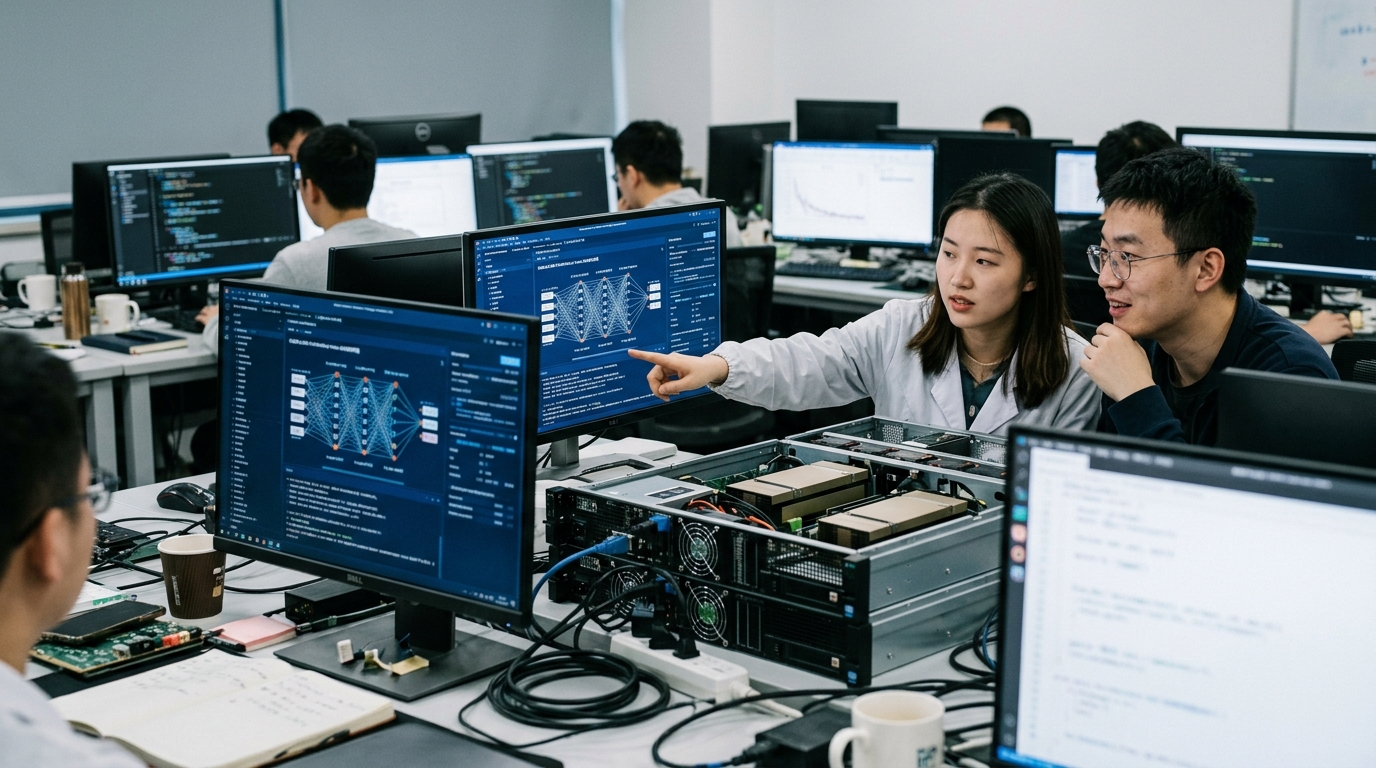
Perhaps the most startling aspect of DeepSeek’s rise is its sheer capital and compute efficiency. While American giants rely on the brute force of tens of thousands of Nvidia H100 GPUs, Chinese researchers—hampered by U.S. export controls on high-end semiconductors—have been forced to innovate at the algorithmic level. This "innovation by necessity" has yielded models that require significantly less power and memory to achieve state-of-the-art results.
- Advanced Mixture-of-Experts (MoE) architectures that optimize active parameter counts.
- Breakthroughs in training stability that allow for faster convergence on limited hardware.
- A commitment to transparency that has made their research papers the new gold standard for the global AI community.
This efficiency is a direct threat to the business models of companies like Anthropic. When a developer in an emerging market has to choose between an expensive, restricted API from a US-based firm and a free, highly efficient open-source model from China, the economic incentive tilts heavily toward the latter. Anthropic’s retreat into a proprietary model is inadvertently subsidizing the growth of the Chinese AI ecosystem.
The Philosophical Divide: Safety vs. Utility
Anthropic’s narrative centers on mitigating existential risks. However, in the pragmatic world of global software development, "safety" is often perceived as a euphemism for censorship or utility-limiting guardrails. By offering models that are perceived as less restrictive and more transparent, Chinese labs are winning over a segment of the market that values raw performance and flexibility over the moralizing constraints of Silicon Valley.
"The strategic retreat of Western labs from the open-source frontier is more than a pivot; it is a surrender of the digital commons to those who are willing to share their tools to gain influence," notes a senior geopolitical analyst.
Ultimately, the current trajectory suggests a bifurcated future. While Anthropic may maintain a lead in specialized, 'safe' corporate environments, the foundational infrastructure of the global AI economy is increasingly being built on open-source contributions from the East. If Western leaders do not find a way to balance safety with the strategic necessity of open distribution, they may find themselves presiding over an impeccably safe, but largely irrelevant, technological island.