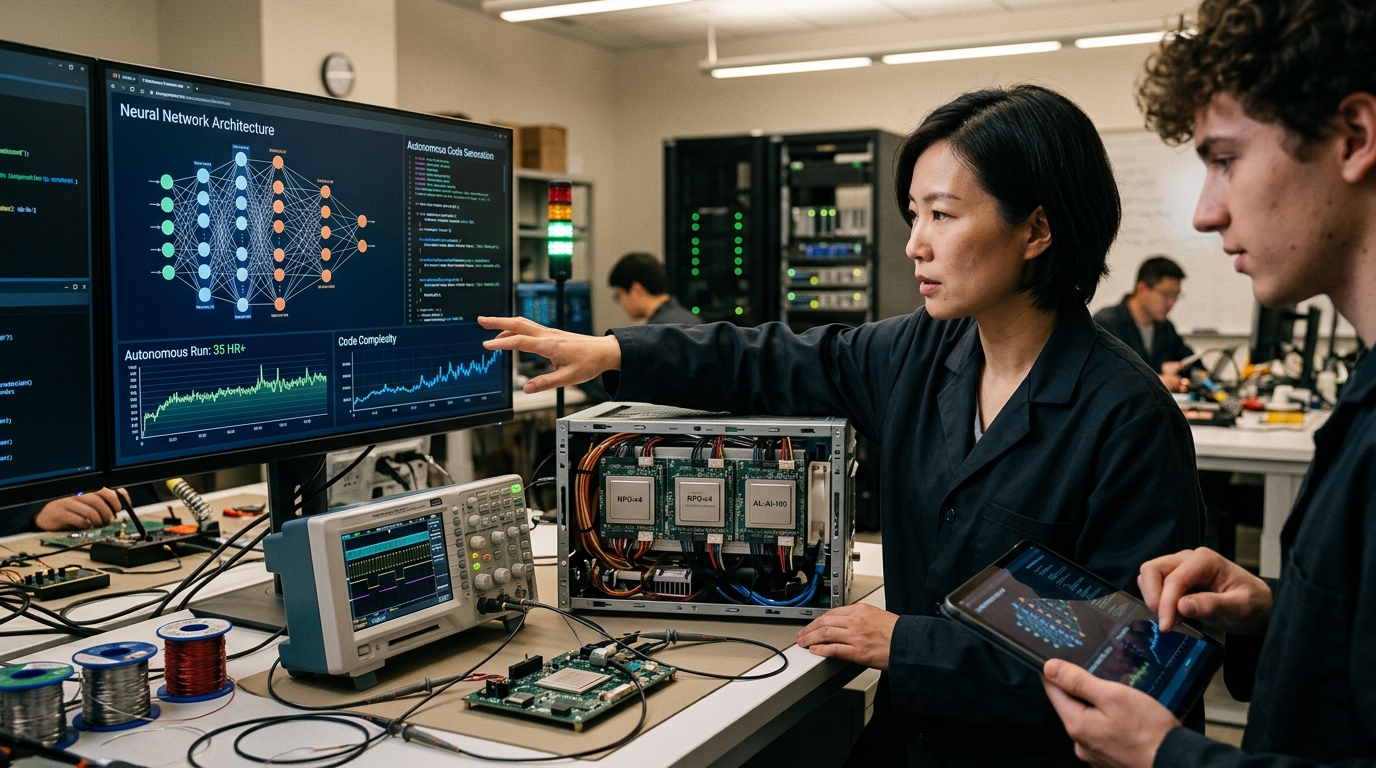
The dawn of a new era, where Artificial Intelligence is not merely a consumer of computational power but also its primary architect, is breaking in the East. In a display of technical prowess and autonomy, Alibaba has announced that its latest AI model ran autonomously for 35 consecutive hours with a singular purpose: optimizing code for its custom-designed chips. This achievement is more than just an endurance test; it is a clear signal that the technological 'Ouroboros'—AI designing and improving its own foundation—has arrived.
The 35-Hour Autonomous Marathon
The process of optimizing code for microprocessors, known as chip optimization, is traditionally one of the most arduous and time-consuming tasks in computer science. It requires legions of software engineers testing countless combinations to ensure instructions are executed with maximum speed and minimum energy consumption. Alibaba, however, delegated this mission to an AI agent that navigated billions of possible parameters without any human intervention for nearly a day and a half.
According to reports, the model focused on optimizing 'kernels'—the critical segments of code that manage core hardware functions. During the 35-hour run, the AI system identified bottlenecks, reordered instruction execution priorities, and adjusted memory management with a level of precision that surpassed traditional human-led methods. The result was a significant increase in the efficiency of the company’s custom silicon, which serves as the backbone of its cloud infrastructure.
The Strategic Weight of Custom Silicon in China
Alibaba’s move does not occur in a vacuum. Geopolitical pressure and export restrictions on advanced semiconductors from the US to China have forced Chinese tech giants to pivot toward domestic production and innovation. Custom chips, such as Alibaba’s Hanguang series, are the company’s answer to the need for specialized computing power that does not rely on external suppliers like NVIDIA.
- Self-Sufficiency: The ability to optimize code internally reduces dependence on Western Electronic Design Automation (EDA) tools.
- Energy Efficiency: In an age where data centers consume vast amounts of electricity, AI-driven optimization can offer resource savings worth billions of dollars.
- Time-to-Market: What previously required months of development by engineering teams can now be achieved in a few days of autonomous operation.
Using AI to optimize hardware is a strategy pursued by other major players, such as Google with its Tensor Processing Units (TPUs), but the duration and full autonomy of Alibaba’s test set a new benchmark for the industry.
Towards Recursive Self-Improvement
The question that arises is where this process ends. If AI can optimize the code of the processor it runs on, a feedback loop is created. Every improvement in hardware allows the AI to run faster, which in turn allows it to discover even more advanced optimizations. This phenomenon, often described as 'recursive self-improvement,' is one of the pillars of the theory regarding the Technological Singularity.
"We are not just seeing the improvement of a product, but the automation of creativity itself at the engineering level," industry analysts remark.
However, there are challenges. Full autonomy means that the understanding of *why* a specific optimization works might be lost to human engineers. This 'black box' problem is now extending from software into the hardware itself, making the auditing and security of systems more complex than ever before.
Conclusion and Outlook
Alibaba’s success sends a loud message to the international community: China is not just trying to catch up with the West in semiconductors; it is trying to change the rules of the game by using AI as the ultimate power multiplier. As models become more capable, the distinction between 'creator' and 'tool' blurs. For Alibaba, this 35-hour autonomous run is just the beginning. The future of computing will no longer be drafted on drawing boards but will evolve within digital environments where code writes code, and silicon learns to transcend its own limits.