In the heart of every Intensive Care Unit (ICU), decision-making is a relentless race against time. For decades, intensivists have relied on battle-tested scoring systems like APACHE (Acute Physiology and Chronic Health Evaluation) and SOFA (Sequential Organ Failure Assessment) to gauge patient severity. However, a new systematic review and meta-analysis published in Cureus confirms what many in the field have long suspected: Artificial Intelligence (AI) is now systematically outperforming these conventional tools in predicting patient mortality.
The Legacy of Conventional Scoring Systems
Systems like APACHE, SOFA, and SAPS (Simplified Acute Physiology Score) have been the gold standard in critical care since the 1980s. Their methodology is rooted in static data points—measurements taken at specific intervals—processed through linear mathematical models. While these systems have been invaluable for benchmarking and resource allocation, they possess inherent limitations. They struggle to integrate the massive, high-frequency data streams generated by modern bedside monitors and fail to capture the non-linear relationships of complex biological systems.
The static nature of these scores means they often miss the dynamic trajectory of a patient's condition. A patient might present a stable SOFA score in the morning, yet undergo a rapid physiological decline by the afternoon that traditional models are simply not calibrated to detect in real-time.
The Machine Learning Revolution in the ICU
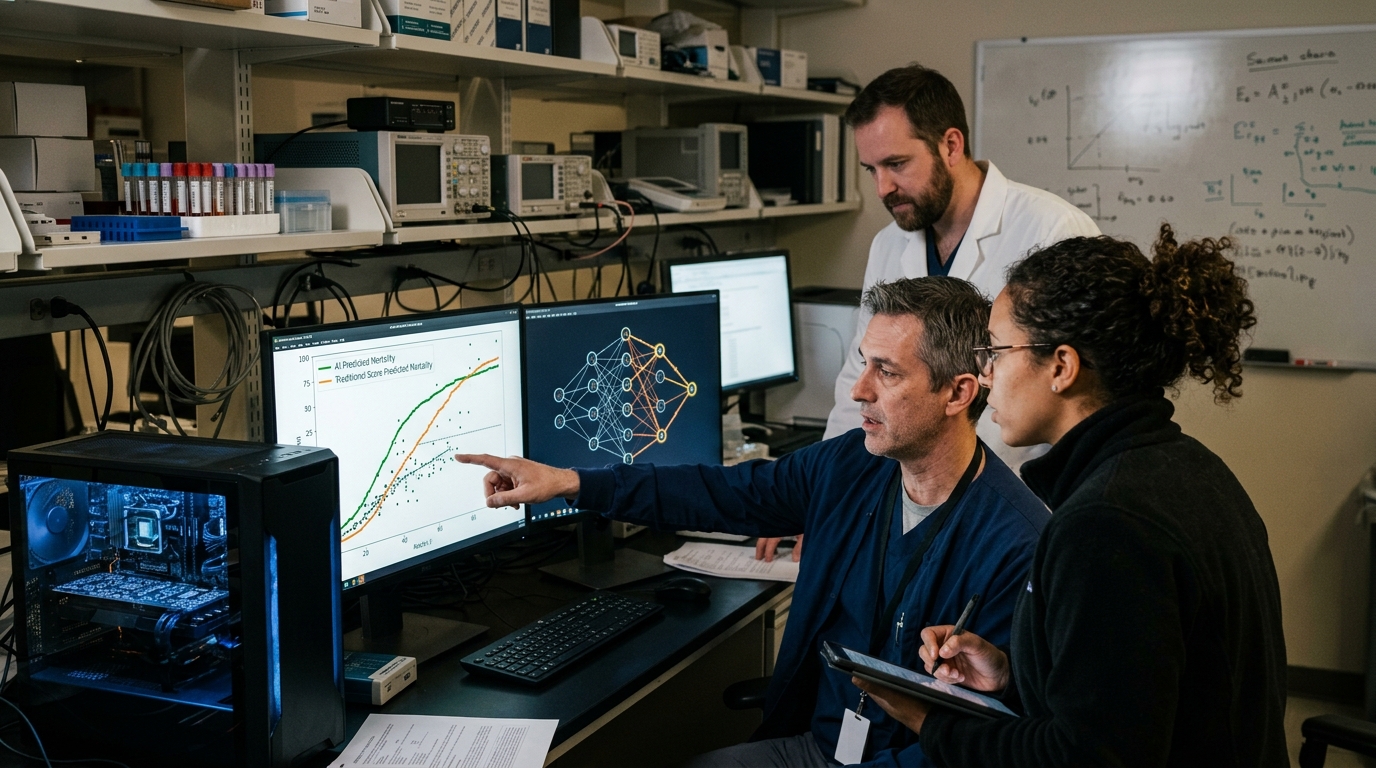
The Cureus meta-analysis examined multiple studies comparing Machine Learning (ML) models against traditional scores. The findings are stark: AI models achieve significantly higher Area Under the Receiver Operating Characteristic (AUROC) values, a key metric for a model's ability to distinguish between survivors and non-survivors.
Why does AI hold the upper hand? The answer lies in its capacity to handle "Big Data." AI models can synthesize thousands of variables simultaneously, ranging from laboratory results and vital signs to nursing notes and ventilator waveforms. Furthermore, Deep Learning architectures, particularly Recurrent Neural Networks (RNNs), are specifically designed to analyze time-series data, allowing them to "learn" from the patient's historical progression rather than just their current state.
- Continuous Monitoring: Unlike traditional scores calculated once every 24 hours, AI can update risk assessments every minute.
- Granular Personalization: AI identifies patient sub-phenotypes that generic systems often overlook.
- Early Warning Signals: AI models frequently detect signs of impending sepsis or multi-organ failure hours before clinical symptoms become overt.
Challenges and the "Black Box" Problem
Despite its technical superiority, the integration of AI into clinical practice faces significant hurdles. The primary concern remains "interpretability." While a physician understands exactly why a patient has a high SOFA score (e.g., low platelets, rising creatinine), AI models often function as "black boxes." Making life-or-death decisions based on an algorithm that cannot explain its reasoning raises profound ethical and legal questions.
"The challenge is no longer whether AI is more accurate, but whether we can trust it at the critical moment of clinical intervention," the study notes.
Furthermore, there is the risk of "algorithmic bias." If a model is trained on data from a specific demographic or hospital system, its accuracy may falter when applied to different populations. External validation and data transparency are essential prerequisites for widespread adoption.
The Future: A Symbiotic Approach
The Cureus meta-analysis does not advocate for the immediate abandonment of APACHE or SOFA, but rather for their evolution. The future of critical care lies in a hybrid approach: AI will provide the computational heavy lifting and pattern recognition, while the clinician provides empathy, ethical judgment, and final validation. The shift from "reactive" medicine to "proactive" precision medicine within the ICU is underway, and Artificial Intelligence is the engine driving this transformation.