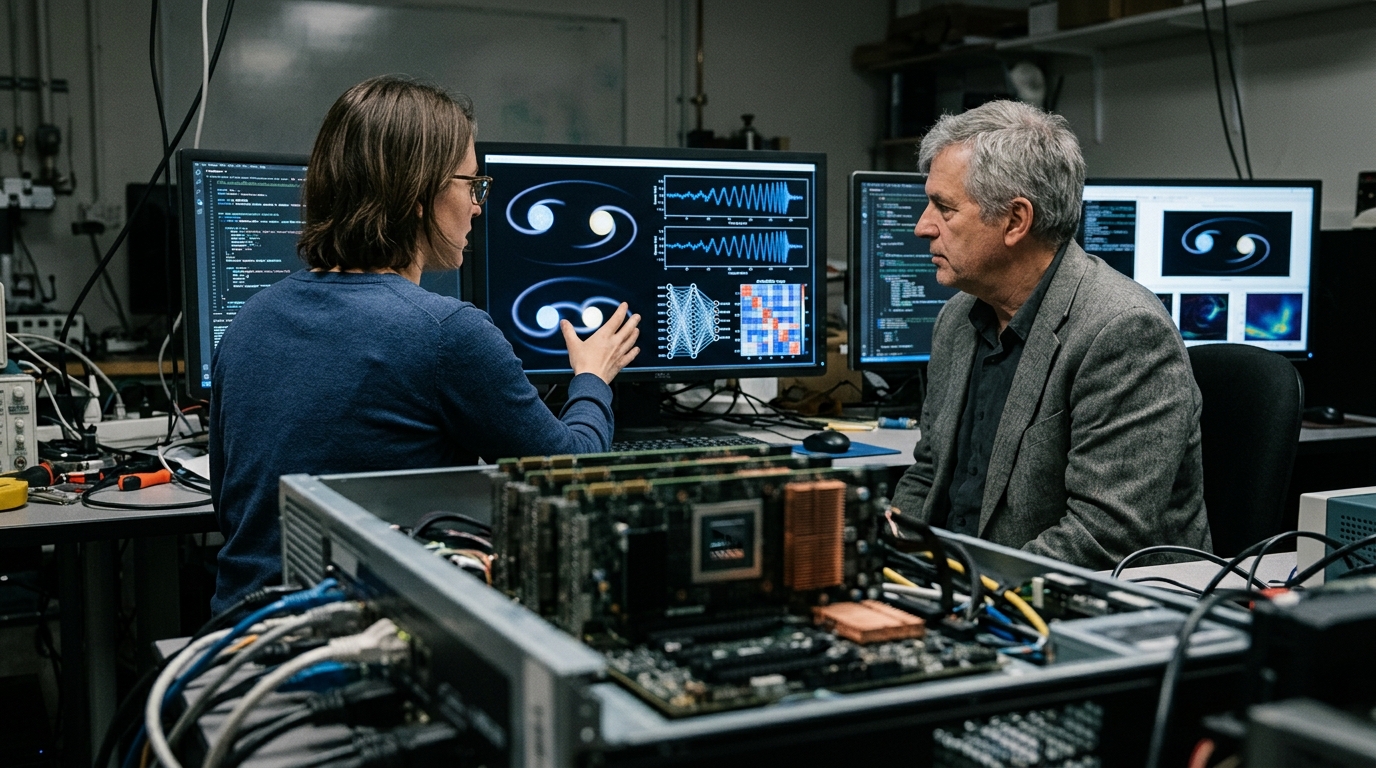
In the vast darkness of the universe, some of the most violent and spectacular events remain hidden from our view—not for a lack of light, but due to the inconceivable complexity of the physical laws governing them. The collision of two neutron stars—objects so dense that a single teaspoon of their matter would weigh as much as Mount Everest—represents one of the greatest enigmas of modern astrophysics. Today, in June 2026, Artificial Intelligence is emerging as the ultimate "decoder" of these cosmic cataclysms, bridging the gap between abstract theory and tangible observation.
The Universe's Alchemy Labs
For decades, scientists suspected that the heavy elements of the periodic table, such as gold, platinum, and uranium, were not forged in common supernova explosions, but during the merger of neutron stars. This process, known as rapid neutron-capture nucleosynthesis (r-process), releases immense amounts of energy and particles, creating a brilliant afterglow called a "kilonova."
However, understanding these phenomena requires solving extremely complex equations that describe general relativity, magnetohydrodynamics, and nuclear physics simultaneously. Until recently, a full simulation of such a collision on a traditional supercomputer could take months, drastically limiting the number of scenarios researchers could investigate. This is precisely where Artificial Intelligence steps in.
The Computational Revolution: From Months to Milliseconds
Recent research, highlighted via EurekAlert and supported by leading astronomical institutes, demonstrates how neural networks can be trained on existing simulations to "learn" the behavior of matter under extreme conditions. These AI models, often referred to as "surrogate models," can predict the outcome of a collision in fractions of a second with startling accuracy.
- Speed: The ability to run millions of simulations in virtually no time allows scientists to explore a vast parameter space, including stellar mass and viewing angles.
- Precision: AI models can identify patterns in light spectra that the human eye or traditional algorithms might overlook.
- Multi-messenger Astronomy: AI facilitates the connection between gravitational wave data (detected by LIGO/Virgo) and optical observations from telescopes, providing a holistic view of the event.
The Physics of "Strange" Matter
One of the most fascinating aspects of this development is the potential to understand the "equation of state" of neutron star matter. At such extreme densities, physics as we know it begins to break down. AI allows physicists to test different theories about what happens inside these stars—whether they consist of simple neutrons or a "soup" of free quarks.
"We aren't just using AI to make calculations faster; we are using it to see the physics that was hidden within the noise of the data," notes one of the study's lead researchers.
The capacity of machine learning to process massive volumes of data from next-generation telescopes, such as the James Webb and the upcoming Vera C. Rubin Observatory, means we are on the threshold of a golden age for astrophysics. For the first time, we can say with certainty where the gold in our wedding rings and the elements in our smartphones originated.
Toward a Universal Understanding
The use of AI in astrophysics is not merely a technical achievement; it is a philosophical shift. As models become more sophisticated, they begin to act as collaborators with scientists, suggesting new hypotheses and research directions. The challenge is no longer a lack of data, but our ability to interpret the vast wealth of information the universe sends our way.
In the future, integrating AI into observational infrastructure will allow for the detection and analysis of mergers in real-time. The moment a gravitational wave hits our detectors on Earth, AI will have already calculated where to point our telescopes to witness the birth of gold, offering us a front-row seat to cosmic creation.