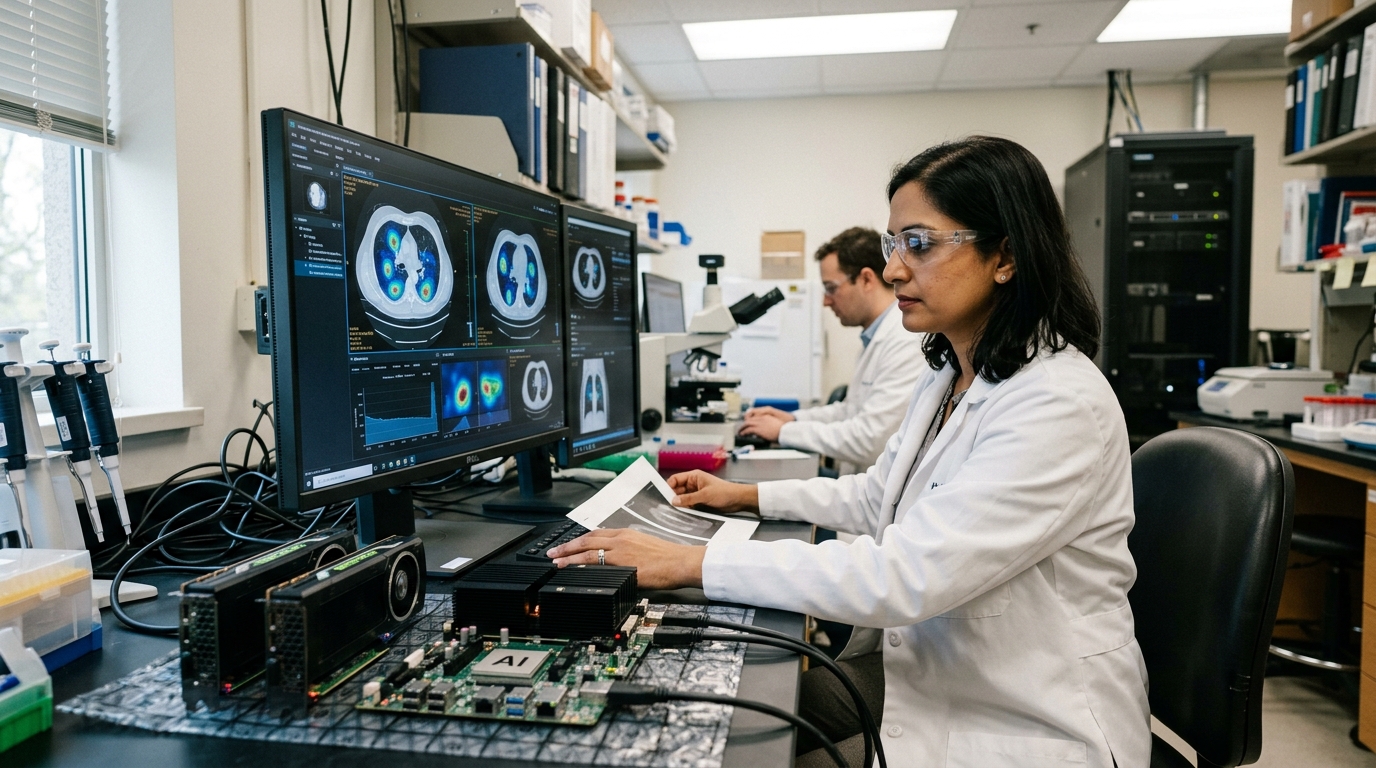
Lung cancer remains the leading cause of oncological mortality worldwide, a grim statistic largely driven by the fact that most cases are diagnosed at an advanced stage. However, a comprehensive systematic review recently published in Cureus provides compelling evidence that Artificial Intelligence (AI) is poised to redefine the parameters of early detection. By evaluating the diagnostic accuracy of various AI models, the study highlights a future where medical imaging is no longer limited by human fatigue or oversight.
The Diagnostic Precision of Deep Learning
The core of the review focuses on the performance of Deep Learning models, particularly Convolutional Neural Networks (CNNs), in analyzing Computed Tomography (CT) scans. The findings are striking: AI models are consistently demonstrating sensitivity and specificity rates that rival, and often exceed, those of board-certified radiologists. These algorithms excel at identifying sub-visual features in pulmonary nodules—subtle changes in texture, shape, and density that may signal malignancy long before they become apparent to the naked eye.
Furthermore, the integration of radiomics—the extraction of large amounts of data from medical images—allows AI to provide a more nuanced risk assessment. Instead of a binary 'cancer or no cancer' output, these models can offer a probabilistic score of malignancy, helping clinicians prioritize high-risk patients for immediate intervention while reducing unnecessary biopsies for benign cases.
The 'Black Box' and Data Diversity Challenges
Despite the technological triumphs, the systematic review does not shy away from the significant hurdles that remain. One of the primary concerns is the 'black box' nature of neural networks. For AI to be fully integrated into clinical workflows, clinicians must be able to interpret why a model flagged a specific nodule. The lack of transparency can lead to skepticism and slow adoption rates in conservative medical environments.
- Data heterogeneity: Models trained on specific demographics may not perform accurately on diverse populations.
- Technical variability: Differences in CT scanner manufacturers and radiation doses can affect algorithmic performance.
- Regulatory hurdles: The path to FDA or EMA approval for autonomous diagnostic tools remains complex and rigorous.
The review emphasizes the need for 'Explainable AI' (XAI), which aims to make the internal mechanics of these models more transparent to healthcare professionals. Without this, the trust gap between man and machine may hinder the practical application of these life-saving tools.
The Future of the Radiologist-AI Partnership
A recurring theme in the Cureus review is that AI should not be viewed as a replacement for human expertise but as a sophisticated clinical assistant. The most effective implementation strategy appears to be the 'human-in-the-loop' model. In this scenario, AI acts as a primary filter, flagging suspicious areas and triaging cases, which allows radiologists to focus their attention on the most complex diagnoses.
"Artificial Intelligence will not replace radiologists, but radiologists who use AI will replace those who do not," a sentiment echoed throughout the analyzed literature, highlighting the inevitability of this technological shift.
As we look forward, the focus must shift from proving the accuracy of AI—which this systematic review has largely confirmed—to optimizing its deployment. This involves creating standardized datasets, ensuring ethical data usage, and developing economic models that make this technology accessible to public health systems globally. The goal is to move from reactive treatment to proactive, early-stage management, significantly improving the five-year survival rates for lung cancer patients worldwide.