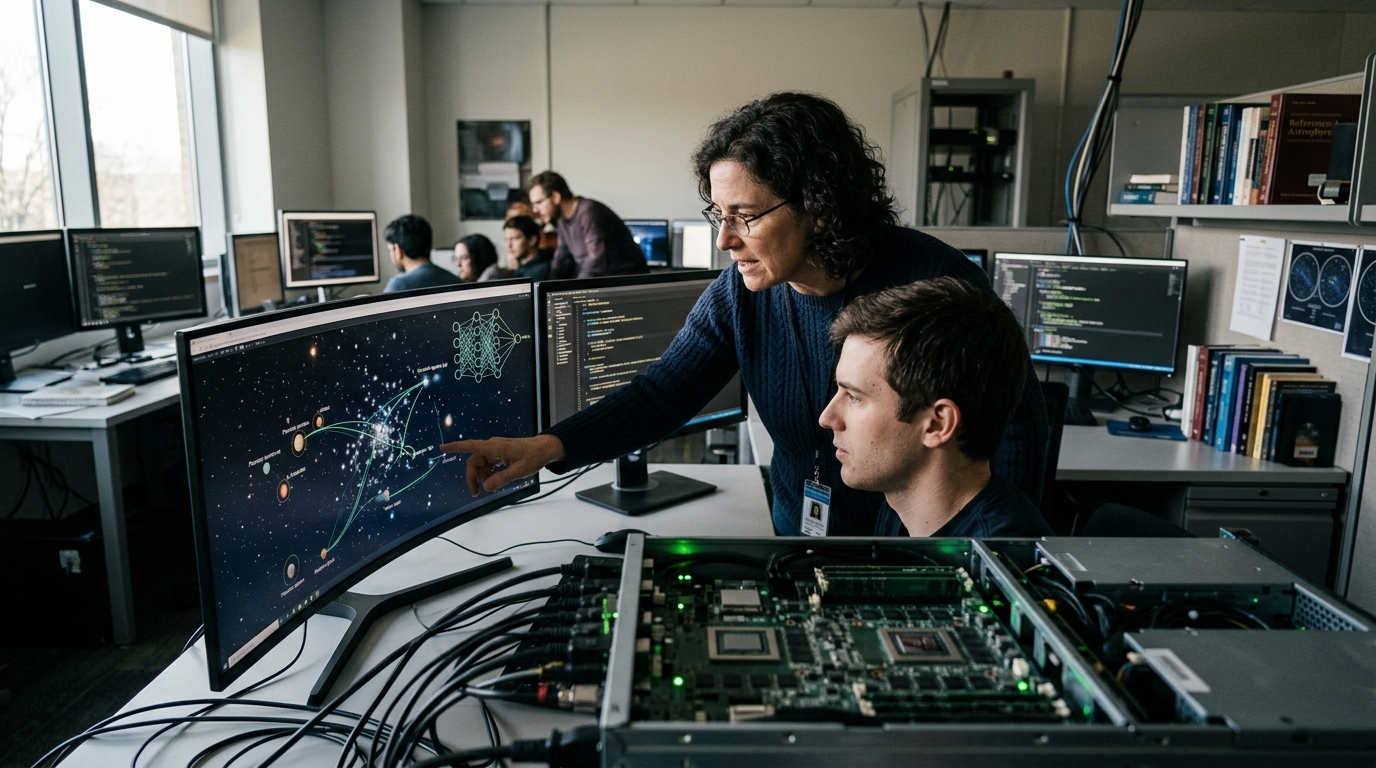
Astronomy is entering a phase of unprecedented transformation, where the discovery of new worlds no longer depends solely on building more powerful telescopes, but on the intelligence of the algorithms analyzing existing data. Recent research, leveraging advanced machine learning models, has led to the identification of over 100 new exoplanets hidden within NASA's vast data archives. This is a triumph of data mining, proving that the universe is far more populated than we dared to imagine.
The Needle in the Stellar Haystack
For decades, the search for exoplanets relied on the transit method. When a planet passes in front of its host star, it causes a subtle dip in the star's brightness. Telescopes like Kepler and TESS have recorded millions of these light curves. However, the problem lies in the "noise." Many signals are so faint or so entangled with stellar activity that traditional algorithms and human analysts overlook them as statistical errors.
This is precisely where Artificial Intelligence steps in. Using Neural Networks trained on thousands of confirmed planetary systems, researchers have been able to "teach" the computer to distinguish true planetary signals from cosmic noise. As one of the lead researchers noted:
"AI does not get tired, it is not biased, and it can perceive patterns in thousands of dimensions that the human brain simply cannot grasp."
Extreme Worlds and Rare Phenomena
The planets discovered are not just numbers on a list. Many are characterized as "extreme" and provide invaluable insights into the physics of celestial bodies. Among the findings are:
- Hot Jupiters: Gas giants orbiting so close to their stars that they complete an orbit in just a few hours.
- Circumbinary Planets: Worlds illuminated by two suns, reminiscent of the Tatooine setting from Star Wars.
- Super-Earths: Rocky planets with a mass greater than Earth's, located in the marginal zone where liquid water could potentially exist.
The discovery of these rare worlds is forcing astrophysicists to revise their models of planetary system formation. The existence of such a diverse array of worlds suggests that the process of planet creation is much more flexible and chaotic than previously believed.
The Meta-Analysis Revolution and the Future
The significance of this study goes beyond the number of 100 planets. It inaugurates a new methodology in scientific research: the meta-analysis of legacy data with new tools. Data collected by NASA 10 or 15 years ago remains a "gold mine" waiting to be explored. As computational power increases and algorithms become more sophisticated, it is certain that we will find thousands more worlds without launching a single new rocket.
However, the challenge remains verification. AI can point to a candidate planet, but final validation often requires observations from ground-based telescopes or the powerful James Webb Space Telescope (JWST). This human-machine symbiosis is what will lead us, perhaps within the next decade, to the discovery of a second Earth or even signs of extraterrestrial life.
In conclusion, the use of AI in astronomy is not just a technical upgrade; it is a philosophical shift. We are realizing that the answers to humanity's greatest questions—"Are we alone?" and "Where are the other worlds?"—may already be stored on our hard drives, waiting for the right code to decipher them.