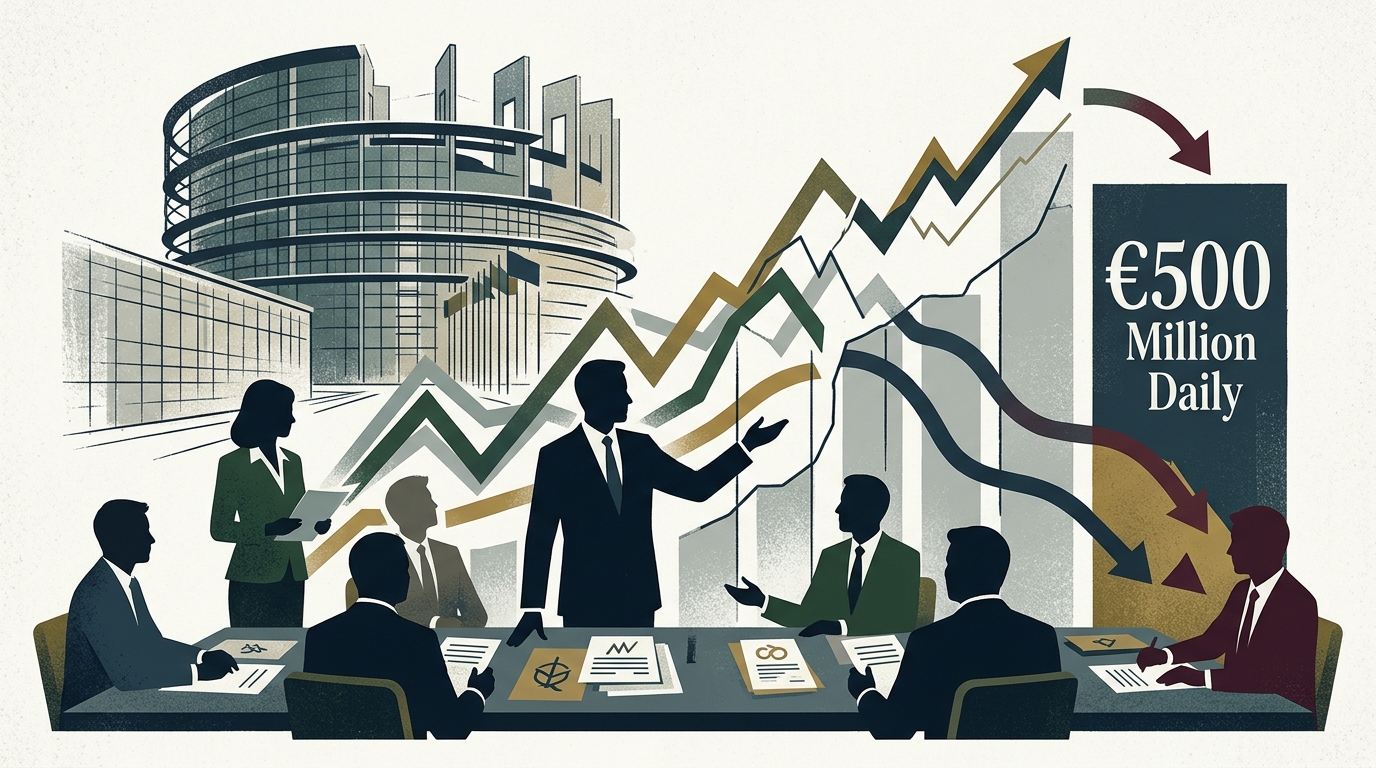
In a speech that could be described as a "red alert" for the European economic architecture, European Commission President Ursula von der Leyen presented a grim reality before the European Parliament's plenary session in Strasbourg. According to Commission data, Europe is bleeding financially, losing nearly 500 million euros every twenty-four hours due to the ongoing energy crisis and the geopolitical upheavals triggered by the war in Ukraine.
This statement is not merely a statistical reference but a political admission of the vulnerable position in which the Old Continent finds itself. The sum of 500 million euros per day represents resources that could have been directed toward education, healthcare, or innovation, but are instead being spent to cover the increased costs of energy imports and to support households and businesses against inflationary pressures.
The Architecture of the Hemorrhage
The energy crisis is not a transient phenomenon but a structural challenge reshaping the European landscape. Von der Leyen emphasized that dependence on fossil fuels, and particularly on Russian gas in the past, created a "cost trap" from which Europe is struggling to escape. Despite efforts to diversify supply sources, the cost of Liquefied Natural Gas (LNG) remains significantly higher than the pipeline gas that fueled European industry for decades.
- The loss of competitiveness of European industry, especially in energy-intensive sectors such as steel and chemicals.
- The transfer of wealth from European consumers to external energy producers.
- The need for massive state subsidies that strain national budgets and increase public debt.
The Commission President was clear: the only way out of this vicious cycle is the acceleration of the Green Deal. The transition to renewable energy sources is no longer just an environmental necessity but the ultimate tool for economic sovereignty and security.
Energy Geopolitics and the Future
In her analysis, von der Leyen linked energy costs to the overall strategic autonomy of the European Union. "Every euro we invest in domestic renewables is a euro that does not leave our economy toward authoritarian regimes," she pointedly noted. The crisis has served as an accelerator for the development of wind and solar parks, yet infrastructure remains behind market needs.
"We cannot afford to lose half a billion euros a day. This is a hemorrhage that undermines our children's future," the President stated, addressing the MEPs.
The challenge for 2026 and beyond is the creation of a unified energy market capable of absorbing international price shocks. Von der Leyen called on member states to set aside national egoisms and invest in cross-border interconnectors, which would allow cheap energy from the South to reach the industrial North and vice versa.
Social Impact and Political Risk
Beyond the numbers, the energy crisis tests social cohesion. Energy poverty affects millions of households, while the rise of populist movements in Europe is often fueled by resentment over the cost of living. The Commission recognizes that if energy costs do not decrease soon, the political stability of the Union may be at risk.
The EU's strategy for the coming period includes reforming the electricity market to decouple electricity prices from gas prices and boosting investment in hydrogen. However, the road remains uphill as international competition for the resources and raw materials of the green transition intensifies.
In conclusion, von der Leyen's speech in Strasbourg serves as a reminder that peace and prosperity in Europe are not guaranteed. Energy independence is the new front line in the war for the survival of the European model, and the price of delay is now measured in hundreds of millions of euros every single day.