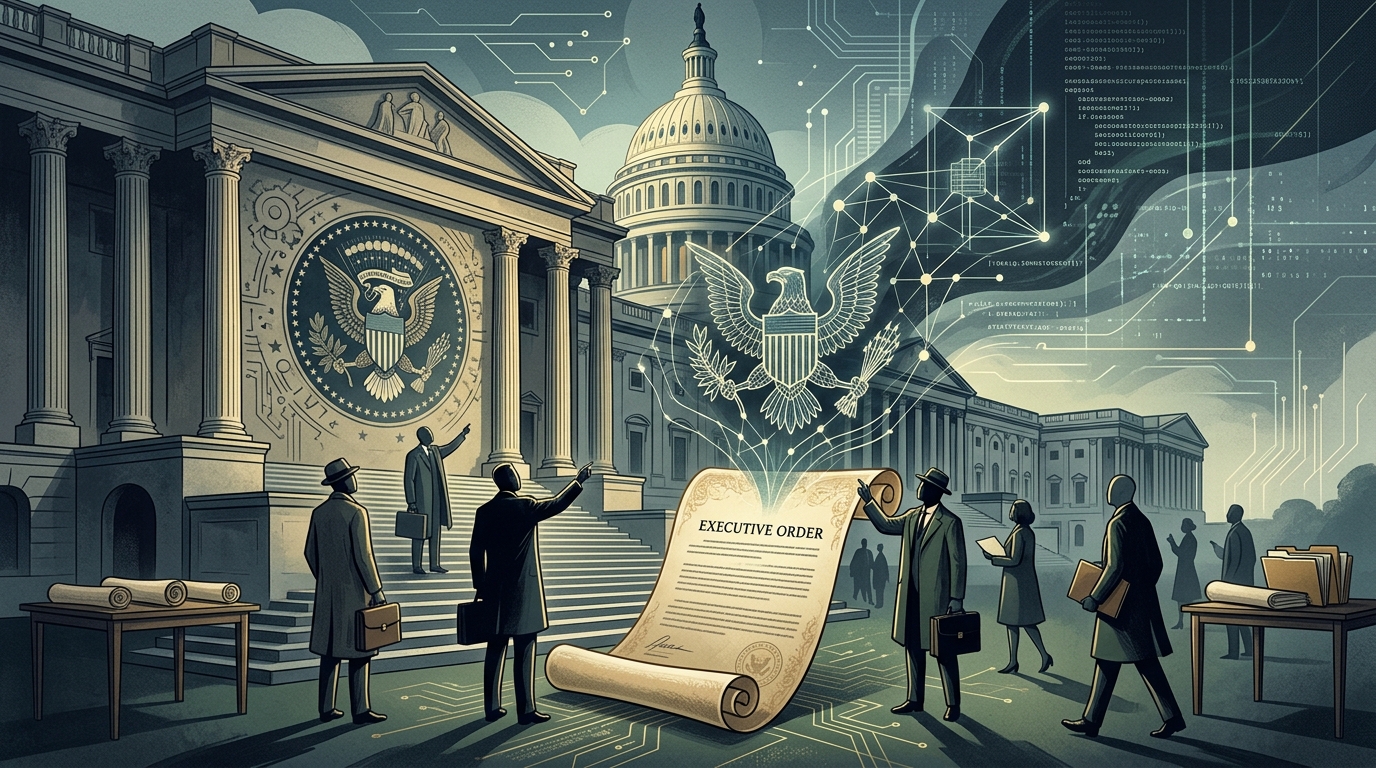
In a move that fundamentally reshapes the United States' technological landscape, President Trump has signed an executive order establishing a new framework for the vetting and evaluation of Artificial Intelligence systems. This action, coming as a direct response to national security concerns and perceived algorithmic bias, marks the end of the previous administration's approach and the beginning of an era where AI is treated primarily as a tool of geopolitical power.
Upending the Biden Framework
The new order officially repeals most provisions of Joe Biden's Executive Order 14110, which focused on "safety, security, and trust." In its place, the Trump administration introduces a vetting process centered on two axes: preventing the penetration of foreign adversaries, particularly China, into the American AI supply chain, and ensuring that AI models do not enforce "ideological censorship."
According to White House sources, the new vetting process will no longer focus on the theoretical risks of "existential threats" that occupied academics, but on the practical applications of technology in defense and the economy. The administration argues that previous regulations were "bureaucratic shackles" that hindered innovation and gave an advantage to Beijing.
National Security and Algorithmic Neutrality
One of the most controversial points of the order is the creation of a review commission to examine whether Large Language Models (LLMs) exhibit systematic bias. The administration's rhetoric speaks of "liberating AI from woke culture," requiring tech companies to prove that their systems are politically neutral. This creates a new type of compliance for Silicon Valley giants, who are now called upon to balance international ethical standards with new American requirements.
- Establishment of mandatory vetting for AI models used in critical infrastructure.
- Simplification of licensing procedures for data center construction.
- Strict restrictions on exporting AI technology to "unfriendly" nations.
- Promotion of AI use in the armed forces to enhance deterrence.
Energy and Infrastructure: Fueling AI
The order is not limited to code but extends to hardware. Recognizing that AI requires massive amounts of energy, Trump is mandating the acceleration of energy source development, including nuclear power and fossil fuels, specifically to power data centers. The logic is simple: the country with the cheapest and most abundant energy will win the AI race. This linking of energy policy with technological supremacy is a central pillar of the 2026 strategy.
"Artificial intelligence is the new oil, and the United States will not allow any other power to control its sources or production," said a senior technology advisor.
Reactions and Challenges
Reactions are split. While investors and proponents of deregulation welcome the move as necessary to maintain American hegemony, digital rights organizations express fears. They argue that the "vetting" process could turn into a tool for government intervention in content, limiting the independence of researchers. Furthermore, the European Union is watching with concern, as the divergence between the EU's strict AI Act and the new American framework threatens to fracture the transatlantic tech market.
In conclusion, the 2026 executive order is not just a policy change, but a statement of intent. Washington is choosing the path of technological nationalism, considering that on the global AI chessboard, security and power precede ethical inquiries.