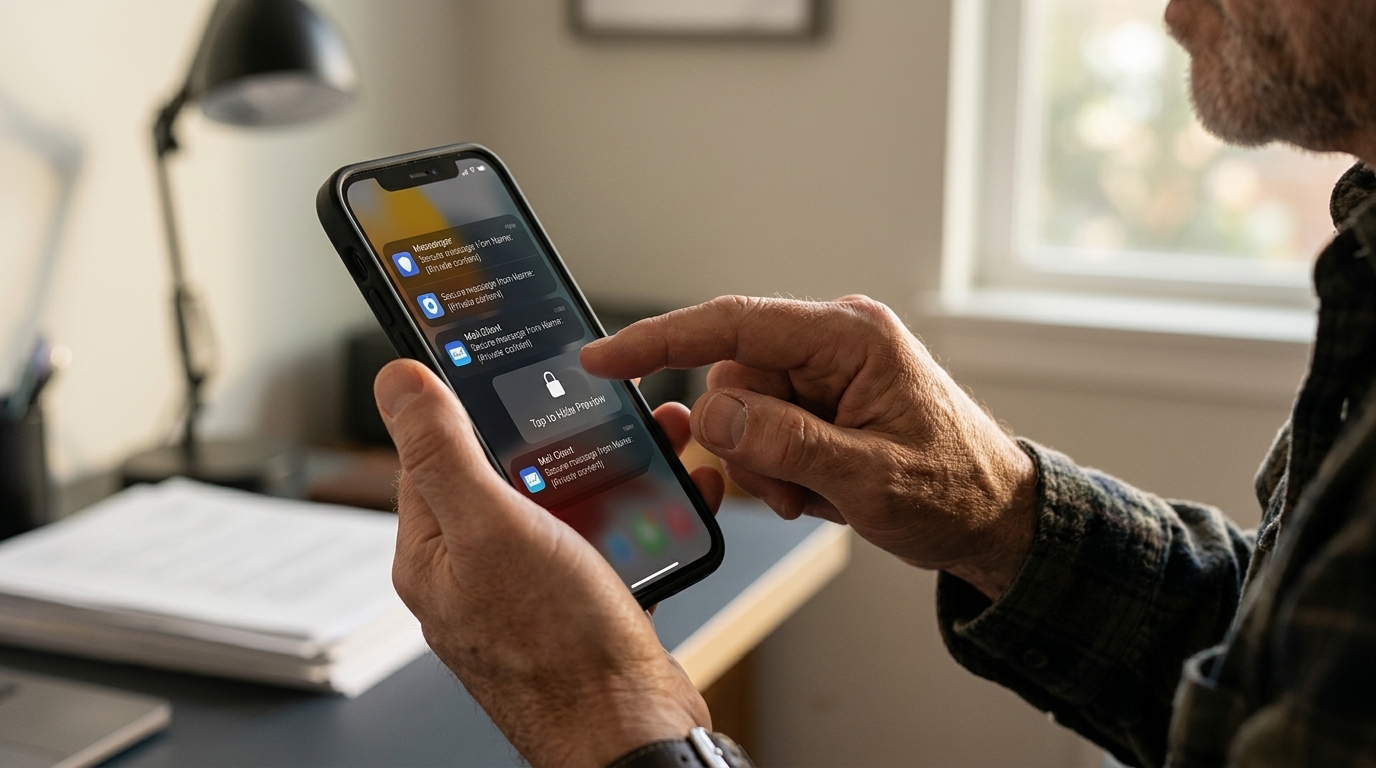
In the high-stakes world of digital security, end-to-end encryption (E2EE) is often hailed as the ultimate shield. Apps like Signal and WhatsApp promise that no one—not even the service providers or government agencies—can intercept and read your messages while they are in transit. However, a recent legal case in the United States has exposed a chilling reality: the weakest link isn't the encryption itself, but how our mobile operating systems handle notifications at the "endpoint."
Recent reports have detailed how law enforcement agencies were able to recover Signal messages from an iPhone even after the user had deleted the application prior to the device being seized. This breach didn't occur because of a flaw in Signal’s cryptographic protocols. Instead, the culprit was the iOS Notification Center database, which retains records of incoming messages long after their source app has been wiped from the device.
The Digital Ghost: How Notification Databases Work
When you receive a notification, your phone’s operating system (iOS or Android) manages its display on the lock screen or the notification shade. To facilitate this, the OS temporarily stores the notification's content in an internal database, typically an SQLite file. This database operates independently of the app that generated the notification.
The critical issue is that deleting an app does not trigger a comprehensive cleanup of all system-level logs associated with it. In the iPhone case, investigators utilized advanced forensic tools—such as those developed by Cellebrite and GrayKey—to extract the contents of the Notification Center database. There, they found snippets of text from Signal messages that remained as "ghosts" of the user's past activity.
- Notifications often mirror the full text of a message to provide context to the user.
- System-level databases are not always subject to the same rigorous encryption as the messaging apps themselves.
- Standard app deletion is a superficial process that leaves underlying system logs untouched.
The Illusion of Total Privacy
This revelation highlights a fundamental distinction in cybersecurity: the difference between data "in transit" and data "at rest." While E2EE provides near-perfect security for data moving across the web, the security of data residing on the device (the endpoint) is often compromised by the very features designed for user convenience.
Furthermore, there is a legal dimension to consider: the "plain view" doctrine. If law enforcement has a warrant to search a device and notifications are visible on the lock screen, that information is often legally fair game. Forensic technology simply extends this principle to data that the user *thought* was gone, effectively bypassing the user's intent to delete their digital footprint.
How to Secure Your Device and Data
True digital privacy requires a shift in how we interact with our mobile devices. It is no longer enough to trust a secure app; you must actively manage what you allow the operating system to record.
The most effective step is to disable notification previews. On iOS, navigate to Settings > Notifications > Show Previews and select "Never" or "When Unlocked." This prevents the actual message content from being displayed on the lock screen and, crucially, often limits what is written to the persistent notification database.
Secondly, leverage the "Disappearing Messages" feature found in apps like Signal. This feature doesn't just delete the chat history; it also instructs the OS to clear associated notifications after a set period. However, users should remain aware that if a device is seized before the timer expires, the data remains vulnerable.
"Privacy isn't a product you buy; it's a practice you maintain through vigilant configuration."
The Future of Digital Forensics and Privacy Rights
As tech giants and law enforcement engage in a perpetual cat-and-mouse game, the average user is caught in the crossfire. Apple and Google are under increasing pressure to make notification databases more ephemeral and secure, yet functional requirements—such as cross-device syncing—make this a complex engineering challenge.
From a policy perspective, this raises serious questions about the right to be forgotten. If the state can reconstruct data that a citizen explicitly chose to delete, the boundary of personal privacy is effectively moved. Until mobile architectures undergo a fundamental redesign to prioritize endpoint sanitization, the burden of security rests with the individual: the less information you allow to appear on your screen, the safer you are.