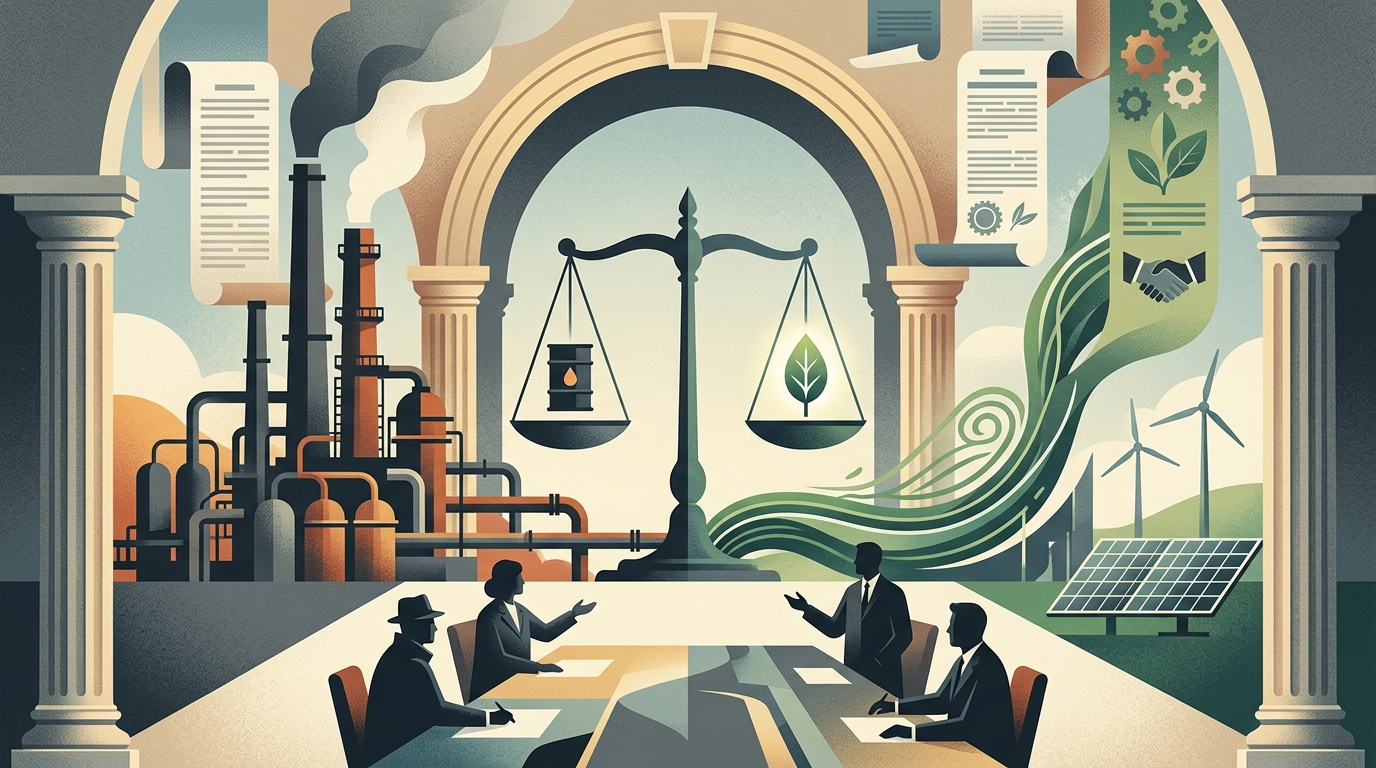
During the sessions of the 11th Delphi Economic Forum, Petros Tzannetakis, Deputy CEO of the Motor Oil Group, presented a comprehensive vision for the future of European and Greek energy. His intervention was more than a corporate briefing; it was a profound analysis of the challenges facing heavy industry in an era of rapid decarbonization and geopolitical volatility. Mr. Tzannetakis emphasized that the green transition is not a linear path but a complex equation requiring the harmonious coexistence of traditional fossil fuels and renewable energy sources.
The Dual-Track Strategy: Refining and Green Growth
Motor Oil, a cornerstone of the Greek economy, is currently in a transformative phase. As Mr. Tzannetakis explained, the group is pursuing a two-speed strategy. On one hand, it continues to invest in the modernization of the Corinth refinery, ensuring it remains one of the most sophisticated and efficient facilities globally. On the other, it is channeling massive capital into the circular economy, renewables, and alternative fuels. The logic behind this is simple yet essential: society and the economy cannot simply "flip the switch" on fossil fuels overnight without risking economic chaos.
Mr. Tzannetakis stressed that refining will continue to play a critical role for decades to come, particularly in sectors like long-haul transport and shipping, where electric solutions are not yet mature. "Balance is the keyword," he noted, highlighting that Motor Oil aims to become an integrated energy provider meeting all market needs while simultaneously reducing its carbon footprint through cutting-edge technologies.
The Call for Regulatory Flexibility
One of the most pivotal points of his speech was the critique of the European Union's regulatory framework. Mr. Tzannetakis argued that Brussels often adopts an overly rigid stance, which could undermine the competitiveness of European enterprises against their international rivals. For Motor Oil, "regulatory flexibility" is not an excuse for delay, but a necessity for survival.
- The need for faster permitting for green energy projects.
- Support for investments in Carbon Capture and Storage (CCS) technologies.
- Avoidance of punitive taxes that fail to account for the costs of transition.
- Ensuring a level playing field with third countries that do not share the same environmental commitments.
According to Mr. Tzannetakis, if Europe wishes to remain an industrial leader, it must offer incentives rather than just restrictions. The transition requires immense capital, and that capital is currently generated largely by the traditional activities of energy groups.
Energy Security as a Prerequisite
The recent energy crisis, triggered by the war in Ukraine, highlighted Europe's vulnerability. Mr. Tzannetakis reminded the Delphi audience that energy security is the foundation of social peace. Refineries are not just industrial units; they are strategic infrastructures that guarantee a country's supply during times of crisis. Motor Oil has proven its ability to adapt by diversifying crude oil supply sources and maintaining system stability.
"We cannot talk about a green future if we haven't secured a safe present. The transition must happen in a way that leaves no one behind and does not jeopardize market adequacy," Mr. Tzannetakis remarked.
Discussions on hydrogen and synthetic fuels (e-fuels) also played a central role. The group is systematically investing in these fields, viewing them as the bridge to 2050. However, the maturation of these technologies requires time and, above all, a stable investment environment that doesn't change the rules of the game mid-way.
Conclusion and the 2030 Outlook
In closing, Mr. Tzannetakis appeared optimistic yet cautious. Motor Oil aims to lead the energy transition in Southeastern Europe, transforming Greece into an energy hub. The success of this endeavor depends on the cooperation between the private sector and the state, as well as the understanding that ecology and economy must walk hand-in-hand. The "green" Motor Oil of the future will be the result of a carefully planned evolution, rather than a hasty revolution that could prove fatal to the country's industrial base.