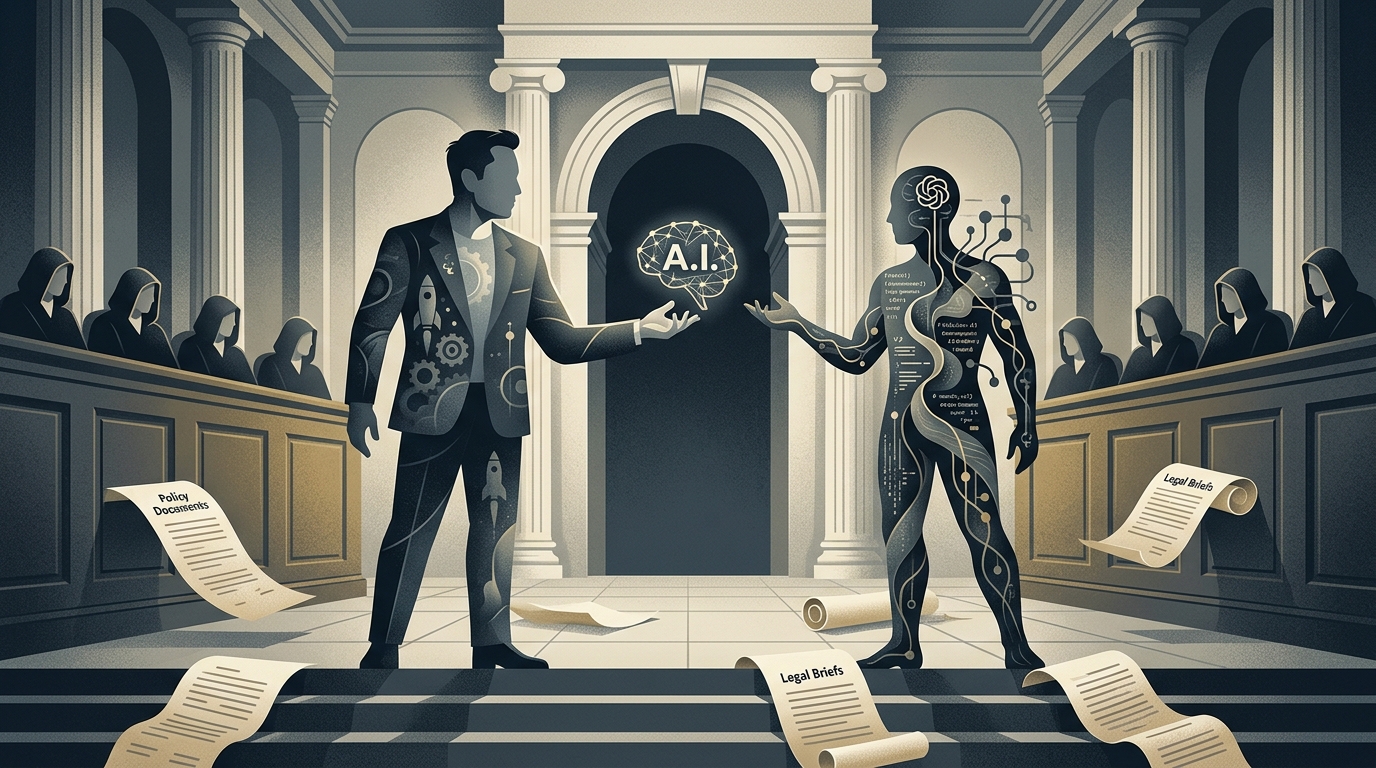
The history of technology is replete with epic confrontations, but few carry the weight and implications of the legal battle between Elon Musk and OpenAI. What began as a partnership to save humanity from the risks of uncontrolled Artificial Intelligence (AI) has devolved into a bitter war over intellectual property, control of billions of dollars, and the very definition of "open" technology. As the trial commences, the tech world braces for a revelation of internal documents that could alter our perception of how the most powerful technology of our era was built.
The "Founding Myth" and the Allegation of Betrayal
At the heart of Musk's lawsuit lies the claim that OpenAI betrayed its original mission. When founded in 2015, OpenAI was presented as a non-profit organization that would develop Artificial General Intelligence (AGI) for the benefit of humanity, free from corporate interests. Musk alleges there was a "founding agreement" stipulating that the technology would remain open-source and not be used to enrich individuals or giants like Microsoft.
Musk's legal team argues that OpenAI's transition to a "capped-profit" entity and its close partnership with Microsoft represent a flagrant breach of this promise. According to Musk, OpenAI has become a de facto closed-source subsidiary of Microsoft, optimizing its technology to maximize the Redmond giant's profits rather than serving the public good. The allegation isn't merely about breach of contract; it extends to claims of fraud and unfair competition, painting a picture of a bait-and-switch operation on a global scale.
OpenAI's Counter-Strike and the Musk Emails
OpenAI's response has been swift and aggressive. The company, led by Sam Altman, published a series of past emails from Musk himself that appear to undermine his arguments. In these emails, Musk seems to agree with the necessity of raising vast amounts of capital—far beyond what donations could provide—and acknowledges that OpenAI would eventually have to become less "open" for security reasons.
OpenAI contends that Musk is driven not by altruistic motives, but by bitterness over his failure to gain full control of the company in 2018. According to the defense, Musk had proposed merging OpenAI with Tesla, claiming it was the only way to compete with Google. When his proposal was rejected, he departed, leaving the company at a critical financial crossroads. OpenAI asserts that without the profit structure and the Microsoft partnership, neither ChatGPT nor the advanced research it currently conducts would exist today.
The AGI Question and the Microsoft Contract
One of the most critical aspects of the trial is the definition of AGI. OpenAI's agreement with Microsoft stipulates that Microsoft has access to OpenAI's technology up to the point that AGI is achieved. Once OpenAI develops Artificial General Intelligence—defined as a system that outperforms humans at most economically valuable tasks—Microsoft's license expires, and the technology reverts to the control of the non-profit board.
Musk claims that GPT-4 and subsequent models already constitute early forms of AGI and that OpenAI is deliberately downplaying their capabilities to maintain the flow of funding from Microsoft. If the court accepts that AGI has already been achieved, the financial consequences for Microsoft and OpenAI's structure would suffer seismic shifts. This point turns the trial from a simple corporate dispute into a philosophical and technical crisis over what constitutes "intelligence."
The Discovery Phase and the Risks Ahead
The trial is now entering the "discovery" phase, where both sides are compelled to hand over internal messages, strategy documents, and financial records. This is what causes the greatest trepidation in Silicon Valley. Will we see exactly how the decisions to fire and rehire Sam Altman in November 2023 were made? Will we learn the true extent of the capabilities of models that have not yet been released?
For OpenAI, the risk is the full exposure of its internal workings, which could damage investor confidence. For Musk, the risk is appearing as a vindictive former partner using the legal system to strike at a competitor (his own xAI). Regardless of the outcome, this trial will set a precedent for how non-profit organizations can—or cannot—transform into for-profit giants in the age of technological supremacy. The verdict will not just decide who gets the credit or the cash, but who controls the steering wheel of human progress.