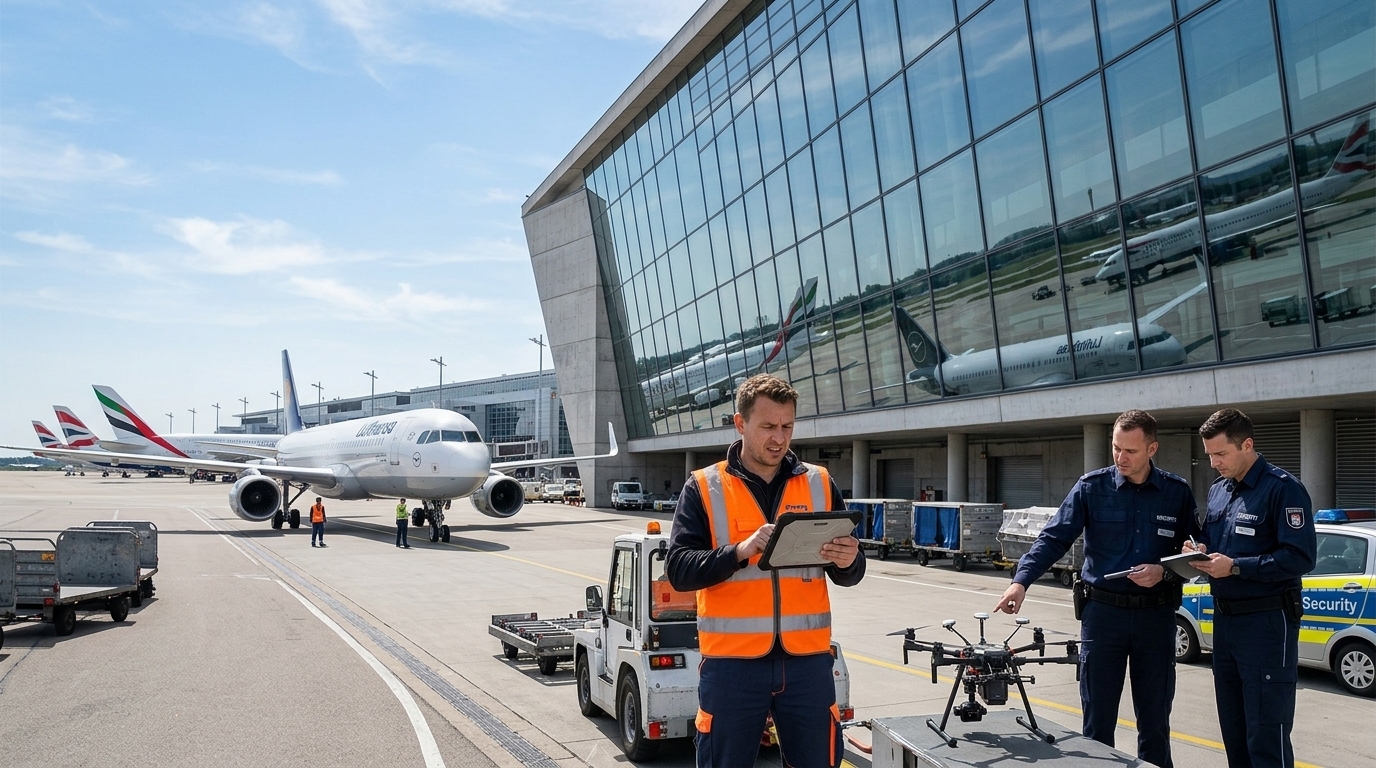
The recent suspension of flights at Munich Airport, one of Europe's most vital aviation hubs, served as a stark reminder of the fragility of global transportation. Following reports from two pilots regarding the presence of an unmanned aerial vehicle (drone) near the runways, security authorities had no choice but to hit the "pause" button on one of the most well-oiled machines of the German economy. Although the threat was never definitively confirmed, the cost of this single hour of paralysis extends far beyond the boundaries of Franz Josef Strauss Airport.
The Protocol of Silence: Why Safety Trumps Efficiency
In the world of civil aviation, doubt equals danger. When two different crews reported visual contact with a drone, air traffic control and police immediately activated emergency protocols. Halting takeoffs and diverting approaches is not a mere administrative decision, but a mandatory action to prevent a potential catastrophe. A drone, even a small one, can cause irreparable damage to a jet engine or shatter a cockpit windshield during the critical landing phase.
However, the process of confirming such threats remains a technological challenge. Despite millions invested in detection systems, distinguishing a small drone from a bird or an optical illusion under certain light angles remains difficult. In the Munich case, searches involving helicopters and ground forces yielded no results, leaving the question: was it a real threat that escaped, or a "false alarm" that cost millions?
The Economic Hemorrhage of a Hub
For an airport serving tens of millions of passengers annually and acting as Lufthansa's second base, every minute of delay translates into a chain reaction of costs. The one-hour suspension is not just about the flights scheduled to take off at that moment. It concerns the fuel consumed by aircraft in holding patterns, the cost of diversions to other airports like Nuremberg or Stuttgart, and compensation for passengers who missed their connections for transatlantic journeys.
- Fuel and Emissions: Holding patterns dramatically increase kerosene consumption.
- Crew Logistics: Delays often push crews to the limit of their legal working hours, forcing airlines to cancel subsequent flights.
- Reputation and Reliability: In a competitive environment, the image of a "safe but dysfunctional" hub affects future bookings.
According to industry analysts, a single hour of full shutdown at an airport of this magnitude can cost airlines and the airport operator a combined total of 500,000 to over 1 million euros, depending on peak hours and the number of affected flights.
The Legal Vacuum and the Need for Stricter Policy
The Munich incident brings back to the fore the need for a stricter European framework regarding drone use. Although EASA (European Union Aviation Safety Agency) has established rules for user registration and No-Fly Zones, the enforcement of these rules in practice remains insufficient. The anonymity offered by purchasing a drone off the shelf allows irresponsible users or even malicious actors to cause chaos without immediate consequences.
"This is no longer a toy in the hands of hobbyists. It is a tool that can paralyze national infrastructure," says an aviation security expert.
Germany has already begun discussing the mandatory installation of Remote Identification (Remote ID) systems for all drones, as well as hardening prison sentences for those who violate airport airspace. However, drone technology is evolving faster than legislation, creating a constant "cat-and-mouse" game between authorities and offenders.
Conclusion: The New Normal of Uncertainty
The drone alert in Munich was not an isolated incident but part of a growing global trend. From London's Gatwick to New York's Newark, airports are under siege from new technology. The challenge for the future is twofold: enhancing anti-drone technology (C-UAS) that will allow for neutralizing threats without stopping flights, and fostering a culture of responsibility among users. Until then, an hour of silence over Munich will remain the price we pay for security in an increasingly unpredictable sky.