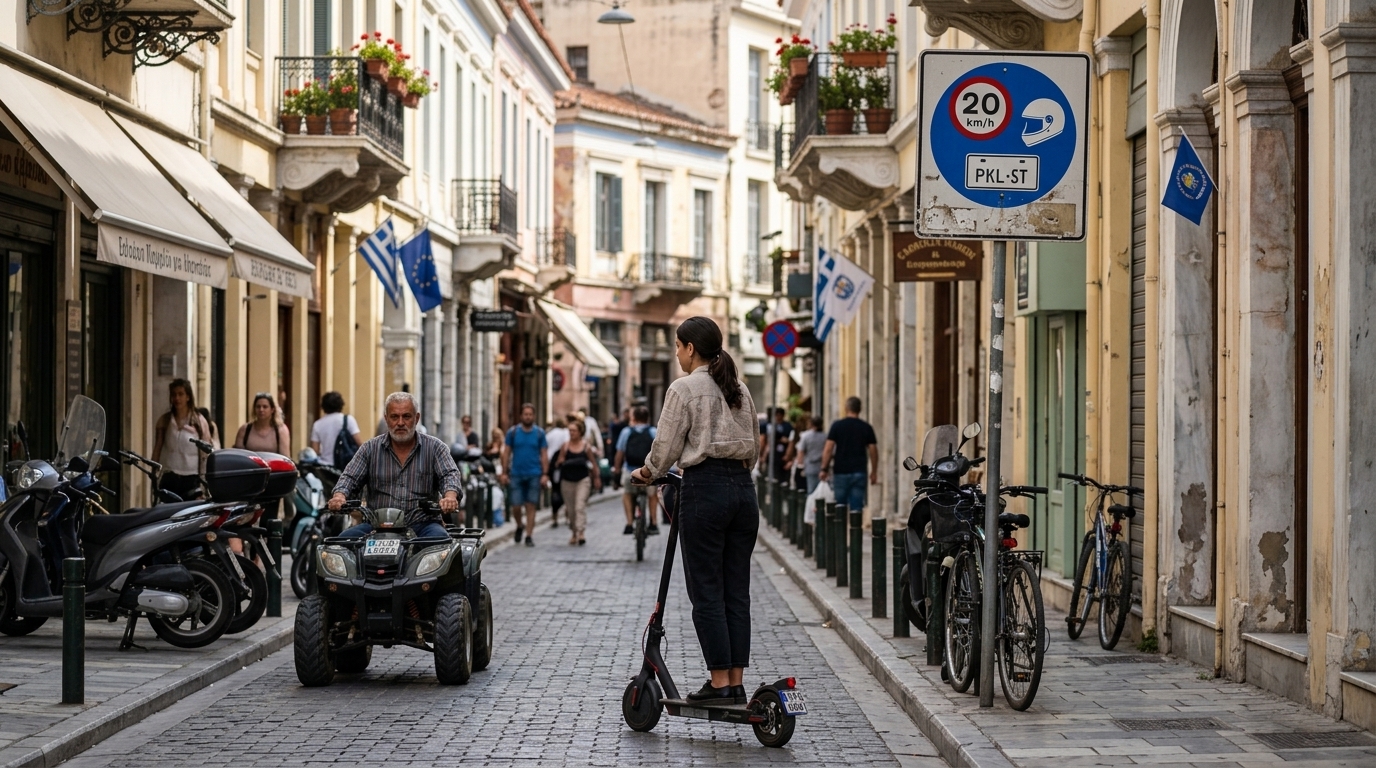
The era of the 'Wild West' for electric scooters and all-terrain vehicles (ATVs) on Greek roads is coming to an abrupt end. Through a series of legislative interventions spearheaded by the Ministry of Infrastructure & Transport and the Ministry of Citizen Protection, Greece is attempting to bring order to an anarchic landscape that has cost lives and caused traffic chaos, particularly in urban centers and popular tourist destinations.
The End of Anonymity and Mandatory Insurance
Perhaps the most significant disruption is the introduction of mandatory civil liability insurance for all Personal Light Electric Vehicles (PLEVs). Until recently, e-scooters operated in a legal vacuum where, in the event of an accident, compensating victims was a complex and often impossible task. Now, every owner or rental company is required to hold an insurance policy covering personal injury and property damage to third parties.
This regulation is not merely fiscal; it aims at accountability. As Citizen Protection Minister Michalis Chrysochoidis emphasized, safety is not optional. Simultaneously, a speed 'governor' set at 25 km/h is introduced for travel on the road network, while in pedestrian zones and squares, the speed must not exceed 6 km/h, protecting pedestrians from unpredictable collisions.
Restricting ATVs: The Tourism vs. Safety Gamble
ATVs, commonly known as 'gourounes' and a staple of the Greek islands, are also under fire. New legislation drastically restricts their movement on paved high-traffic roads, allowing access only to specific routes or for agricultural use, depending on their engine capacity and specifications. This decision sparked reactions among tourism professionals, but the accident statistics—often fatal for young tourists—left no room for further delays.
The 'Komvos' Project and Digital Management of Athens
In tandem with these restrictions, the government unveiled the 'Komvos' (Hub) plan, an ambitious digital platform for traffic management in Athens. The goal is to collect real-time data from sensors and cameras to adjust traffic lights and de-congest central arteries. Within this framework, micromobility is expected to play the role of the 'last mile' solution, but under strict rules that will not exacerbate the already heavy vehicular traffic.
Towards a New Mobility Culture
The success of these measures will be judged in practice and, crucially, through enforcement. Traffic police inspections have intensified, with heavy fines for failing to wear a helmet or for two people riding a single scooter. However, the major deficit remains infrastructure. Without an extensive network of bike lanes, e-scooters will continue to be a 'foreign body' wedged between cars and pedestrians. The transition to a greener, more sustainable city requires not just bans, but dedicated space for alternative modes of transport.