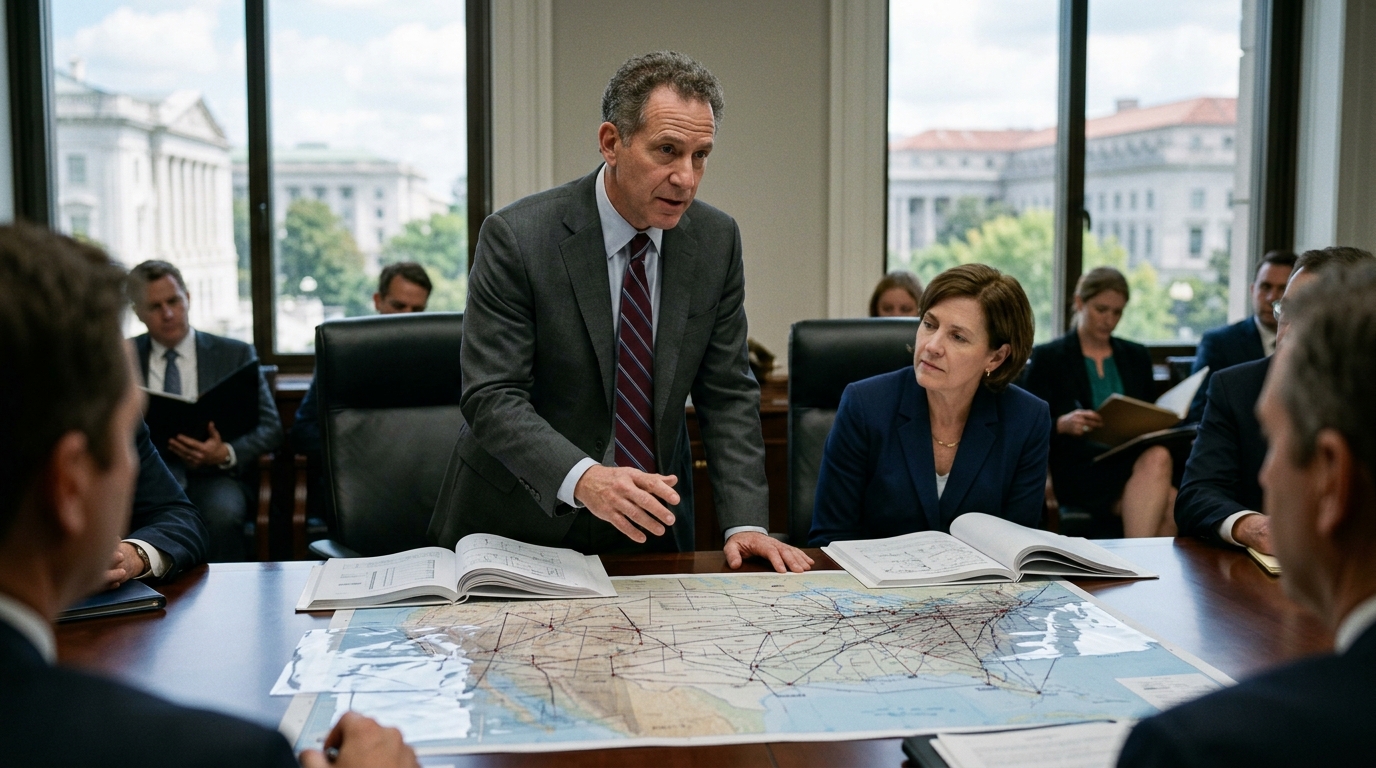
The U.S. Federal Aviation Administration (FAA) is currently navigating one of the most ambitious technological transitions in its history. With the United States' national airspace system regarded as the busiest and most complex in the world, modernization is no longer an option but a vital necessity for the survival of the transportation sector. The recent announcement regarding the intensification of artificial intelligence (AI) testing for air traffic redesign marks the end of the era of static routes and the beginning of a dynamic, algorithmically optimized reality.
The Challenge of "Rigid" Airspace
For decades, air traffic management has relied on a system of "highways in the sky." These routes are largely fixed, designed around ground-based radio aids dating back to the mid-20th century. Although the transition to GPS (via the NextGen program) improved the situation, decision-making remains largely manual. Air traffic controllers are tasked with managing thousands of flights simultaneously, factoring in weather, airport constraints, and military zones.
The AI currently being tested by the FAA aims for "dynamic sectorization." Instead of the airspace being divided into fixed geographical segments, the algorithm can reconfigure sector boundaries in real-time, depending on workload and flight density. This means that if a thunderstorm closes a route over Ohio, the AI can instantly suggest alternative paths for hundreds of aircraft, minimizing the holding patterns that cost millions in fuel and emissions.
Prediction and Prevention: The Future of Safety
The use of Machine Learning is not limited to routing. The FAA is experimenting with predictive models that can forecast potential conflicts or "congestion" before they occur. By analyzing decades of historical data combined with live streaming parameters, the system can identify patterns that escape the human eye. For instance, it can predict that a delay at Chicago's O'Hare airport will cause a "domino effect" on the East Coast four hours from now, suggesting proactive speed adjustments for aircraft taking off from California.
- Optimization of trajectories in four dimensions (latitude, longitude, altitude, and time).
- Reduction of the environmental footprint by eliminating unnecessary maneuvers.
- Integration of unmanned aircraft (drones) and air taxis into existing airspace.
- Automated flow management at airports to reduce taxi times on runways.
However, introducing AI into aviation comes with strict protocols. The FAA follows a "Human-in-the-loop" approach, where AI acts as an advisor rather than the final decision-maker. Certifying these systems is exceptionally difficult, as "black box" algorithms are unacceptable in environments where safety is paramount. Research focuses on "Explainable AI" (XAI), which can justify its recommendation to the controller in fractions of a second.
Economic and Geopolitical Implications
The success of this venture will have a massive impact on the global economy. U.S. airlines lose billions of dollars annually due to delays related to the control system. Reducing these delays by even 5% would mean massive profits and lower fares for consumers. Furthermore, the FAA seeks to set global standards. If the American AI model proves successful, it will serve as the blueprint for Eurocontrol in Europe and for emerging markets in Asia, consolidating U.S. technological leadership in the industry.
"We are not just trying to improve the existing system; we are trying to reinvent the way humanity moves through the skies," said an FAA official during the program's presentation in Washington.
In conclusion, the FAA's integration of AI represents a critical test of whether traditional government agencies can keep pace with the speed of technological evolution. The challenge is not only technical but also cultural, requiring a new relationship of trust between humans and machines in one of the most critical fields of modern life.