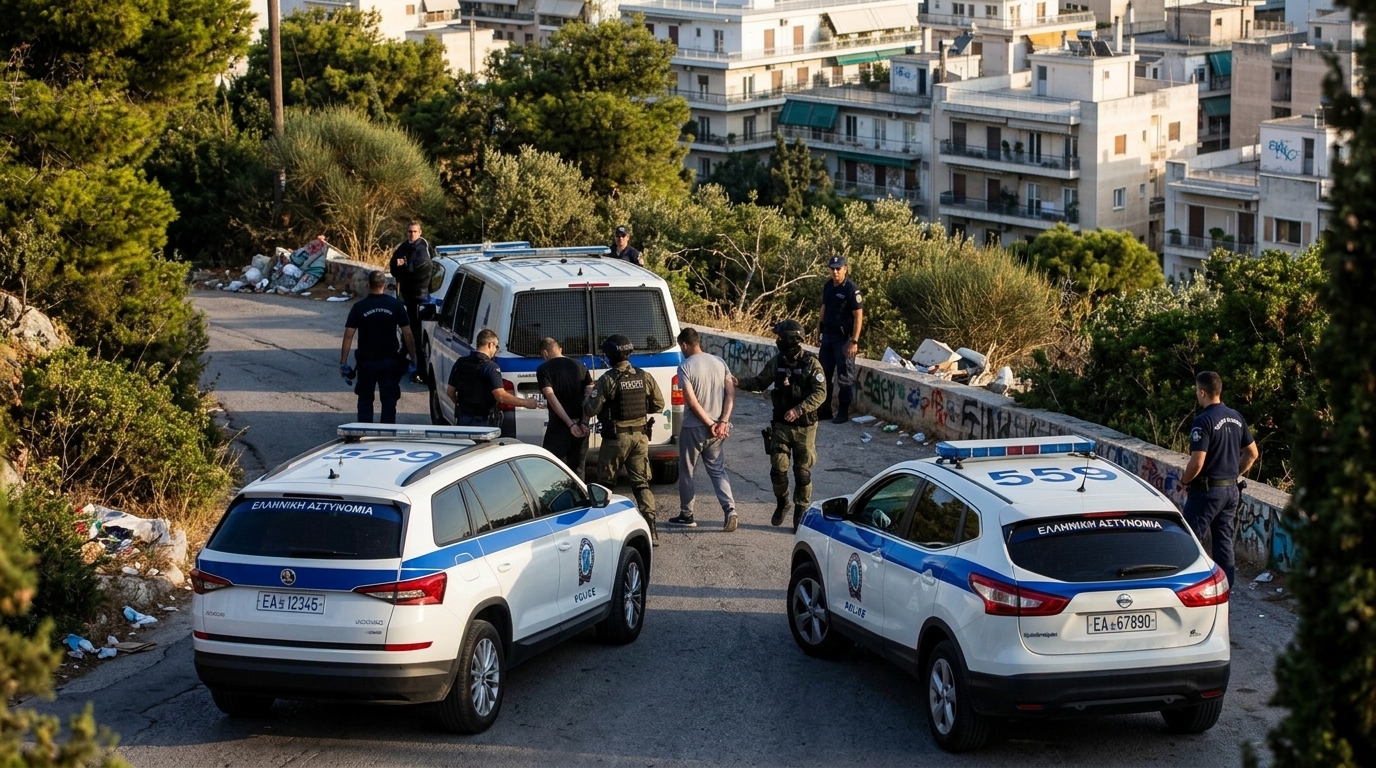
In a coordinated operation conducted on Strefi Hill, the Hellenic Police arrested five individuals accused of drug trafficking. This intervention, designed and executed by the Drug Enforcement Division of the Attica Crimes Investigation Directorate, is not merely an isolated police incident. Instead, it fits into a broader framework of political and social confrontation that has plagued the Exarchia district in recent years.
The Operation and the Findings
According to official announcements, authorities had placed Strefi Hill—a location historically linked to both local recreation and urban marginalization—under discreet surveillance. The detainees allegedly established a distribution network that exploited the hill's topography, which offers numerous escape routes and cover. During the investigation, quantities of cannabis, precision scales, and cash were seized, pointing to the organized commercial nature of the group's activities.
The success of the operation is being touted by the Ministry of Citizen Protection as evidence of its commitment to "cleansing" public spaces of illegality. However, for the residents of Exarchia, the reality is far more nuanced. Strefi Hill has been at the center of a dispute regarding its redevelopment for years, with many residents alleging that the police presence is being used as a tool to enforce a specific model of urban development.
Strefi Hill as a Political Battleground
Strefi Hill is more than just a green lung for the city; it is a symbol of Exarchia's resistance to state intervention. Its recent history is marked by protests against redevelopment plans promoted by the Municipality of Athens in collaboration with private entities. Critics of these plans argue that the goal is not to improve the quality of life but to facilitate "gentrification"—the displacement of long-term residents and the transformation of the neighborhood into a sterilized tourist destination.
"Safety is the pretext, privatization is the goal," local collectives often state.
On the other hand, a significant portion of the population demands the obvious: the right to walk on the hill without the fear of crime. Drug trafficking is a harsh reality that degrades the area and creates ghetto-like conditions. In this instance, the police are tasked with balancing crime suppression with the need to avoid escalating tensions in a neighborhood that is already at a boiling point.
Displacement of Crime and Policing Strategy
One of the fundamental questions arising after such operations is whether these arrests solve the problem or simply displace it. The history of Athens has shown that when the police "clear" one area (as seen previously with Omonoia Square or Pedion tou Areos), the drug markets simply move a few blocks away. Without a comprehensive social policy for addiction treatment and reintegration, police operations resemble tactical exercises that offer temporary communication relief but no permanent solution.
In Exarchia, the situation is further complicated by the construction of the Metro station at the central square, which has turned the area into a perpetual construction site under constant police surveillance. The presence of riot police (MAT) on every corner has fostered a sense of siege, often leading to clashes. While the five arrests on Strefi Hill represent a victory for the Drug Enforcement Division, the battle for Exarchia's identity remains open and multifaceted.
Conclusion: The Need for a Holistic Approach
Addressing drug trafficking is essential, but it cannot be the sole answer to Exarchia's problems. The area requires investment in infrastructure, support for local businesses, and, most importantly, a sincere dialogue between the state and the community. Strefi Hill must remain a space that is free, green, and safe for everyone, without sacrificing its social cohesion on the altar of speculative interests. Security is not imposed solely with handcuffs; it is built through social justice and respect for public space.