In an era where Artificial Intelligence (AI) has transitioned from science fiction to a daily reality influencing everything from labor markets to information consumption, the European Commission and the Organisation for Economic Co-operation and Development (OECD) have made a move of profound strategic importance. The unveiling of a joint framework for "AI Literacy" marks the beginning of a coordinated global effort to bridge the widening chasm between rapid technological advancement and societal understanding.
The Necessity of a Digital Compass
As we navigate the summer of 2026, the implementation of the EU AI Act is in full swing. However, regulatory frameworks alone are insufficient to protect the fabric of society. As the joint EC-OECD report highlights, the protection of the citizen depends not only on legal structures that curb corporate excesses but also on the individual's ability to discern when they are interacting with an algorithm, recognize its inherent biases, and use these tools safely and effectively.
AI literacy is now being defined as a fundamental skill, as essential to the 21st century as reading and writing were to the 19th. It is no longer the exclusive domain of developers or data scientists. It concerns the teacher using generative AI to craft lesson plans, the patient receiving an AI-assisted diagnosis, and the voter encountering deepfake content on social media platforms.
The Four Pillars of AI Literacy
The new framework is structured around four central pillars designed to provide a holistic education for the general population:
- Understanding and Awareness: Foundational knowledge of what AI is, how models are trained, and the distinction between static software and systems that "learn" and evolve from data.
- Critical Evaluation: The ability to question AI outputs, identifying "hallucinations" and understanding that AI does not possess a concept of truth, but rather generates probabilistic responses based on patterns.
- Ethical and Social Consciousness: Awareness of AI's impact on privacy, human rights, and the environment—specifically the massive energy consumption required by modern data centers.
- Practical Application: Developing the skills to utilize AI tools to enhance productivity while strictly adhering to safety protocols and ethical guidelines.
This framework is far from a mere academic exercise. It is intended to be integrated into national curricula across member states and into lifelong learning programs for workers whose roles are being fundamentally reshaped by automation.
Labor Markets and the Misinformation Threat
One of the most critical aspects of this initiative is addressing the pervasive fear of automation. The OECD emphasizes that AI literacy can serve as an "antidote" to job insecurity. When workers understand the tools they use, they stop viewing them as an existential threat and begin to see them as collaborative partners. This shift requires a radical overhaul of professional training, particularly in sectors like administration, law, and the creative industries.
"AI literacy is not a luxury for the few, but a necessity for democracy itself," the report states.
Simultaneously, fortifying society against misinformation is a top priority. In a year marked by multiple global elections, the ability of citizens to identify AI-generated content is the final line of defense for the public sphere. The framework proposes specific methodologies for source verification and for understanding the manipulative techniques employed by social media algorithms to drive engagement through polarization.
The Road Ahead: From Policy to Practice
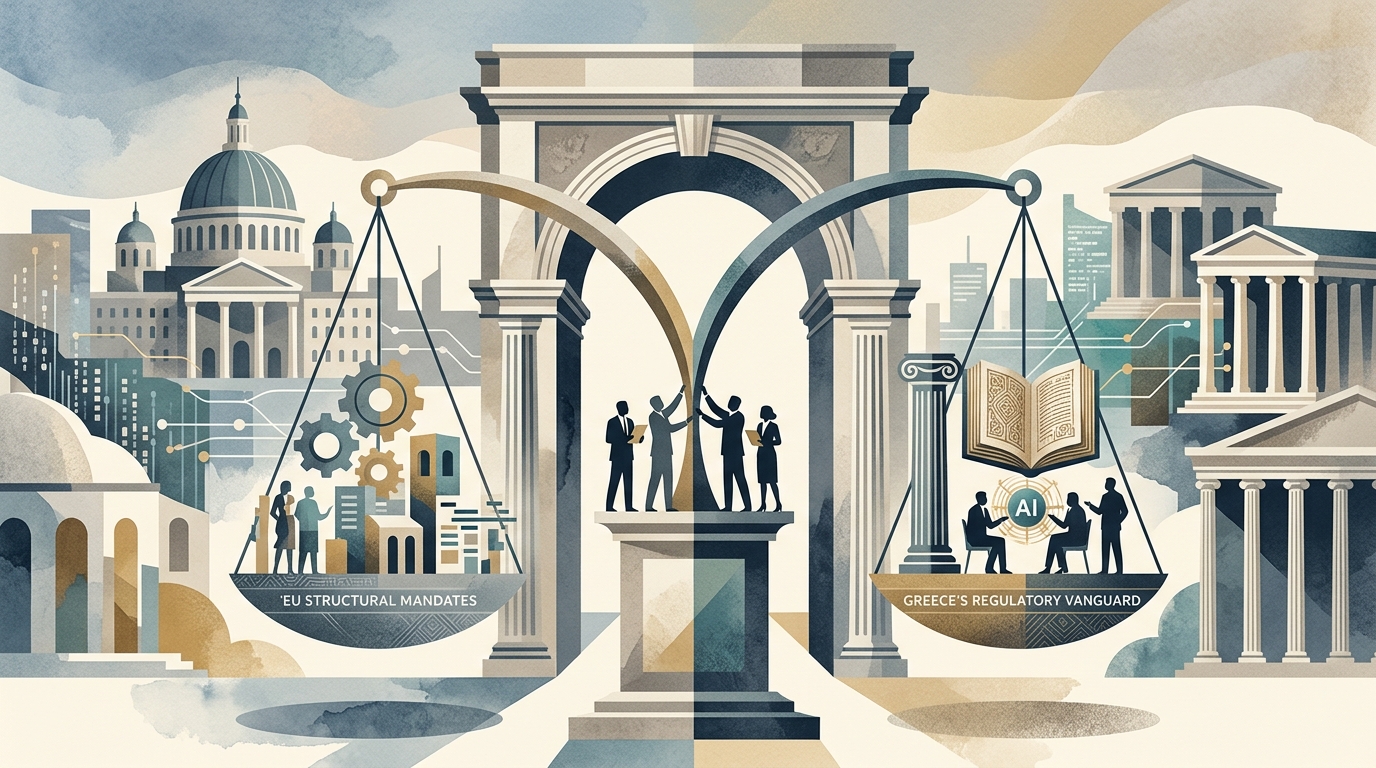
The challenge now shifts to individual nations. While the European Commission promises funding through the "Digital Europe" program, successful implementation requires deep cooperation between the private sector, academia, and civil society. Countries like Greece, which have made significant strides in digital governance, must now pivot toward investing in human capital, ensuring that the transition to an AI-driven economy does not exacerbate existing social inequalities.
In conclusion, the EC-OECD AI literacy framework is a formal recognition that technology is too consequential to be left solely to technocrats. It is a clarion call for a more conscious, critical, and capable society, ready to coexist with the most transformative invention of our time. Knowledge, as it turns out, remains the only effective regulator of power.