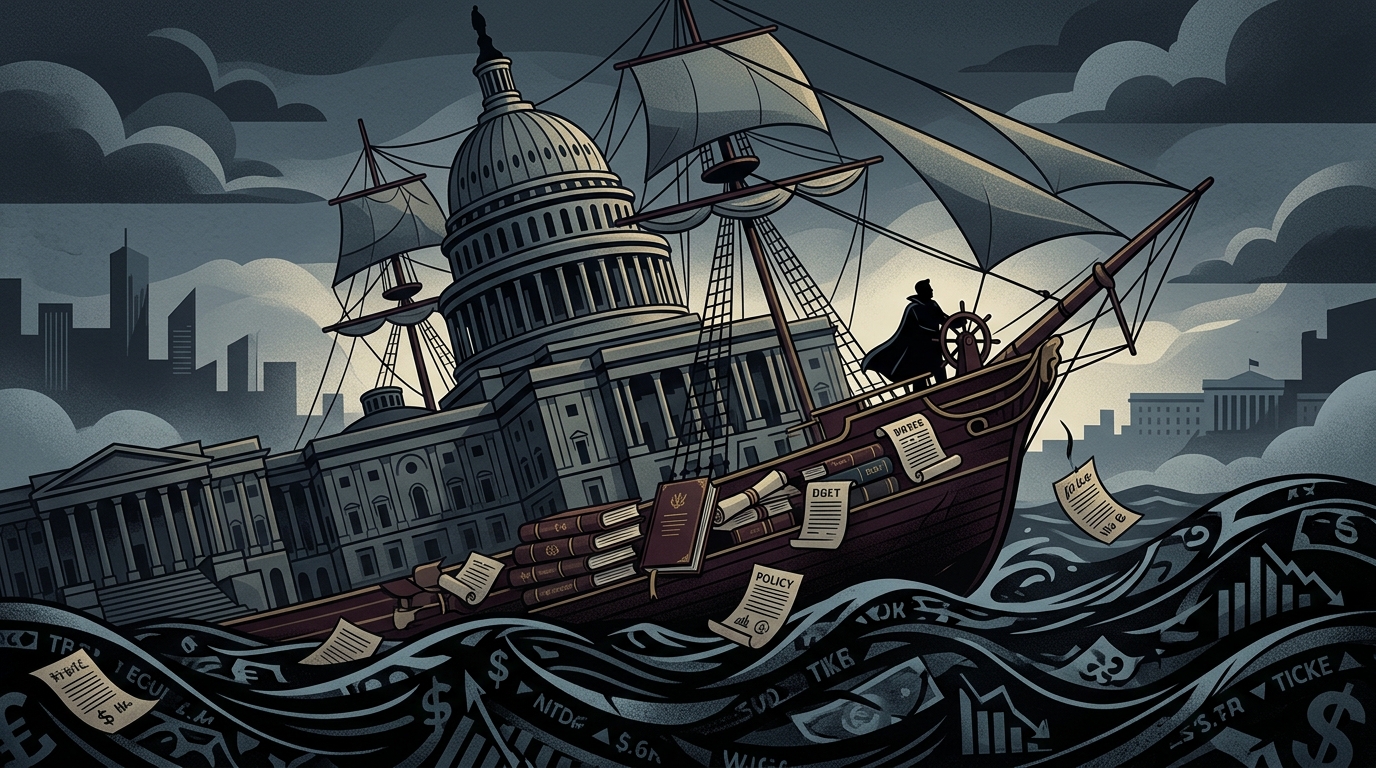
Elon Musk’s rhetoric has never been characterized by moderation, but his recent intervention regarding the fiscal health of the United States strikes a chord of existential dread for the global economy. Through a series of public statements, the visionary behind Tesla and SpaceX warns that the "USS America" is taking on water, burdened by a debt load that now appears unmanageable. The core of his warning focuses not just on the absolute magnitude of the debt, but on the velocity at which it is compounding, creating a feedback loop that threatens to devour the federal budget.
The $1 Trillion Interest Wall: A Mathematical Time Bomb
According to the latest fiscal data for 2026, annual interest payments on the US national debt have surged past the $1 trillion mark. To put this in perspective, this expenditure now eclipses the nation’s entire defense budget. Musk argues that this development is not merely a statistical anomaly but a structural failure of the highest order. When a sovereign nation must borrow money simply to pay the interest on its existing debt, it enters a state of "fiscal dominance." In this scenario, the central bank is forced to keep interest rates artificially low or monetize the debt, both of which are recipes for long-term inflationary decay.
Musk’s analysis aligns with the long-standing warnings of fiscal hawks in Washington. Despite relatively low unemployment, the federal deficit remains at levels historically reserved for times of major war or economic depression. This disconnect suggests a systemic addiction to government spending, ignoring the long-term consequences of currency debasement and the potential loss of international confidence in US Treasuries. If the world's primary safe-haven asset begins to be viewed as a liability, the entire global financial architecture is at risk.
DOGE and the Strategy of Radical Austerity
Musk does not stop at diagnosis; he offers a cure that many find radical: a fundamental restructuring of government operations. Through the proposed "Department of Government Efficiency" (DOGE), the billionaire promotes an agenda of massive federal spending cuts. His logic is as simple as it is ruthless: if the government cannot live within its means, it must be forcibly downsized. Musk views the federal bureaucracy as a bloated entity that stifles innovation while accumulating debt that future generations will never be able to repay.
However, implementing such a policy carries immense social and political risks. The vast majority of federal spending is tied to "mandatory" programs like Social Security and Medicare, along with the defense budget. Any meaningful attempt to balance the books would require touching these political third rails. Musk contends that the choice is no longer between the status quo and austerity, but between a controlled reduction in spending and a chaotic, involuntary bankruptcy that would collapse the standard of living for all Americans.
The Geopolitical Cost of Financial Fragility
A United States drowning in debt is a United States losing its ability to project power abroad. Musk recognizes that the US Dollar’s status as the world’s reserve currency is Washington’s greatest asset, yet also its most vulnerable. Should foreign creditors—including China, Japan, and the Gulf states—begin to doubt the US's ability to settle its debts without resorting to hyper-inflationary tactics, the demand for dollars will plummet. This would lead to a spike in import costs and a permanent state of economic decline, ending the era of American exceptionalism.
Ultimately, Musk’s warning serves as a reminder that the laws of mathematics are indifferent to political ideology. Whether it is a corporation like Tesla or the world’s most powerful superpower, accumulating debt faster than growth leads to the same inevitable conclusion. The difference lies in the scale: a US default would trigger tsunamis that would overwhelm every corner of the globalized system, from European pension funds to emerging markets in Asia.
Conclusion: The Ship and the Storm
Musk’s intervention can be interpreted in two ways: as a sincere alarm from a man who has staked billions on the American dream, or as a calculated move to pressure the government into deregulation and a smaller state footprint. Regardless of the motive, the underlying data is stark. America is at a crossroads. Continuing the current fiscal trajectory is no longer a viable option. The challenge for the nation’s leadership is to find a way to "lighten the ship" without causing a mutiny or steering it directly into the rocks of a social explosion. The clock is ticking, and as Musk points out, the interest alone is now a monster that must be fed daily.