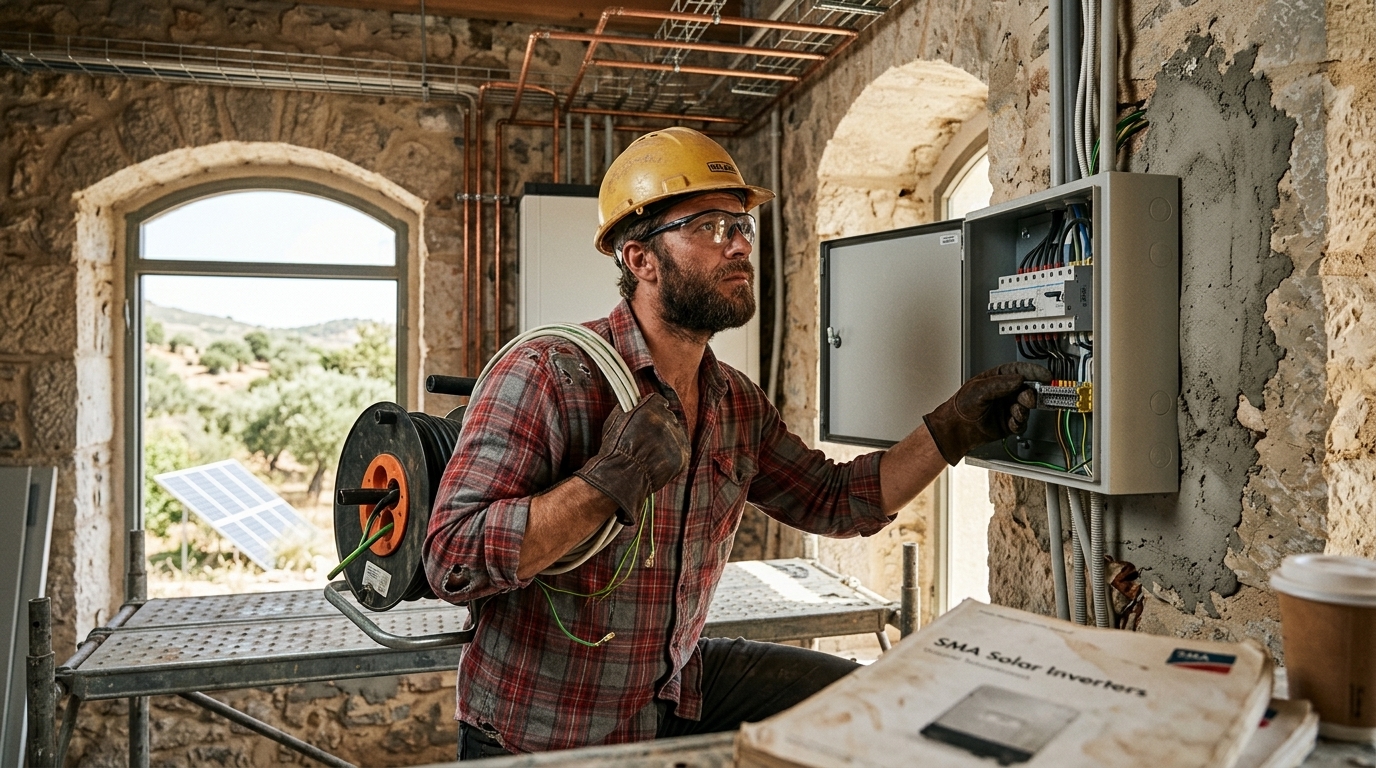
Greece stands at a pivotal juncture in its modern history, striving to balance the demands of climate neutrality with the challenges of the digital age. However, behind the glossy screens of smart cities and the sleek panels of photovoltaics lies an "invisible" yet critical infrastructure: the electrical installations of our buildings. The Hellenic Institute of Electrical Installations Technology (ELITHE) is sounding the alarm, pointing out that without a modern, safe, and certified electrical grid, the twin transition—green and digital—risks becoming a dead letter.
The Unseen Backbone of Growth
For decades, electrical installations in Greece were viewed as a secondary issue, confined to the technical specifications of construction. Today, the reality has shifted dramatically. The move toward electromobility, the installation of heat pumps for heating, and the need for a stable power supply for digital infrastructure (data centers, smart home devices) have exponentially increased the demands on internal building grids. Many buildings in Greece, however, were constructed before 1980, with specifications that did not anticipate even a fraction of today's loads.
ELITHE emphasizes that safety is not just a matter of accident prevention but also one of economic viability. An inefficient installation causes energy losses, increasing costs for the consumer and nullifying the benefits of energy upgrades. To bridge this gap, the Institute proposes a suite of five measures aimed at modernizing the regulatory framework and the technical culture in the country.
The 5 Proposals by ELITHE
The Institute's proposals are not merely technical guidelines but a comprehensive strategic intervention. Specifically:
- Mandatory Periodic Inspections: Establishing strict schedules for the re-inspection of installations in residences and commercial spaces. Today, many owners are unaware that electrical installations "age" and require maintenance just like an elevator.
- Third-Party Certification: Introducing independent inspection bodies to validate the quality and safety of works, ensuring compliance with European standards (such as HD 384 and ELOT 60364).
- Digital Registry of Installations: Creating a digital platform to record the history of every installation, the inspections performed, and any pending issues. This would act as a "digital passport" for the property.
- Financial Incentives for Upgrades: Linking energy efficiency programs (like the Greek "Exoikonomo") with the mandatory upgrade of the electrical installation. Energy renovation is incomplete with obsolete wiring and panels.
- Education and Certification of Technicians: Continuous training for electricians in new technologies (smart grids, PVs, EV chargers) to meet modern demands effectively.
The Link to the Green Deal
The European Green Deal requires a drastic reduction in emissions, which is achieved through the "electrification" of the economy. When a household installs an electric vehicle charger, the power demand can spike instantaneously. If the installation is not designed for such loads, the risk of fire from overheating is real. ELITHE stresses that the transition to clean energy will fail if the "last mile" of distribution—the wire reaching our devices—is flawed.
"The electrical installation is the neuron of the modern building. If the neuron is damaged, the body cannot function, no matter how advanced the brain is," industry executives characteristically state.
Furthermore, the digital transition requires power quality. Sensitive electronic devices, from business servers to automation systems, require stable voltage without fluctuations. A poor installation can cause damage to equipment worth thousands of euros, undermining the competitiveness of Greek businesses.
Conclusion: A Policy Choice
Adopting ELITHE's proposals is not just a technical matter; it is a political decision concerning citizen protection and the national economy. The government and relevant authorities are called upon to integrate these proposals into the National Energy and Climate Plan (NECP). Safety should not be viewed as a cost but as an investment in a future where technology serves humanity safely and reliably. The time for action is now, before yesterday's infrastructure becomes the obstacle to tomorrow.