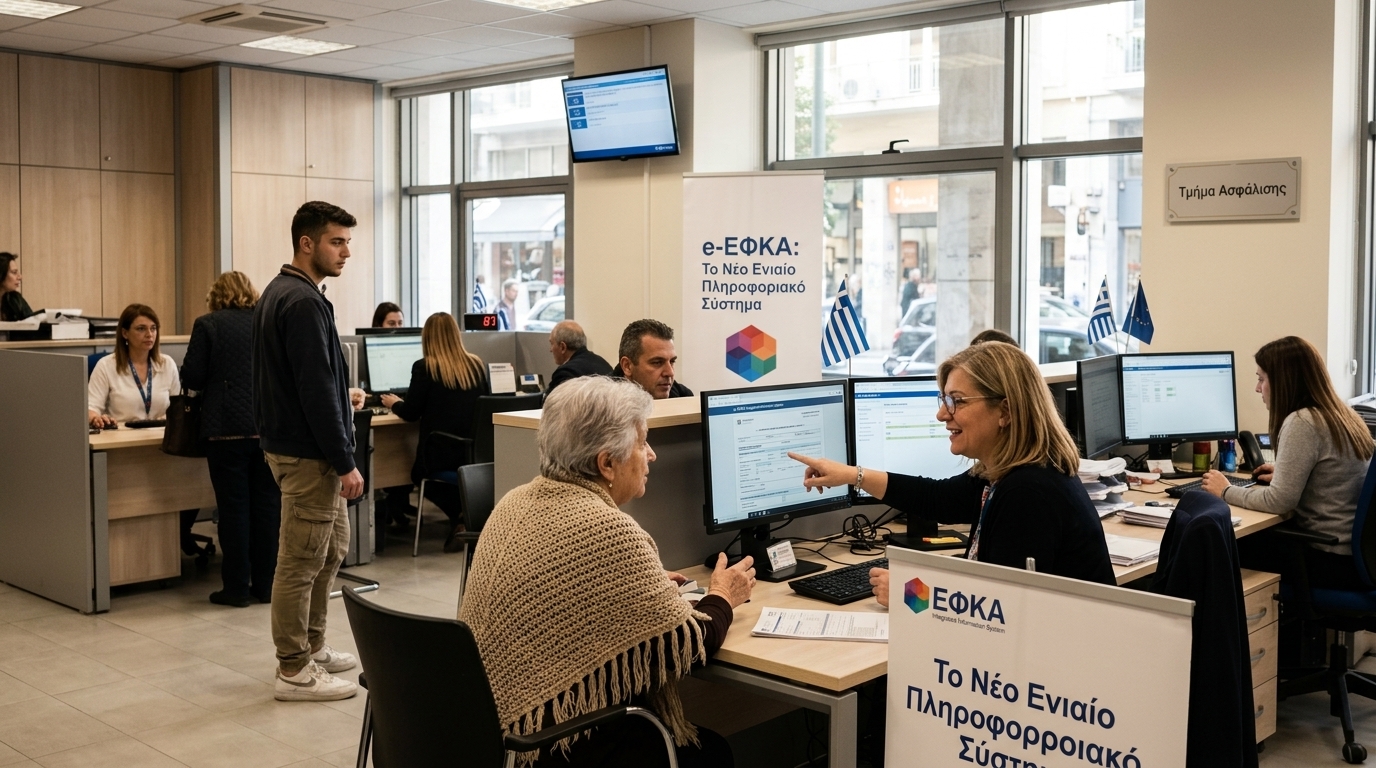
For decades, Greek social security was a bureaucratic labyrinth where millions of insured citizens were trapped between incompatible digital systems, handwritten ledgers, and fragmented information that often led to multi-year delays in pension issuance. The establishment of EFKA in 2017 was an institutional unification that remained a "dead letter" at the technical level, as the old funds (IKA, OAEE, OGA, etc.) continued to operate as "digital islands." Today, with the help of resources from the Recovery and Resilience Facility (RRF), the country is attempting the largest technological leap in the history of public administration: the implementation of the new Integrated Information System (IIS).
Digital Unification: Ending the "Babel" of Data
The new IIS is not just a software upgrade; it is a radical restructuring of how the state interacts with the citizen. Until today, an EFKA employee often had to refer to five or six different databases to calculate the insurance time of a citizen who had changed professional categories. The result was the "manual" processing of thousands of applications, which was the main cause of pending pensions.
With the new system, a Unified Insurance Record is created. Each insured person will have a digital file where all contributions, insurance periods, and medical data will be gathered in real-time, regardless of the original fund. This data unification will allow for automated pension issuance (fast-track), reducing waiting times from months or years to just a few days for the majority of cases.
Economic Transformation and Transparency
The investment, exceeding 33 million euros, is funded by the Recovery Fund and is a strategic priority for fiscal stability. The reduction in administrative costs is obvious: fewer man-hours for bureaucratic procedures mean faster service and the ability to reallocate staff to more substantial auditing roles. Furthermore, the new system will act as a bulwark against contribution evasion. Through interconnection with the "Ergani" system and the Independent Authority for Public Revenue (AADE), e-EFKA will be able to immediately identify discrepancies between wages and paid contributions, shielding the revenues of the social security system.
- Full digitization of the insurance record for 6.5 million citizens.
- Automation of pension and benefit award processes.
- Unified management of revenues and debts for all employers.
- Real-time interconnection with the Social Security Debt Collection Center (KEAO).
Challenges and the Implementation Bet
Despite the optimism, the transition is not without risks. Migrating data from old, incomplete, or even damaged records into the new digital environment is a process of "surgical" precision. Data quality is key: if the initial data is incorrect, the new system will simply produce incorrect results faster. Additionally, there is the challenge of staff training. EFKA employees, many of whom are familiar with outdated procedures, are called upon to adopt a completely new work culture.
"The new IIS is the backbone of the social state in the 21st century. We are not just building a website, but an infrastructure that will ensure no citizen feels like a stranger in their own state," sources from the Ministry of Labor state.
In conclusion, e-EFKA is on the threshold of a new era. If the project is completed within the 2026 deadlines, Greece will have managed to transform the "sick man" of public administration into a model of digital efficiency, restoring trust between the state and the citizen.