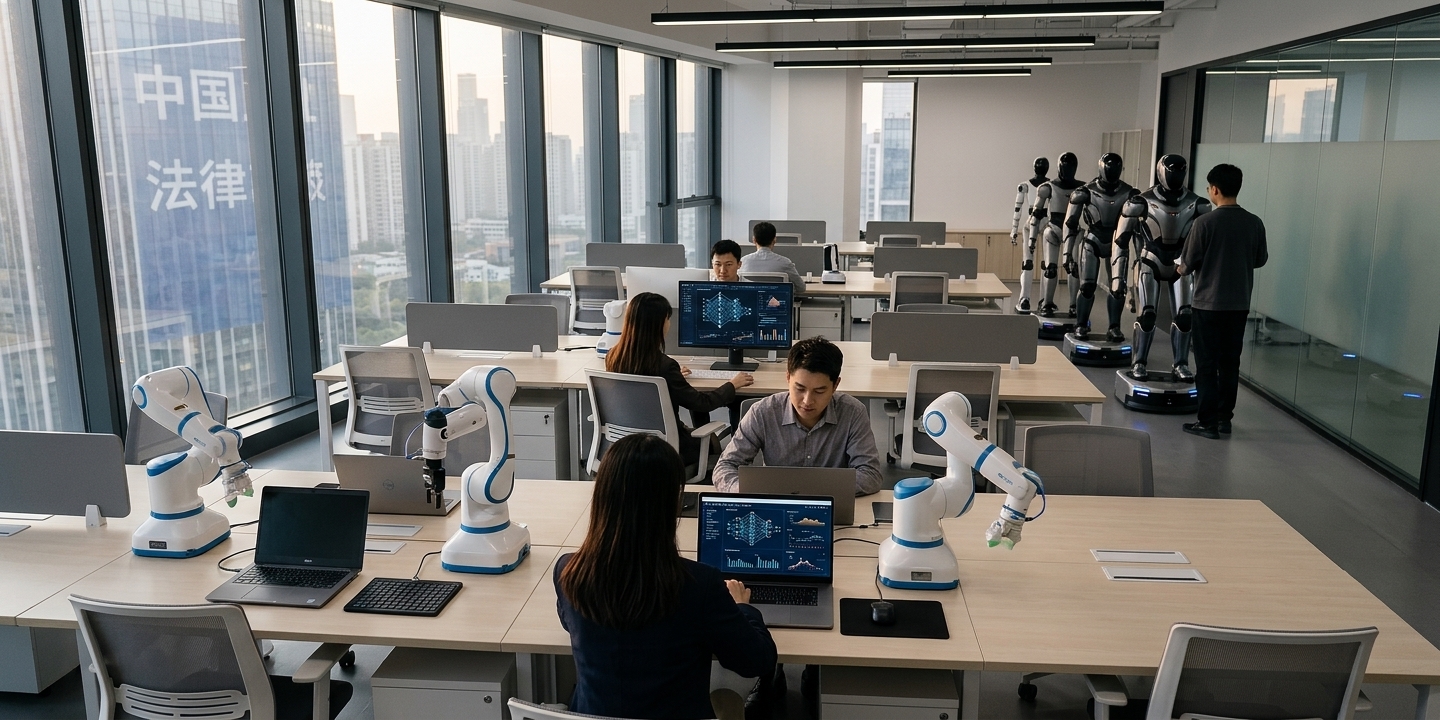
China, the nation leading the global race for Artificial Intelligence (AI) dominance, is now grappling with the social consequences of its own technological success. In a ruling that resonates across the global tech sector, a court in eastern China has delivered a verdict that could fundamentally alter how businesses integrate automation. The decision clearly states that the mere replacement of human tasks by algorithms does not constitute a legal ground for unilateral contract termination or forced demotions.
The Anatomy of a Legal Precedent
The case involves an employee at a technology firm in Jiangsu province who saw the majority of his tasks automated by a new Generative AI system. Management, deeming his role redundant, offered him a new position with significantly lower pay and reduced responsibilities. When the employee refused to sign the new contract, the company proceeded with his dismissal, citing "objective changes in economic circumstances" and the necessity of digital transformation.
The court, however, held a different view. In its reasoning, the judges emphasized that the introduction of AI is a business choice and not an insurmountable external obstacle that makes continued employment impossible. The court ruled that the company was obligated to retrain the worker or find an equivalent position, rather than using technology as a tool to slash labor costs through layoffs. This ruling highlights a critical legal distinction: technological progress does not override established labor rights.
The Political Dimension: Common Prosperity vs. Corporate Profit
This move by the Chinese judicial system should not be seen in isolation from the country's broader political landscape. Under the leadership of Xi Jinping, the Communist Party of China has pushed the "Common Prosperity" agenda, aimed at reducing social inequality and ensuring social stability. Mass unemployment caused by unregulated AI adoption is Beijing's ultimate nightmare.
- Maintaining social cohesion takes precedence over the short-term profits of tech giants.
- Courts are acting as a regulatory lever to prevent labor unrest.
- The ruling forces companies to invest in employee upskilling and internal mobility.
In contrast to the West, where labor laws often favor corporate flexibility (especially in the US with "at-will employment"), China appears to be building a protective wall around its middle-class workers. This creates a paradox: an authoritarian government is offering stronger protections against technological unemployment than many liberal democracies.
Implications for Tech Giants
For companies like Alibaba, Tencent, and Baidu, this ruling is a shot across the bow. While these firms are racing to integrate AI to boost efficiency and cut overhead, the legal obligation to retain staff or move them to equivalent roles adds a significant financial burden.
"Artificial Intelligence must be a tool for human empowerment, not an excuse for human impoverishment," noted one of the legal consultants involved in the case.
This development is expected to slow the pace of aggressive automation, forcing businesses to plan their transition to the digital age more carefully. The need for internal transfer programs and continuous education will now become a central pillar of corporate strategy in China. Furthermore, this ruling may serve as a model for other jurisdictions in Asia, where labor models often follow China's lead.
Conclusion: A New Social Contract
The Chinese court's decision marks the beginning of a new era in labor relations. As AI becomes an integral part of the production process, the question is no longer whether it will replace jobs, but how society will protect those affected. China has sent a clear message: technological supremacy cannot be built on the ruins of job security. The future of work in the AI era will be determined not by the power of algorithms, but by the strength of laws that protect human dignity.