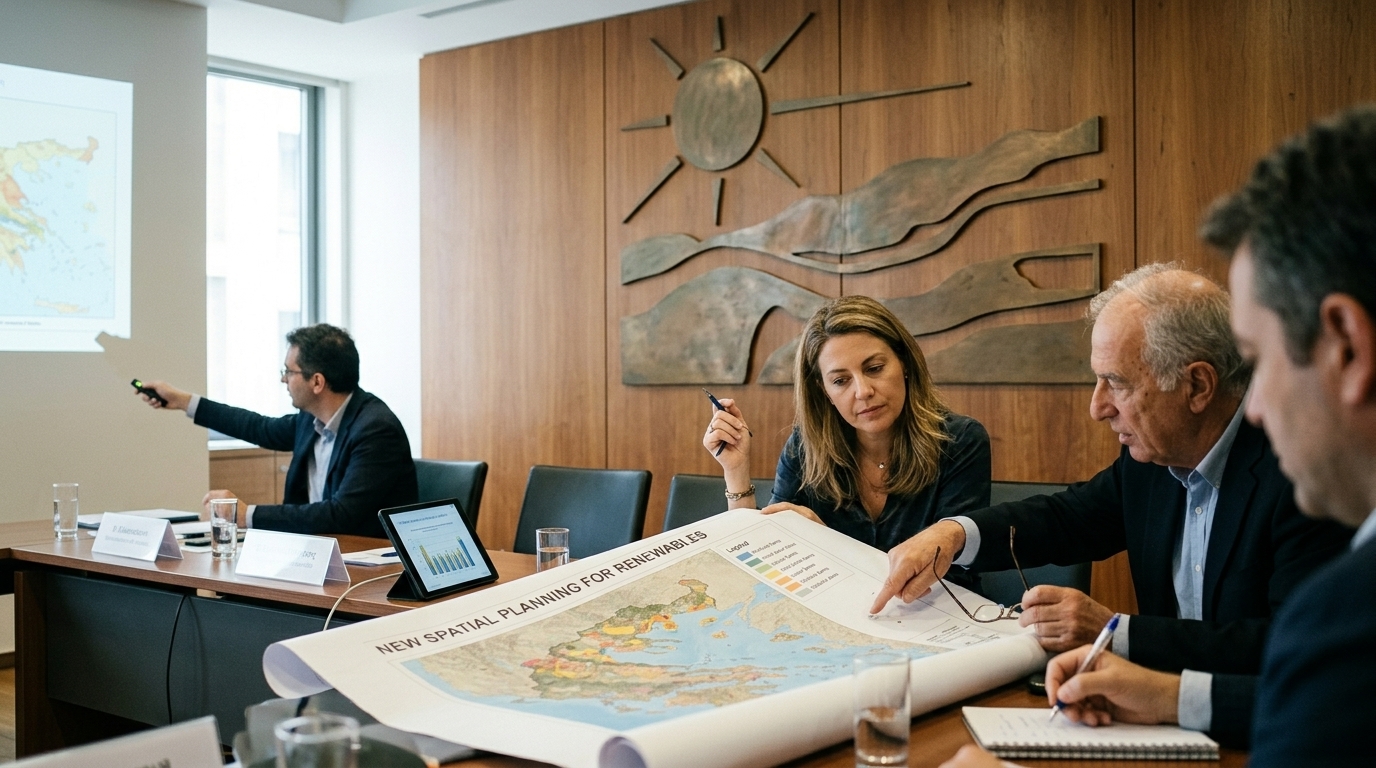
Greece’s energy transition is at a critical juncture. While the country has achieved impressive penetration rates for Renewable Energy Sources (RES), the lack of a modern and stable spatial planning framework remains the primary obstacle to further growth. The Athens Chamber of Commerce and Industry (ACCI), recognizing the need for a clear investment landscape, recently submitted a package of ten specific proposals. These recommendations extend beyond the mere placement of wind turbines and solar panels; they advocate for a comprehensive restructuring of the economy centered on sustainability and competitiveness.
The current Special Spatial Planning Framework for RES dates back to 2008—an era when technology and market demands were radically different. The delay in its revision has created a legal vacuum, leading to repeated appeals to the Council of State and freezing significant investment projects. ACCI emphasizes that the new regulation must balance environmental protection with the necessity for affordable energy for both industry and households.
Legal Certainty as a Foundation
The first, and perhaps most crucial, proposal from ACCI concerns the establishment of legal certainty. Energy investors commit capital for decades. When the rules of the game change retroactively or remain ambiguous, risks escalate and the cost of capital follows. The Chamber calls for the enactment of rules that stand the test of time and reduce bureaucratic complexity. This includes the digitalization of procedures through an integrated Geographic Information System (GIS), where stakeholders can view in real-time which areas are eligible for project development.
Furthermore, ACCI highlights the need for expedited licensing. Greece remains one of the slowest countries in the EU regarding the approval of environmental terms for RES projects. The proposal for "one-stop-shop" services is not new, but its effective implementation remains elusive. Linking the various databases of the public administration could reduce licensing times from years to a few months, significantly enhancing the country's attractiveness as an investment destination.
Energy Storage and Grids: The Next Frontier
Further RES development is impossible without a corresponding upgrade of the electrical grids and the integration of storage technologies. ACCI proposes the prioritized licensing of projects that combine production and storage (batteries or pumped hydro). Storage is the solution to the intermittency of RES—the fact that the sun does not always shine and the wind does not always blow. Without storage, surplus energy is lost, representing both an economic and ecological waste.
Simultaneously, the expansion of transmission and distribution grids is imperative. The Chamber seeks incentives for the development of "green" industrial zones, where businesses can connect directly to RES sources, reducing their energy costs and improving their environmental footprint. This is particularly critical for Greek manufacturing, which is burdened by high electricity prices compared to its European competitors.
Social Acceptance and Local Communities
One of the greatest hurdles in RES development is the resistance from local communities. ACCI proposes a new model of compensatory benefits that are more direct and visible to citizens. Instead of simple contributions to an impersonal state treasury, benefits should translate into reduced electricity bills for residents of the areas hosting the projects, as well as funding for local infrastructure.
The proposal also includes ensuring a balance between tourism, agriculture, and energy. ACCI argues that RES installations should not come at the expense of high-productivity agricultural land or iconic tourist landscapes. Instead, solutions such as floating solar panels or offshore wind farms should be prioritized, as they have a smaller visual and environmental footprint on land. Proper spatial planning is key to ending polarization and making the green transition a participatory endeavor rather than a top-down imposition.
Conclusion: A Strategic Choice
ACCI’s ten proposals are not merely technical suggestions; they are a political and economic statement about the country's future. Greece possesses the natural advantage to become the energy hub of Southeast Europe. However, this advantage will remain untapped unless accompanied by a modern, fair, and stable institutional framework. The new spatial planning for RES represents the final opportunity to correct past distortions and lay the foundations for truly sustainable growth.