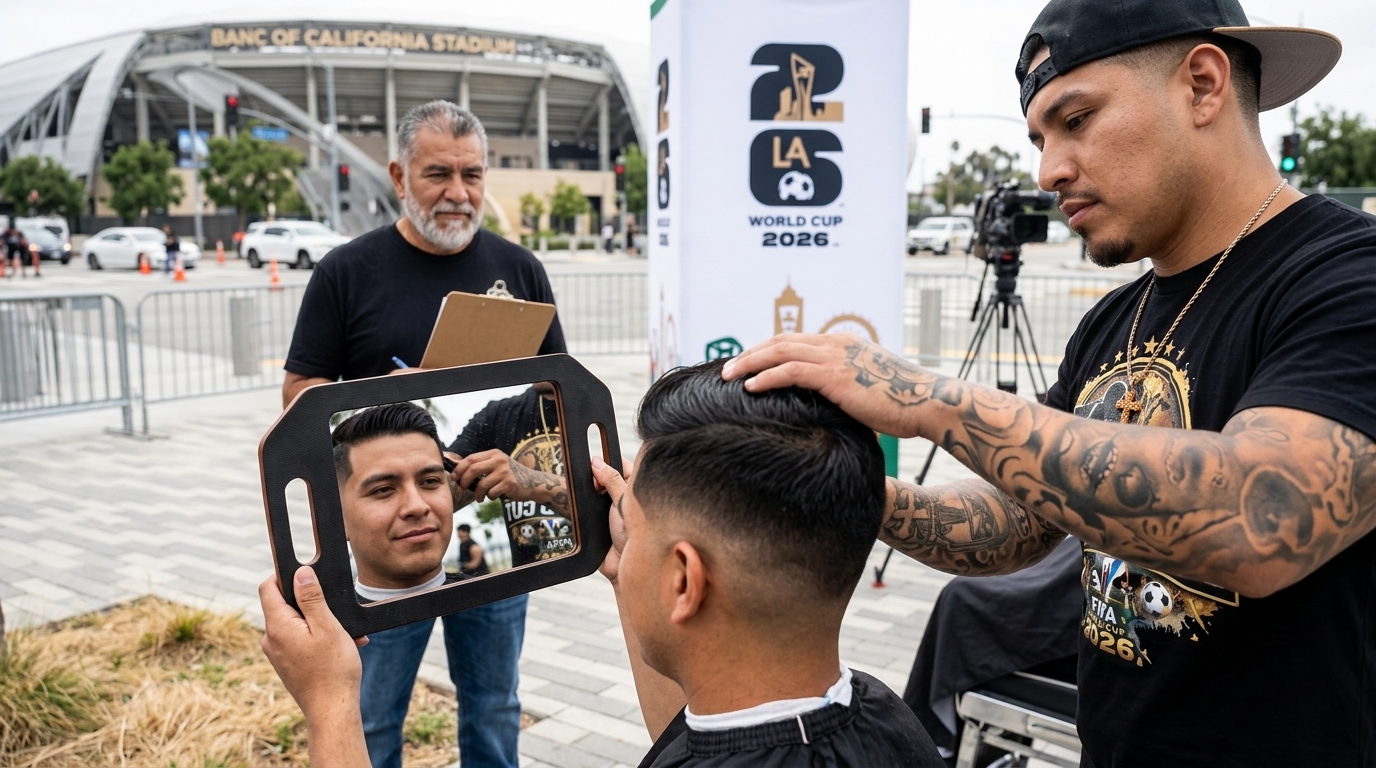
As the 2026 FIFA World Cup reaches its crescendo across the United States, Los Angeles has become a global epicenter of athletic spectacle. However, just a few blocks away from the futuristic gleam of SoFi Stadium in Inglewood, a different story is being written—not with goals and cheers, but with the rhythmic click-clack of shears and the scent of talcum powder. David Arias, a barber who knows all too well what it means to be on the margins, has transformed his shop into a beacon of hope for those society often chooses to forget.
The Art of the Cut as a Bridge to Reintegration
For Arias, cutting hair is not merely a service; it is a ritual of restoring dignity. Having personally navigated the challenges of the correctional system and the hurdles of returning to normalcy, he decided to use his business as a platform for a deeper social mission. In the context of the 2026 World Cup, where the eyes of billions are fixed on his neighborhood, Arias launched an initiative providing free training in the art of barbering to formerly incarcerated individuals and homeless youth.
"Football teaches us that there is always a second half," Arias says while meticulously grooming a client. "Many of the people who come here feel like their game is already over. We show them they can still change the score." His approach is holistic: the barbershop functions as a safe space where discussions about football matches evolve into deeper confessions, mentorship, and psychological support.
The Contrast Between Glamour and Reality
The World Cup's presence in Inglewood is a double-edged sword. On one hand, the economic activity and global exposure are unprecedented. On the other, the threat of aggressive gentrification looms, potentially displacing the very communities that form the soul of the area. Arias is acutely aware of this. "We see the billions flowing around the stadium, but how much of that actually reaches the people who have lived here for decades?" he asks pointedly.
Through partnerships with local NGOs and support garnered from social responsibility programs linked to the tournament, he has managed to expand his program. His apprentices don't just learn how to handle clippers and razors; they learn business management, communication skills, and most importantly, how to believe in themselves again. The success of the program is reflected in the faces of its graduates, many of whom have already opened their own small businesses or are working in top-tier shops across the city.
Football as a Catalyst for Social Change
Choosing the World Cup as a temporal milestone was no accident. The energy radiating from the event is infectious. Arias hosts "football nights" at his shop, where watching the matches is paired with career guidance workshops. He uses the structure of a football team—discipline, strategy, and solidarity—as a model for the personal development of his mentees.
The message of the "second chance" broadcast by Arias has reached the ears of FIFA organizers, who included his story in a documentary about the tournament's social impact. However, for David himself, the greatest reward isn't the publicity; it's the moment a young person looks in the mirror after a haircut and sees, for the first time in years, a person with a future.
In an era where professional sports are often accused of being detached from social reality, cases like David Arias remind us that the true power of football lies outside the stadium lines. It lies in its ability to unite, inspire, and ultimately provide the tools for a fresh start. As the 2026 World Cup moves toward its grand finale, the legacy it leaves in Inglewood may not be measured in trophies, but in the lives transformed inside a small, buzzing barbershop.