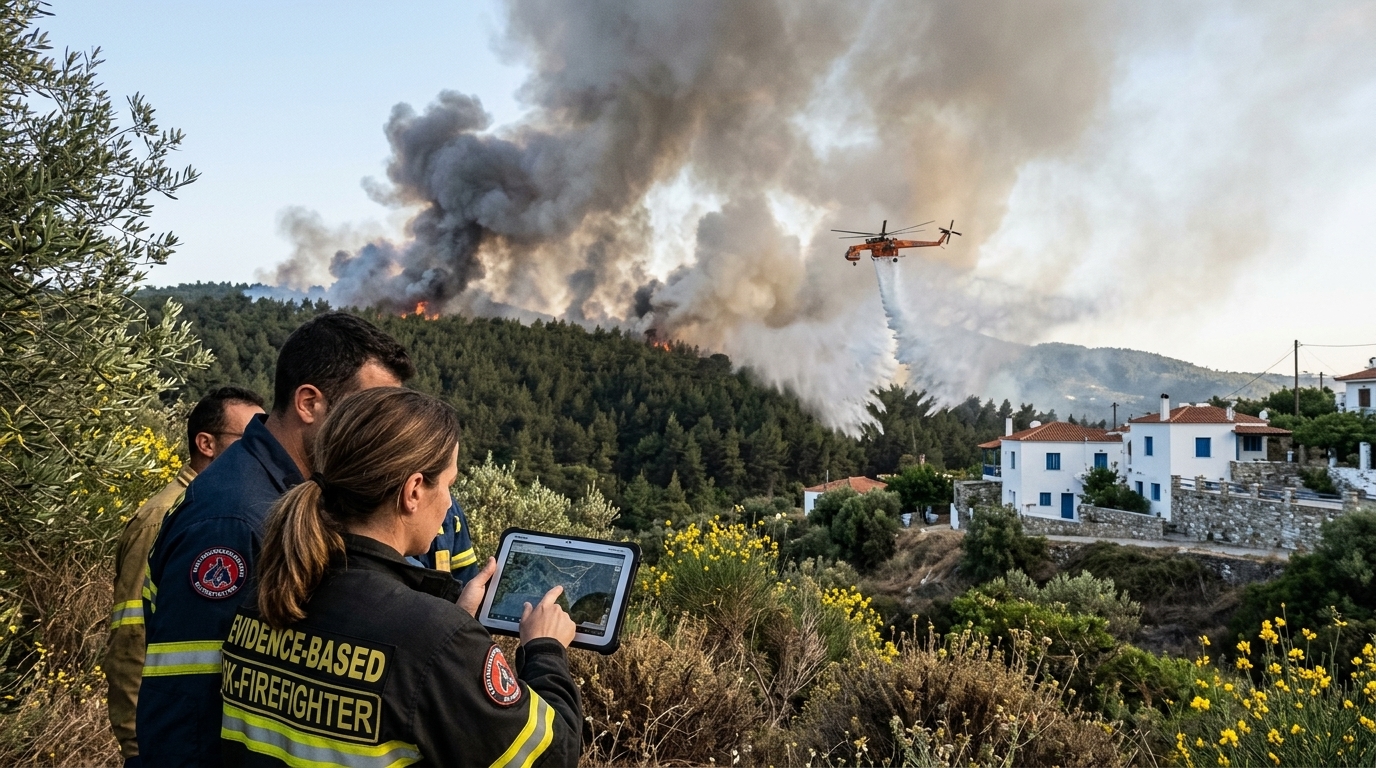
The news of a wildfire breaking out in a forested area of Skiathos late Sunday afternoon, April 19, is not merely a local incident; it is a loud wake-up call for the beginning of a season that no longer respects calendar boundaries. The immediate mobilization of firefighting forces, both ground units and the island's volunteer teams, prevented the worst. However, the fact that we are still in mid-spring is causing intense concern among scientists and civil protection authorities.
The Uniqueness of the Sporades Ecosystem
Skiathos, internationally renowned for its dense stone pine forests and lush green hillsides, possesses an ecosystem that is extremely sensitive to wildfires. The dominance of Aleppo pine (Pinus halepensis), a species evolutionarily adapted to fire but also highly flammable due to its resin, makes every spark potentially catastrophic. The island's geography, with steep slopes and a road network that often hinders access to pristine forests, demands a strategy based less on suppression and more on early detection.
According to reports, the fire broke out in an area with low vegetation and trees, but prevailing winds threatened to push it further inland. The success of the operation relied on speed. Nevertheless, climate change has altered the parameters: winters are now drier, and spring temperatures increasingly resemble early summer, reducing moisture levels in forest fuels.
AI and Prevention: The New Frontier
Within the context of 'The AI Chronicle,' we must examine how technology can change the game in managing such crises. The Skiathos case highlights the need for a 'smart' protection network. Globally, machine learning algorithms are already being used to analyze satellite data in real-time to detect thermal signatures before the first flames are even visible to the human eye.
- Thermal Camera Drones: Using unmanned aerial vehicles to patrol sensitive areas like Skiathos can provide 24/7 surveillance, even in low-visibility conditions.
- IoT Sensors: Deploying ground sensors that measure humidity, temperature, and carbon monoxide levels can create a hyper-local early warning system.
- Predictive Spread Models: AI can predict a fire's trajectory by accounting for topography and meteorological conditions, allowing authorities to deploy forces proactively at critical junctions.
Greece has begun investing in programs like 'AEGIS,' which aims to modernize Civil Protection. However, integrating these tools at a local level, such as within island municipalities, remains the ultimate challenge.
Economic and Social Implications
A wildfire in Skiathos is not just an environmental blow; it is an economic one. Tourism is the backbone of the local economy. The image of a charred landscape can deter visitors for years. Furthermore, the cost of restoration and the subsequent anti-flooding works required after a fire is many times higher than the cost of prevention. Social responsibility also plays a decisive role. Educating citizens and tourists about the risks, especially during a period traditionally considered 'safe,' is essential. The April 19 fire reminds us that readiness must be constant, and investing in cutting-edge technology is not a luxury, but a necessity for survival.
"Nature does not wait for summer to warn us. Technology is our shield, but political will is the hand that holds it."
In conclusion, the wildfire in Skiathos should be treated as a lesson. Its successful extinction is a victory for those on the ground, but the frequency of such phenomena requires a radical rethink of our fire protection model, with Artificial Intelligence at the core of our strategy.