Hannover Messe, the world's leading industrial trade fair, has once again opened its gates for 2026, serving as the definitive barometer for global technological evolution. At this pivotal crossroads of innovation, the presence of Stergios Kalogiros and Vergina News underscores a significant shift: Greek media is no longer confined to narrow national borders but is actively seeking answers for tomorrow where the future is being forged. This year's event, themed "Energizing a Sustainable Industry," places Artificial Intelligence (AI) and Robotics at the forefront—no longer as experimental applications, but as the backbone of the global economy.
AI as the New Electricity of Industry
Walking through the vast halls of the Hannover Exhibition Center, it becomes clear that AI is far more than a buzzword. It is the invisible maestro coordinating entire production lines. Stergios Kalogiros, through his on-the-ground reporting, highlights how Generative AI has leaped from creating text and images to designing industrial components and optimizing energy grids. Technology giants, in collaboration with traditional industrial powerhouses, are showcasing systems capable of predicting equipment failure before it occurs, saving billions in maintenance costs.
Particularly impressive is the integration of Large Language Models (LLMs) into human-machine interfaces. Today, factory workers no longer need to master complex programming languages; they can issue voice commands to robotic systems or request data analysis in natural language. This democratization of technology is a key observation of the Greek mission, as it offers countries like Greece the opportunity to close the productivity gap through smart specialization.
Robotics 2.0: From Automation to Autonomy
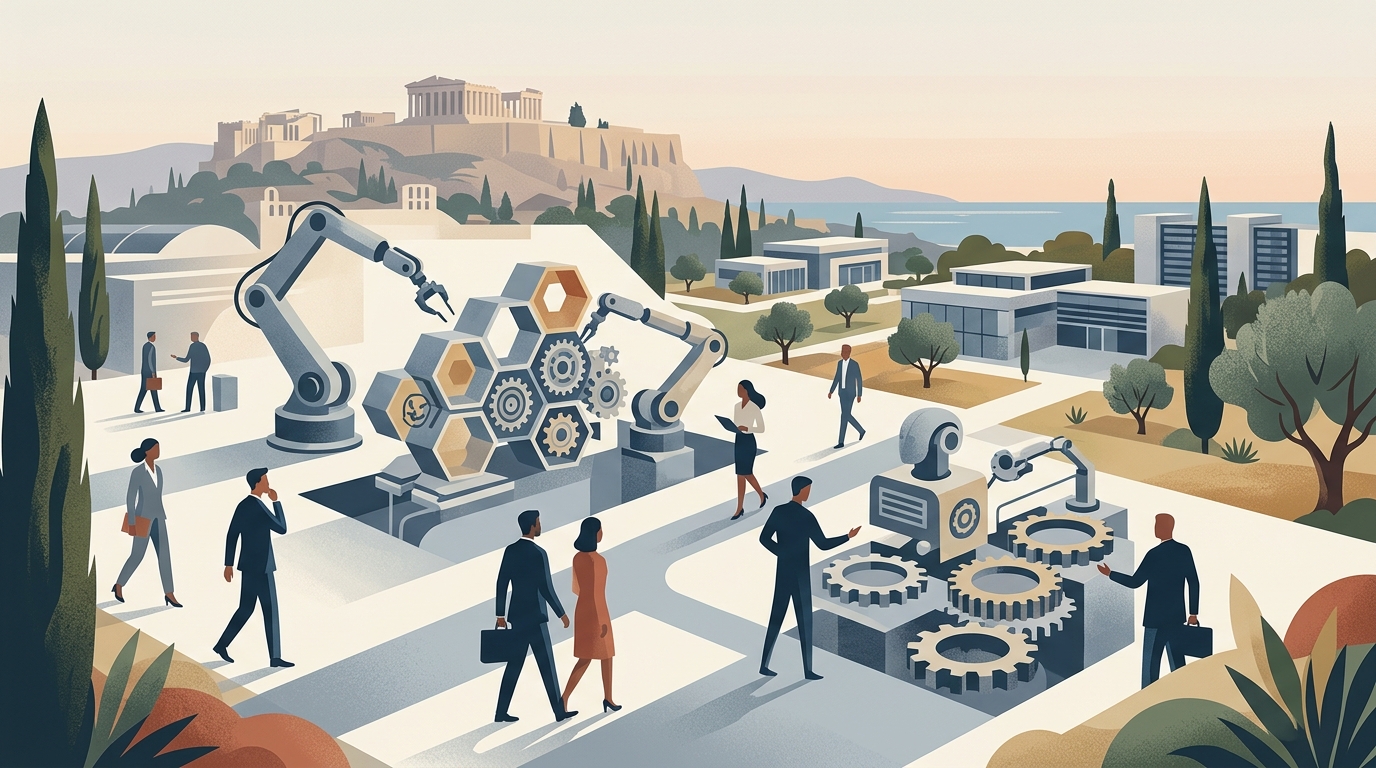
If the previous decade was characterized by robots performing repetitive tasks behind safety cages, 2026 marks the era of Cobots (collaborative robots) and humanoids. At Hannover Messe, we witnessed robots equipped with advanced haptic feedback and neural-network-based vision, capable of working alongside humans with absolute safety. Kalogiros focuses on the social dimension of this evolution: robotics is not meant to replace humans but to liberate them from dangerous and unhealthy tasks, elevating their role to that of supervisor and creator.
"Technology is not an end in itself, but a means to a more just and prosperous society. Here in Hannover, we see the future happening now, and Greece must be present, not as an observer, but as a participant," Kalogiros noted in his dispatches.
The progress in autonomous navigation within factories (AMRs - Autonomous Mobile Robots) is equally stunning. These systems now possess "swarm intelligence," exchanging real-time information to avoid obstacles and optimize logistics routes, drastically reducing the carbon footprint of industrial transportation.
Greece and the Industry 5.0 Challenge
The presence of Vergina News at such a global gathering raises a crucial question: Where does Greece stand on this map? While Greece may not possess a heavy machine-tool manufacturing industry, it boasts an exceptionally dynamic ecosystem of startups and research centers excelling in AI software and robotic design. Hannover Messe 2026 demonstrates that value is shifting from hardware to software—from "iron" to "intellect."
According to Kalogiros's analysis, the challenge for the Greek state and business community lies in the rapid adoption of these technologies to revitalize the Greek provinces. "Industry 5.0," which emphasizes human well-being and sustainability, perfectly aligns with the Greek model of small and medium-sized enterprises (SMEs) seeking qualitative excellence over mass production.
- AI integration is reducing industrial energy consumption by up to 30%.
- Collaborative robots are becoming increasingly affordable for SMEs.
- Cybersecurity is emerging as a dominant issue for protecting industrial data.
- Workforce upskilling remains the most critical factor for success.
In conclusion, Hannover Messe 2026 is not just a machinery exhibition; it is a manifesto for how technology can serve humanity. Journalistic coverage of such events is essential to break through provincialism and understand that 21st-century competition is not fought with the tools of the past, but with intelligence and adaptability.