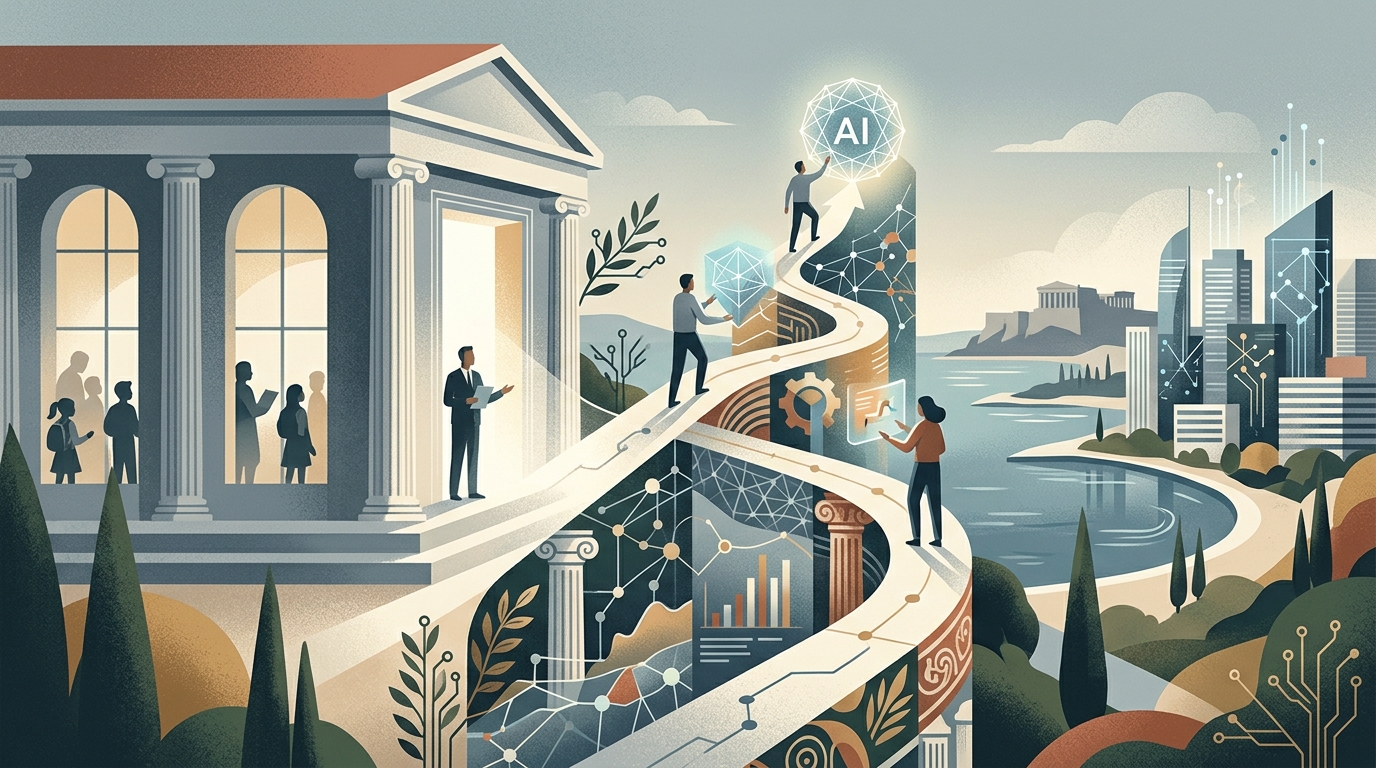
In an era where technological advancement often outpaces institutional capacity, the Greek government is attempting a bold leap into the future. Prime Minister Kyriakos Mitsotakis, during a recent visit to the Ministry of Education, Religious Affairs, and Sports, set 2030 as the milestone year for the full integration of Artificial Intelligence (AI) into the Greek school system. This is not merely about introducing new computers; it is a radical overhaul of the pedagogical process, centered on teacher training and the use of personalized learning tools.
The Teacher as a Navigator in the Digital Age
The key to the success of any educational reform is not the technology itself, but the people called upon to use it. The government's plan envisions a broad training program for more than 150,000 educators across all levels. The goal is for teachers and professors not to feel threatened by AI, but to utilize it as a "digital assistant" that will relieve them of administrative burdens and allow them to focus on the essential transmission of knowledge.
As the Prime Minister emphasized, AI can help educators identify the learning gaps of each student more quickly. Imagine a system that analyzes the performance of a class and suggests different approaches to the teacher for students who are struggling, or additional material for those who are advancing faster. This "personalized learning" is the holy grail of modern pedagogy, and AI is the means to achieve it at scale.
New Tools and Digital Transformation
By 2030, Greek schools are expected to be fully equipped with tools that today seem futuristic. The introduction of the "Digital Tutor," a tool that will provide support to students outside school hours, is just the beginning. The plan includes:
- Interactive Learning Systems: Applications using Generative AI to create educational scenarios in real-time.
- Infrastructure Upgrades: Installation of fiber optics in all schools and provision of modern equipment in every classroom.
- Assessment Platforms: Tools that will assist in the transparent and fair evaluation of students, reducing subjectivity.
"AI is not going to replace the teacher. However, the teacher who uses AI will replace the teacher who does not," Mitsotakis noted, highlighting the necessity for adaptation.
Challenges and Ethical Dilemmas
Of course, the path to 2030 is not without obstacles. The digital divide remains a reality in Greece, with remote areas lagging in infrastructure. Furthermore, the use of AI in education raises serious questions regarding the protection of minors' personal data and the possibility of algorithmic bias. The government maintains that the framework will be fully aligned with the European Union's AI Act, ensuring that technology remains "human-centric."
Another issue is critical thinking. In a world where information is generated automatically, schools must teach students how to evaluate the validity of sources and how to use AI creatively rather than passively. Therefore, the reform is not just about tools, but also about the curriculum, which must emphasize "soft skills" and the ethics of technology.
Conclusion: A Stake for the Generation of 2030
The commitment to 2030 is ambitious and requires consistency, resources, and, above all, the consensus of the educational community. If Greece manages to modernize its educational system, it will be able to provide future generations with the tools to compete in a globalized environment. AI in schools is not a luxury; it is the new basic skill, equivalent to reading and writing in the 20th century. The question is not whether it will happen, but whether we will be ready to manage it for the benefit of students and society.