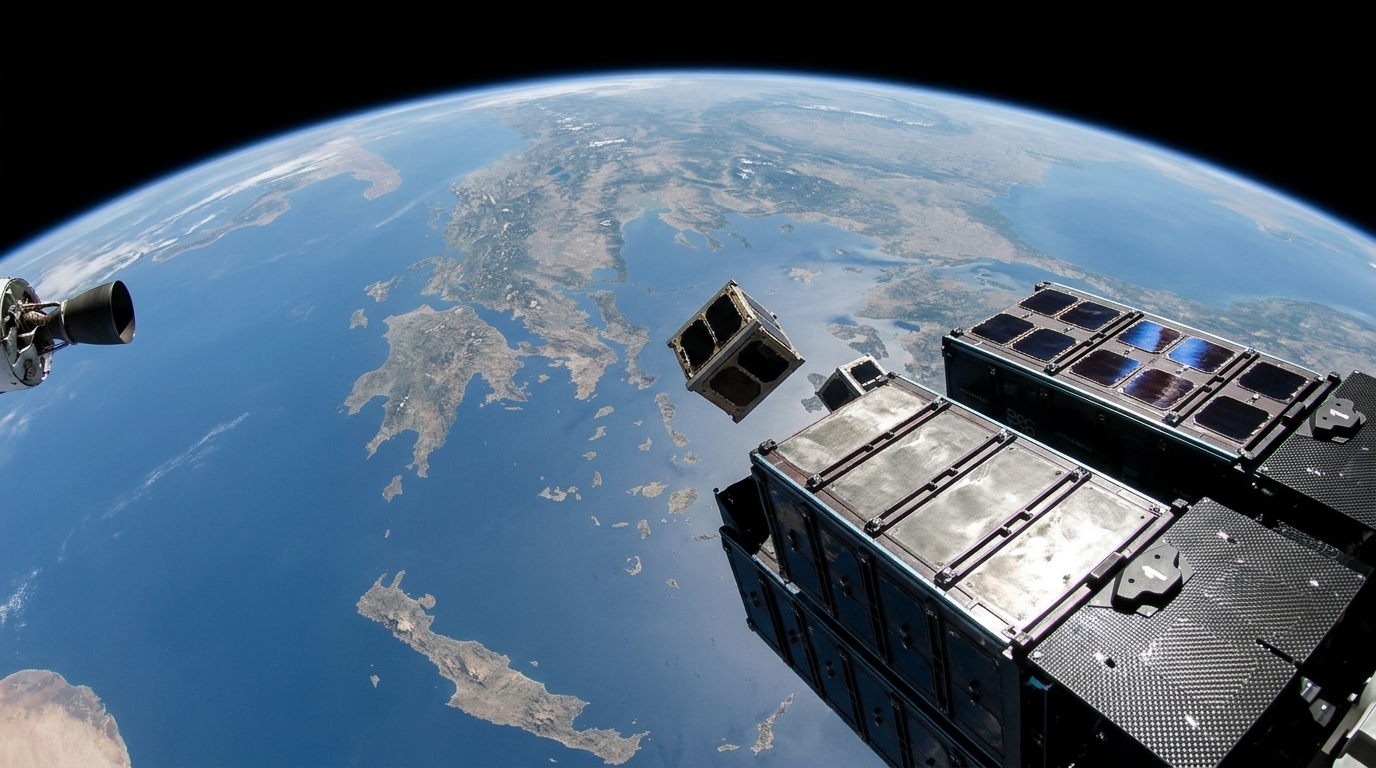
The launch of Hyperion GR-1 is not merely a technical success; it is a milestone in the history of modern Greece. For the first time, the nation possesses its own "eyes" in space, liberating its capabilities from reliance on external data providers. The microsatellite, part of the National Microsatellite Program, has been successfully deployed into orbit, marking Greece's official entry into the "New Space" era.
This project, implemented under the supervision of the Ministry of Digital Governance and the Hellenic Space Center (HSC), with the support of the European Space Agency (ESA), aims to provide high-resolution optical data. In an age where the climate crisis hits the Mediterranean with unprecedented severity, possessing such tools becomes a dire necessity rather than a luxury.
Strategic Importance for Civil Protection
The primary role of Hyperion GR-1 is to bolster Civil Protection. With the ability to capture images in real-time or with minimal latency, Greek authorities can now monitor the progression of wildfires, floods, and other natural disasters with centimeter-level precision. This allows for better coordination of ground and aerial forces, targeted evacuations, and immediate damage assessment.
- Monitoring fire fronts in inaccessible terrains.
- Mapping flooded areas for rapid relief efforts.
- Surveillance of critical infrastructure, such as dams and energy grids.
"Hyperion GR-1 is not just a satellite; it is a national shield that allows us to see danger before it reaches our doorstep," stated a senior official from the Ministry of Digital Governance.
Precision Agriculture and Environmental Management
Beyond security, the economic sector expected to benefit most is primary production. Precision agriculture relies on data. Hyperion GR-1 will provide Greek farmers and agribusinesses with information on soil moisture, crop health, and the need for fertilization or irrigation. This translates into reduced production costs, conservation of water resources, and environmental protection from excessive chemical use.
Furthermore, maritime surveillance is significantly enhanced. In a country with thousands of kilometers of coastline, controlling illegal fishing, monitoring maritime pollution (such as oil spills), and protecting maritime borders gain a new, invincible ally. The satellite's ability to distinguish vessels and activities over vast distances offers a strategic advantage to the Coast Guard.
Development of the Greek Space Ecosystem
The construction and management of Hyperion GR-1 is not an isolated activity. It has sparked the growth of an entire ecosystem of technology companies in Greece. Through this program, Greek aerospace firms participated in the design, assembly, and testing of subsystems, creating high-skill jobs and curbing brain drain.
The investment, largely funded by the Recovery and Resilience Facility, is part of a broader plan involving the creation of a microsatellite constellation. This constellation will ensure that Greece has continuous coverage, regardless of weather conditions or time of day, using a combination of optical and radar (SAR) sensors.
Challenges and Future Prospects
Despite the excitement, challenges remain. Managing the massive volume of data (Big Data) that Hyperion GR-1 will produce requires advanced computing infrastructure and artificial intelligence for analysis. Greece must invest in "ground segments" capable of converting raw images into actionable information for end-users.
In conclusion, Hyperion GR-1 places Greece on the global map of space technology. This is not just a prestige achievement, but a substantive tool that will improve citizens' daily lives, protect the natural environment, and fortify national security in an increasingly uncertain geopolitical landscape.