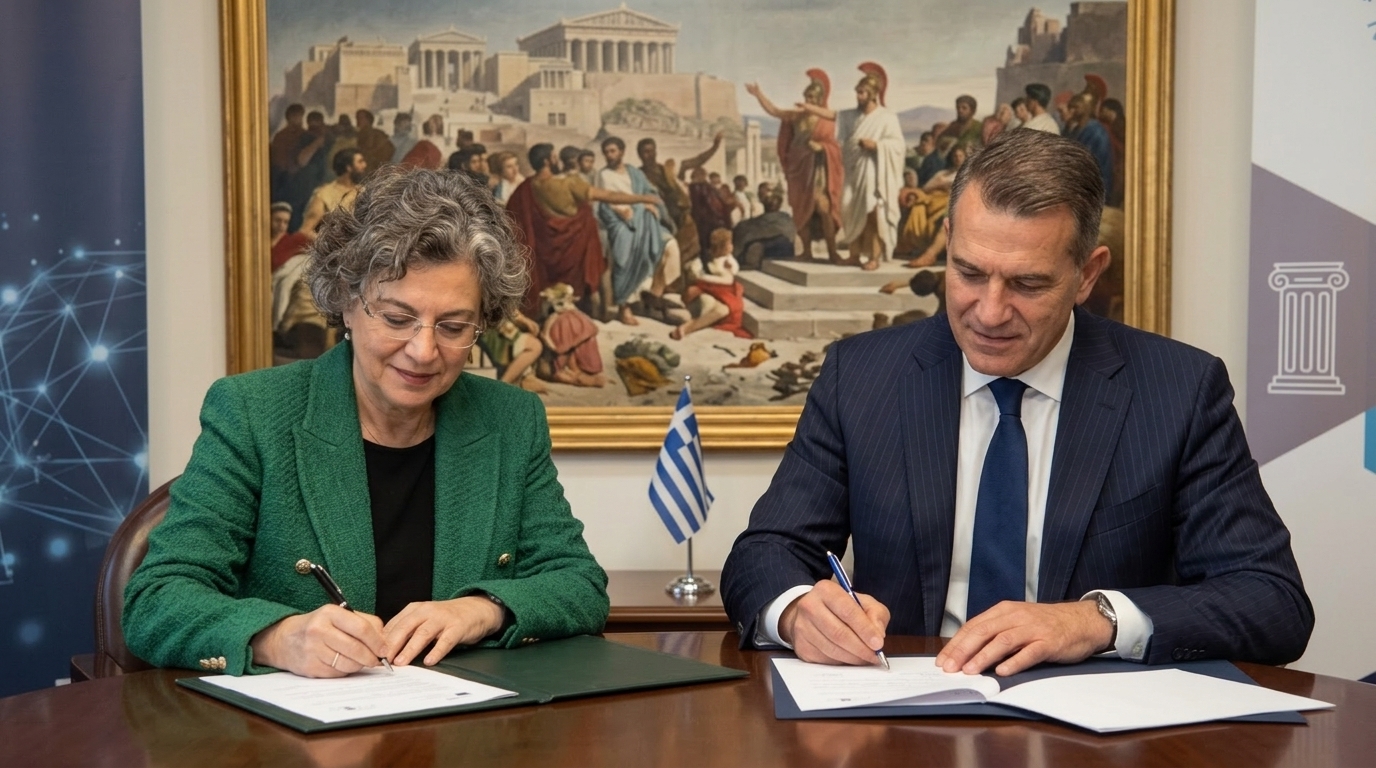
In an era where digital convergence and data utilization represent the 'holy grail' of public administration, the Independent Authority for Public Revenue (AADE) and the University of West Attica (UNIWA) have taken a step with a profound strategic footprint. The signing of the Memorandum of Cooperation between the Governor of AADE, Georgios Pitsilis, and the Rector of UNIWA, Professor Panagiotis Kaldis, is not merely a formal administrative act, but the starting point of an effort to bridge the gap between academic theory and the harsh operational reality of tax administration.
The Architecture of Cooperation: Pillars and Objectives
The memorandum is based on three central pillars: education, research, and innovation. At its heart lies the need for continuous training of AADE staff, who are called upon to manage increasingly complex digital tools. Through specialized lifelong learning programs designed by UNIWA, the Authority's employees will have access to cutting-edge expertise in fields such as Data Analytics, Cybersecurity, and Digital Governance.
On the other hand, connecting students with AADE offers a unique opportunity for internships in a rapidly transforming environment. Students from UNIWA's departments of Informatics, Business Administration, and Accounting will have the chance to see firsthand how their theoretical knowledge is applied in large-scale systems, while AADE will be able to draw 'new blood' with fresh ideas and modern skills.
TaxTech: Artificial Intelligence at the Service of Revenue
One of the most interesting aspects of the cooperation is the joint action in the field of research. AADE has already begun using algorithms to detect tax evasion and monitor transfer pricing. The partnership with UNIWA is expected to accelerate the development of TaxTech (Tax Technology) tools. The university's research community can provide valuable predictive analytics models that will help AADE anticipate tax evasion trends before they become established.
- Development of machine learning algorithms to identify suspicious transaction patterns.
- Studies on optimizing user experience (UX) on AADE's digital platforms.
- Design of systems for the secure management and exchange of Big Data.
The use of Artificial Intelligence is not only about enforcement but also about service. Improving digital assistants (chatbots) and automating responses to frequent taxpayer queries are areas where academic expertise can make a difference, reducing bureaucracy and the burden on citizens.
Social Impact and Institutional Maturity
The choice of the University of West Attica is not accidental. As one of the fastest-growing institutions in the country, with a strong orientation towards applied sciences, UNIWA represents the new generation of Greek universities seeking extroversion. For AADE, this cooperation is part of a broader strategy to create an innovation ecosystem around public administration.
"Investing in knowledge and technology is the only way to a modern, fair, and efficient tax administration," stated Georgios Pitsilis during the signing ceremony.
In a country where the relationship between the state and universities has traditionally been cold or limited to a theoretical level, such initiatives show a path of institutional maturity. The creation of joint laboratories and the organization of conferences will allow for a continuous exchange of views, making Greece a participant in international developments in the field of GovTech.
Challenges and Prospects
Of course, the success of such a memorandum is judged by its implementation. The challenge lies in the absorption of innovation by a traditionally sluggish public mechanism. However, AADE has proven in recent years that it possesses the political will and technical capacity to implement large-scale digital projects. The synergy with UNIWA adds the necessary academic depth and research validity required for the Greek tax administration to move into the next phase of its evolution.