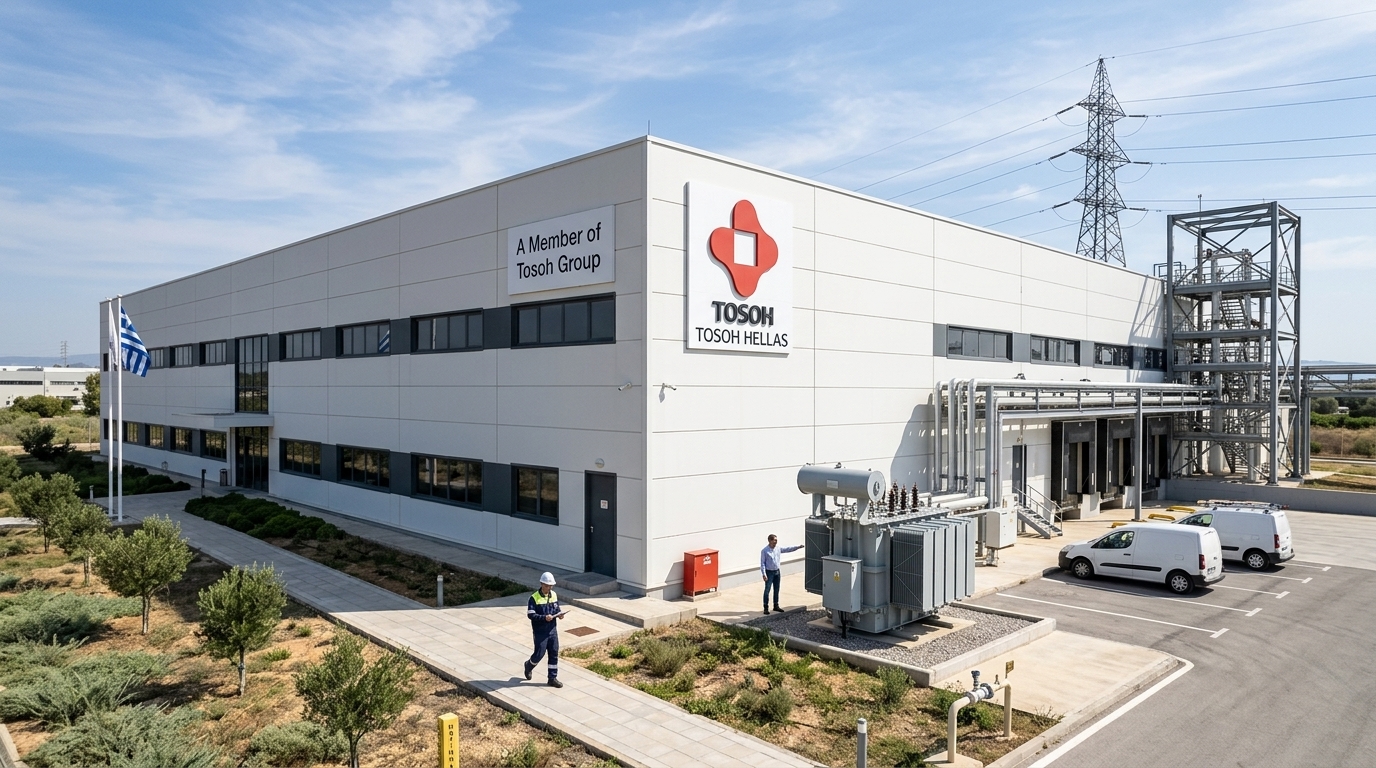
In the heart of the Industrial Area of Sindos, far from the media spotlight of Athens, a quiet yet decisive shift is occurring in the map of European industry. Tosoh Hellas, the Greek subsidiary of the Japanese giant Tosoh Corporation, is no longer just a successful export unit; it has become a symbol of the new geopolitical reality: the West's attempt to decouple from Chinese dominance in critical raw materials.
The Strategic Importance of Electrolytic Manganese Dioxide (EMD)
The primary product of Tosoh Hellas is Electrolytic Manganese Dioxide (EMD), a material vital for the manufacturing of dry-cell (alkaline) batteries and the burgeoning lithium-ion battery market. As the European Union and the US escalate trade pressure on Beijing by imposing tariffs and restrictions, the demand for "non-Chinese" manganese has skyrocketed. Sindos, home to the only EMD production plant in Europe, suddenly finds itself at the center of European energy security.
The company's recent financial report for 2025 confirms this trend. With a turnover reaching €50.39 million, a 3% increase from the previous year, Tosoh Hellas shows remarkable resilience. However, the most striking figure is the 20% jump in gross profits, which reached €12.91 million. This disparity between turnover and profitability suggests two things: increased operational efficiency and, more importantly, the company's ability to exert pricing power in a market desperately seeking alternative sources outside of China.
The Friend-shoring Phenomenon and Thessaloniki
The term "friend-shoring" describes the relocation of production activities to countries considered geopolitically safe and friendly. Greece, as a member of the EU and NATO, offers exactly this sanctuary for Japanese Tosoh. In a world where supply chains are being weaponized by major powers, Tosoh's continued presence and expansion in Thessaloniki serve as a vote of confidence in the region's stability.
- Export Orientation: Over 90% of production is directed to international markets, strengthening the country's trade balance.
- Technological Superiority: The Sindos plant utilizes advanced electrolysis methods that meet strict EU environmental standards, something Chinese competitors often struggle to match.
- Local Employment: The company supports hundreds of high-skill jobs in Northern Greece, acting as a bulwark against the "brain drain."
Despite the success, challenges remain. Energy costs in Greece remain among the highest in Europe, weighing heavily on an industry that relies on electrolysis—an extremely energy-intensive process. The ability of Tosoh Hellas to maintain its profitability depends directly on stabilizing energy prices and adopting "green" solutions, such as self-generation from renewable energy sources.
The Geopolitical Chessboard and the Future
The case of Tosoh Hellas highlights a broader shift in the global economic paradigm. With the EU's Critical Raw Materials Act, Europe aims to ensure that at least 10% of the annual consumption of strategic raw materials is mined within the Union and 40% is processed within it. Tosoh Hellas is already "there," ready to fill this gap.
"Success in Sindos is not just financial; it is proof that European industry can be competitive when it combines Japanese methodology with Greek talent and strategic geographical positioning," market analysts note.
In conclusion, Sindos's "victory" in the trade war with China is no accident. It is the result of a long-term investment that found the perfect timing in an era of de-globalization. For Greece, the challenge is to create the infrastructure that will attract more "Tosohs," turning Northern Greece into a production hub for materials essential to the green transition.