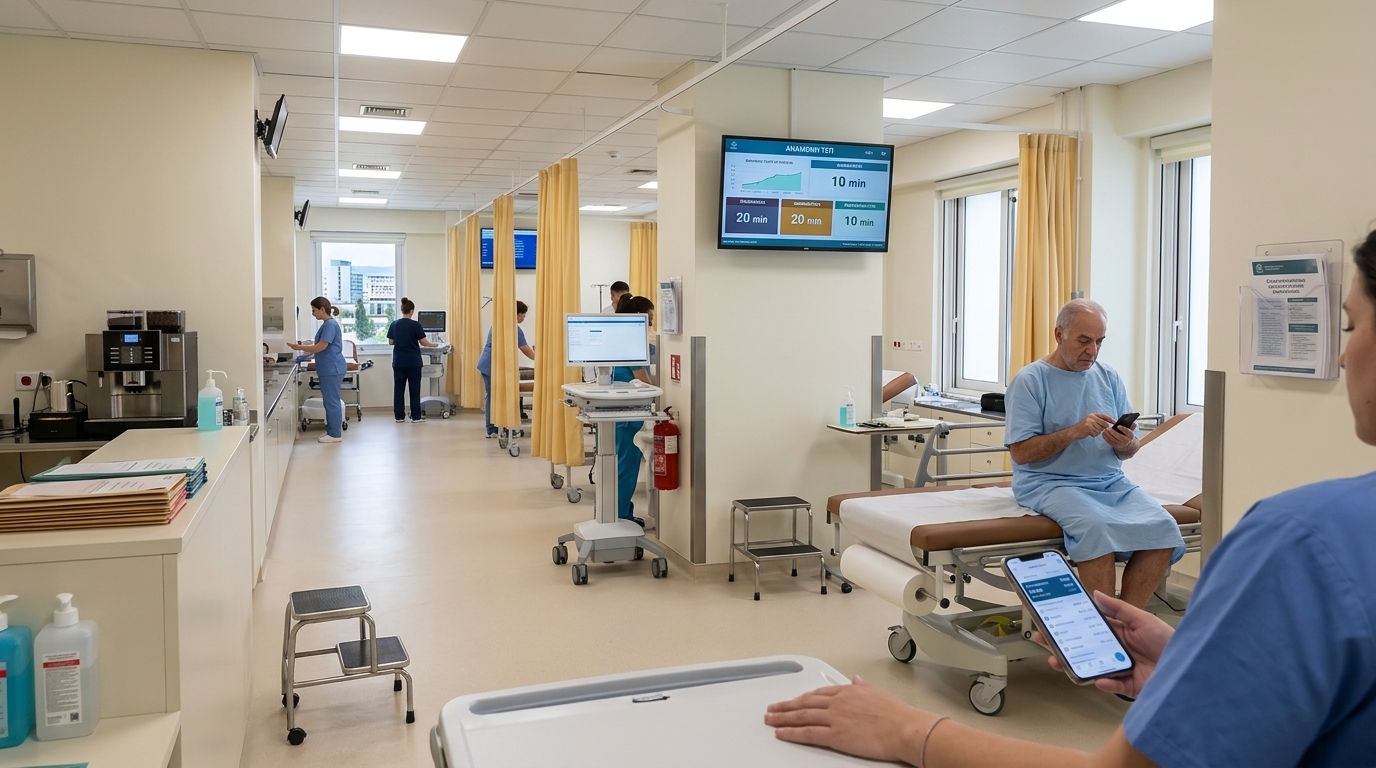
The sight of overcrowded corridors in Greece's public hospitals, with patients and relatives waiting for hours without any information on when they will be seen, is one of the most persistent ailments of the National Health System (ESY). However, a new digital initiative recently announced promises to bring transparency and organization to the palm of every citizen's hand. By the end of 2026, waiting times in the Emergency Departments (ER) of on-call hospitals will be available in real-time via a mobile application.
The Digital Transition of Emergency Departments
Implementing this project is not merely a technical upgrade but a structural change in how the state interacts with the patient. The system will be fed with data directly from hospital information systems, recording the moment of patient entry, the triage process, and the time elapsed until the final examination by the on-call physician. The core idea is to decongest major hospitals in Athens and Thessaloniki by allowing citizens to choose healthcare units with a lighter workload, provided their condition permits.
According to the announcements, the application will be integrated into the 'MyHealth' ecosystem, which already serves as the central pillar of the digital medical record in Greece. This feature will be accompanied by a navigation map showing the nearest on-call hospitals, the distance, and, most importantly, the estimated waiting time per specialty. For instance, a citizen with an orthopedic issue can see if the wait at KAT Hospital is three hours, while at another on-call hospital, it is only forty minutes.
Challenges and Systemic Hurdles
Despite the optimism exuded by this digital reform, analysts and healthcare representatives express reservations. The primary argument is that digitizing the wait does not necessarily mean reducing it. The ER problem in Greece is multi-factorial: staffing shortages, the under-functioning of Primary Healthcare, and a culture where citizens flock to hospitals even for cases that could be handled at a local Health Center.
- Data Accuracy: If ER staff are overwhelmed, the correct and timely entry of data into the system might take a backseat to clinical priorities.
- Flow Management: There is a risk that if a hospital appears 'empty,' it might suddenly receive a massive wave of patients, causing wait times to skyrocket before the app can update.
- Hospital Infrastructure: Many hospitals still operate with outdated IT systems that require radical upgrades to communicate with the central platform.
Funding from the Recovery Fund
This project is part of a broader digital health transformation package, largely funded by the Recovery and Resilience Facility (RRF). Greece has committed significant resources to the 'Digital Transformation of Health,' which includes upgrading IT infrastructure in over 120 hospitals. This strategy aims to create a unified data network where the patient's medical record is accessible from any point in the system, reducing redundant tests and bureaucracy.
"Digitization is not an end in itself, but the means to respect the time and dignity of the citizen," government sources state.
In the long run, the system is expected to provide statistical data to the Ministry of Health leadership, allowing for better allocation of resources and personnel based on real-time needs. If, for example, a hospital consistently shows long wait times on weekends, it could be reinforced with extra shifts or equipment.
Conclusion: A Step Towards Modernization
The application for monitoring wait times is an essential tool for any modern state. In the UK and Nordic countries, such systems have been operational for years, contributing to better crisis management in emergencies. For Greece, the challenge is two-fold: on one hand, the technical excellence of the application, and on the other, the substantial strengthening of the ESY with human resources. Without doctors and nurses, the app will merely record the collapse of a system in 'live broadcast.' However, transparency is always the first step toward improvement, and access to information is a fundamental right of the patient in the 21st century.