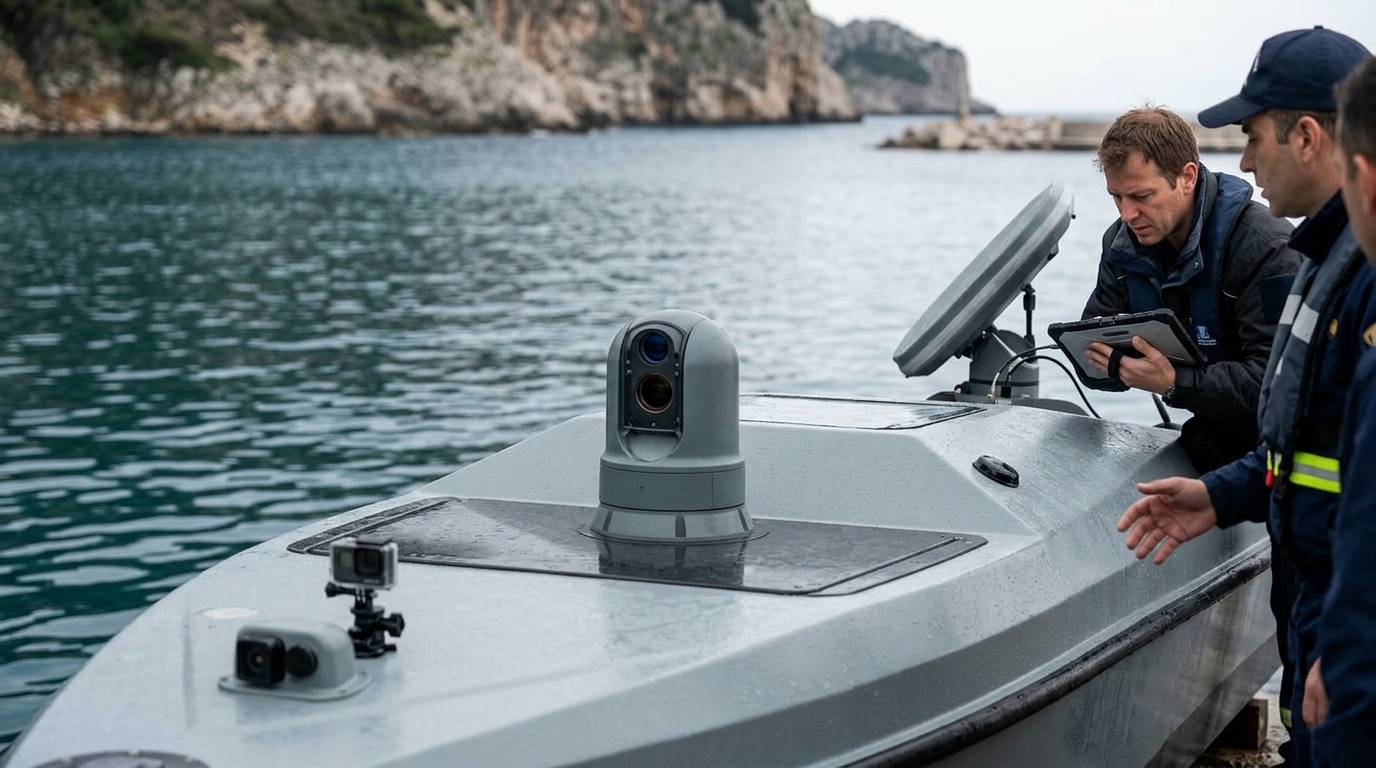
The tranquility of the Ionian Sea was violently disrupted recently, not by a natural storm, but by a discovery that reads like a scene from a spy thriller. Reports that fishermen off the coast of Lefkada discovered an unmanned surface vehicle (USV), which according to sources was "loaded" with explosives, have put Greek security forces and the military on high alert. This incident is not just local news; it is a loud wake-up call regarding the new reality of maritime threats in the Mediterranean.
Anatomy of a Threat: What We Know About the "Ghost Drone"
The vessel, described as a low-profile, semi-submersible drone, was found drifting unmanned. Initial images suggested a technologically sophisticated craft designed to evade radar detection. The presence of explosives inside indicates that it was not a simple research tool but a "kamikaze" weapon, similar to those used extensively in recent conflicts in the Black Sea and the Red Sea.
According to expert analysis, such vessels are often modified jet-skis or custom-built carbon fiber hulls equipped with high-definition cameras, satellite connectivity (such as Starlink), and motion sensors. The fact that it was found in Lefkada, an area far from current war fronts, raises intense concerns. Was it a vessel that lost its orientation due to technical failure? Was it part of an exercise gone wrong? Or is it an indication that hybrid warfare is expanding into areas previously considered "safe"?
Geopolitical Questions and the Strategic Importance of the Ionian
The Ionian Sea is a critical corridor for navigation and hosts significant infrastructure, as well as being close to NATO bases in Italy. The appearance of an armed drone in these waters opens a Pandora's box for national security. Authorities are examining all possibilities: from the actions of state actors wishing to test Greek defense reflexes, to the use of such means by criminal organizations or terrorist groups.
"The sea is no longer just a field of commerce, but an arena of invisible warfare where the cost of entry has dropped dramatically," says a senior Coast Guard officer.
The difficulty in detecting these vessels lies in their small size and their ability to sail almost beneath the water's surface. For Greece, a country with thousands of kilometers of coastline, the challenge is enormous. The Lefkada incident proves that border surveillance must now integrate advanced anti-drone systems (C-UAS) and underwater radar, as traditional means appear insufficient against these asymmetric threats.
The Democratization of Naval Warfare
What we are witnessing is the "democratization" of naval power. In the past, only states with powerful navies could project power at sea. Today, with a few tens of thousands of euros and access to cutting-edge technology, anyone can build a lethal weapon capable of sinking a frigate or striking critical infrastructure. The Lefkada drone is a symptom of a global trend where autonomy and remote control are changing the rules of the game.
The analysis of the vessel's remains and its electronic circuits by forensic laboratories and the General Staff will provide answers. However, the political message is already clear: security in the Mediterranean is fragile. Greece is called upon to lead developments in European security by developing its own surveillance networks and working closely with its allies to counter this "invisible" threat that washed up on its shores.
- The need for an immediate upgrade of coastal surveillance systems.
- Strengthening cooperation between the Coast Guard and the Navy.
- International cooperation to track the origin of drone components.
- Informing citizens and fishermen on how to identify suspicious objects.
In a rapidly changing world, Lefkada reminded us that the war of the future will not be announced with fanfare, but may appear silently, like a "ghost" in our crystal-clear waters.