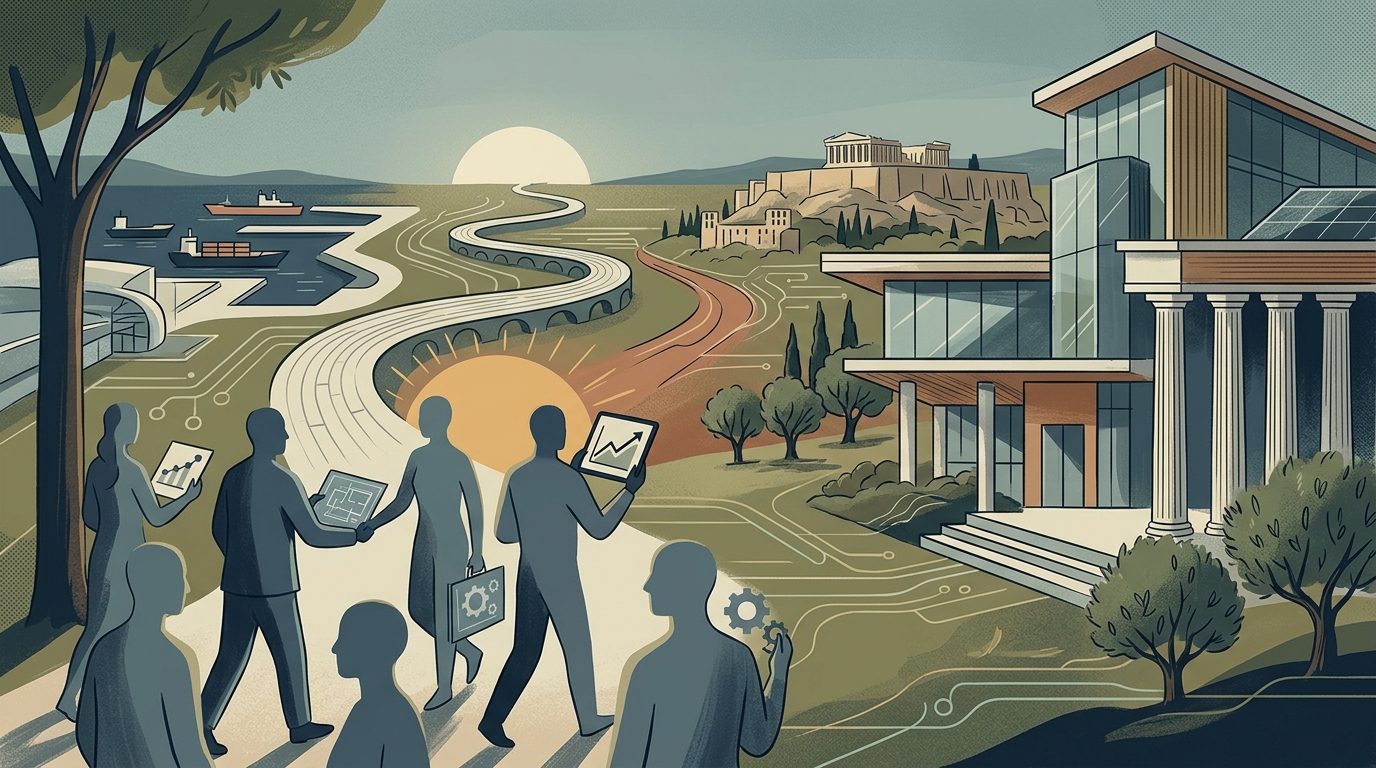
The recent event organized by the University of Cyprus, focusing on the relationship between Artificial Intelligence (AI), writing, and the love of reading (philanagnosia), was more than just an academic debate; it was a profound reflection on the future of the human spirit in the era of Large Language Models (LLMs). In a packed auditorium, academics, authors, and students attempted to map the uncertain territory where creativity meets code and reading transforms from an internal process into digital consumption.
AI as a Co-author: Blessing or Curse?
The central question of the event concerned the nature of writing itself. With the emergence of tools like ChatGPT and Claude, text production has become faster than ever. However, as speakers pointed out, speed does not necessarily imply depth. Artificial Intelligence operates on probabilities, predicting the next word in a sequence. In contrast, human writing often stems from the unpredictable, from trauma, and personal experience—elements that an algorithm can mimic but never truly experience.
At the University of Cyprus, the discussion expanded to the use of AI as an "assistant" in the creative process. Many argued that technology can act as a tireless partner for brainstorming, helping writers overcome the dreaded "blank page." On the other hand, serious concerns were raised about the homogenization of style. If we all use the same models to edit or enrich our texts, we risk ending up with a global literary "middle ground," devoid of the idiosyncrasies and sharp edges that characterize great works of art.
The Challenge of Reading in the Algorithmic Age
The concept of philanagnosia—the love of reading—is under pressure from the culture of instant gratification. The event highlighted that AI now offers the ability to summarize entire books into a few paragraphs. This creates a risk: the transition from "deep reading" to "functional scanning." Deep reading requires time, concentration, and critical thinking—elements that tend to weaken when a reader relies on algorithmic summaries.
Speakers emphasized that reading is not merely about information intake but an act of empathy. By reading a literary work, we step into the shoes of the "Other." Can an AI, which possesses no self, help us understand the human condition? The consensus was cautious. Promoting reading in schools and universities must now include the cultivation of "digital resilience," so that young people can discern the value of a complete work over an artificial summary.
Academic Ethics and the Future of Education
A significant portion of the event was dedicated to educational reform. Universities worldwide, including the University of Cyprus, face a dilemma: to ban AI or to integrate it? The trend points toward the latter, but under strict conditions. Writing remains the primary tool for assessing student thought. If writing is outsourced to a machine, how then shall thought be evaluated?
New assessment methods were proposed, such as oral examinations or in-class writing assignments without internet access. However, the most radical proposal was the teaching of "critical AI literacy." Students must learn to verify AI sources, recognize model hallucinations, and use technology as a tool to enhance, rather than replace, their own intellect.
The Greek Language on the Digital Map
Finally, special mention was made of the Greek language. Most AI models are trained primarily on English-language data, which often leads to "anglicisms" or a simplified use of Greek syntax and vocabulary. Preserving our linguistic heritage in the age of AI requires the creation of localized corpora that will allow models to understand the depth and specificity of the Greek language. The University of Cyprus, as a beacon of culture, is called to play a leading role in this effort, ensuring that the digital transition does not lead to linguistic alienation.