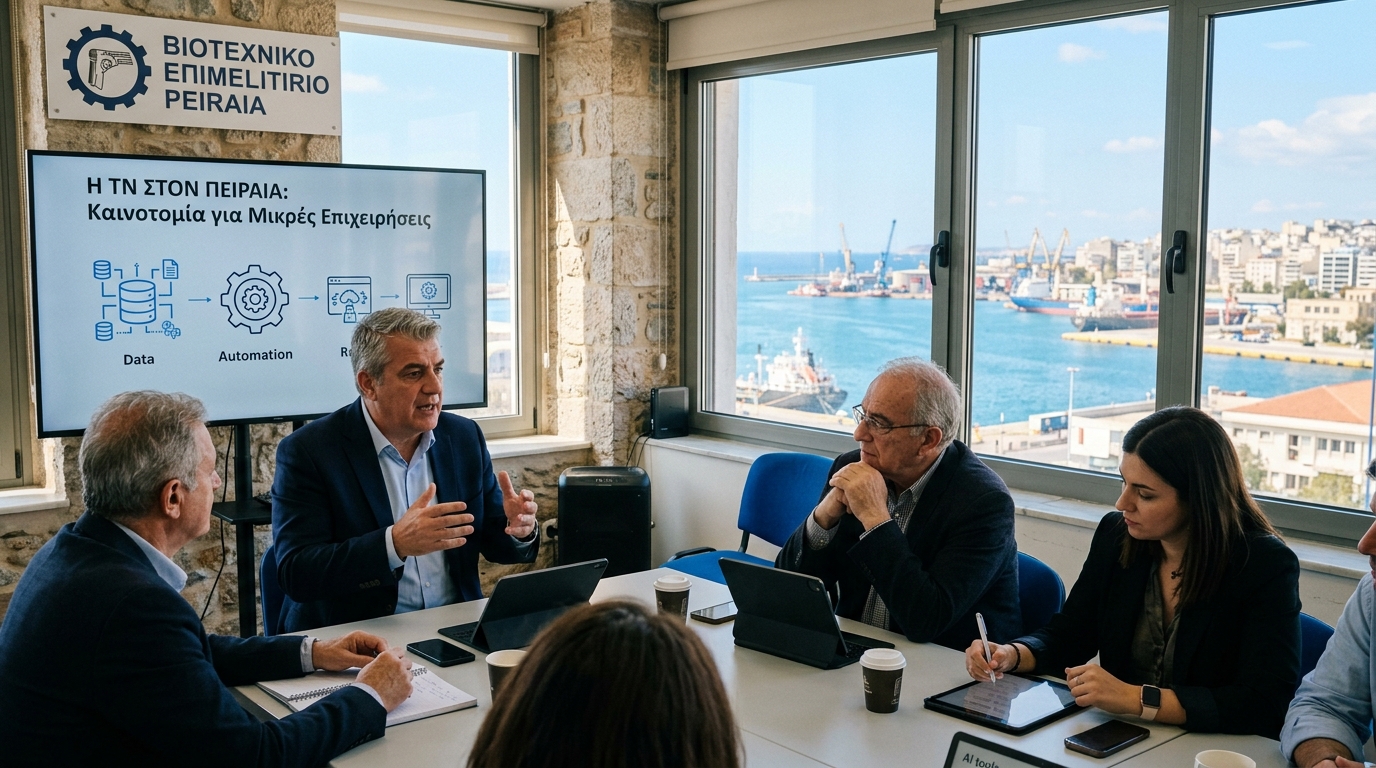
The rapid evolution of Artificial Intelligence (AI) is no longer a science fiction scenario or a privilege reserved for Silicon Valley tech giants. In Greece, and specifically within the dynamic fabric of Piraeus, the Piraeus Chamber of Craftsmen (VEP) has taken a crucial initiative to bring this technological revolution down to the scale of Greek small and medium-sized enterprises (SMEs). The event titled "Artificial Intelligence in Our Daily Lives" was not just an informative seminar, but a wake-up call for the traditional craft sector, which must either transform or face marginalization.
From Traditional Workshops to Digital Transformation
For decades, Greek craftsmanship relied on personal skill, passion, and direct customer contact. However, globalization and the digitization of markets have changed the rules of the game. VEP, recognizing this necessity, sought to demystify Artificial Intelligence, presenting it not as an impersonal enemy that will replace human hands, but as a multi-tool that can enhance productivity. From automating customer communication via smart chatbots to optimizing supply chains and predicting market trends, AI offers solutions that were previously financially inaccessible to small players.
The discussion in Piraeus focused on how a carpenter, a mechanic, or a local producer can use Generative AI tools to improve business marketing or design new products with the help of algorithms. This "democratization" of technology is key to the survival of SMEs, which form the backbone of the Greek economy.
Challenges of Adaptation and the Digital Divide
Despite the enthusiasm, the transition is not without obstacles. One of the main issues highlighted is the "digital divide." Many older-generation craftsmen feel excluded from developments, as a lack of digital skills acts as a deterrent. This is where the role of chambers like VEP becomes vital, acting as bridges of knowledge. Education and lifelong learning are now becoming essential prerequisites for practicing any profession.
- Shortage of specialized personnel capable of managing AI systems.
- Initial investment costs in infrastructure and software.
- Concerns regarding data security and intellectual property.
- The need for a clear legal framework to protect small professionals.
The President of VEP and the speakers emphasized that Artificial Intelligence requires a new mindset. It is not enough to simply purchase software; one must learn to ask the right questions and evaluate results with critical thinking. The ethical use of technology was also a central theme, as transparency and maintaining human identity in products remain the comparative advantages of Greek craftsmanship.
Strategic Importance for the Local Economy
Piraeus, as the country's largest port and a historical trade hub, has the potential to become a pioneer in applying AI to the shipping industry and supporting crafts. Integrating intelligent systems into ship maintenance, component manufacturing, and port services can provide immense added value. VEP seems to understand that "smart" craftsmanship can attract young people back to technical professions by combining tradition with innovation.
"Artificial Intelligence is not the future; it is the present that is already shaping our success or failure in the market," it was noted during the event.
In conclusion, the initiative of the Piraeus Chamber of Craftsmen serves as a shining example of how local organizations can guide their members through the fourth industrial revolution. The challenge for the Greek state now is to support these efforts with financial tools and targeted training programs, ensuring that no professional is left behind in the digital age.