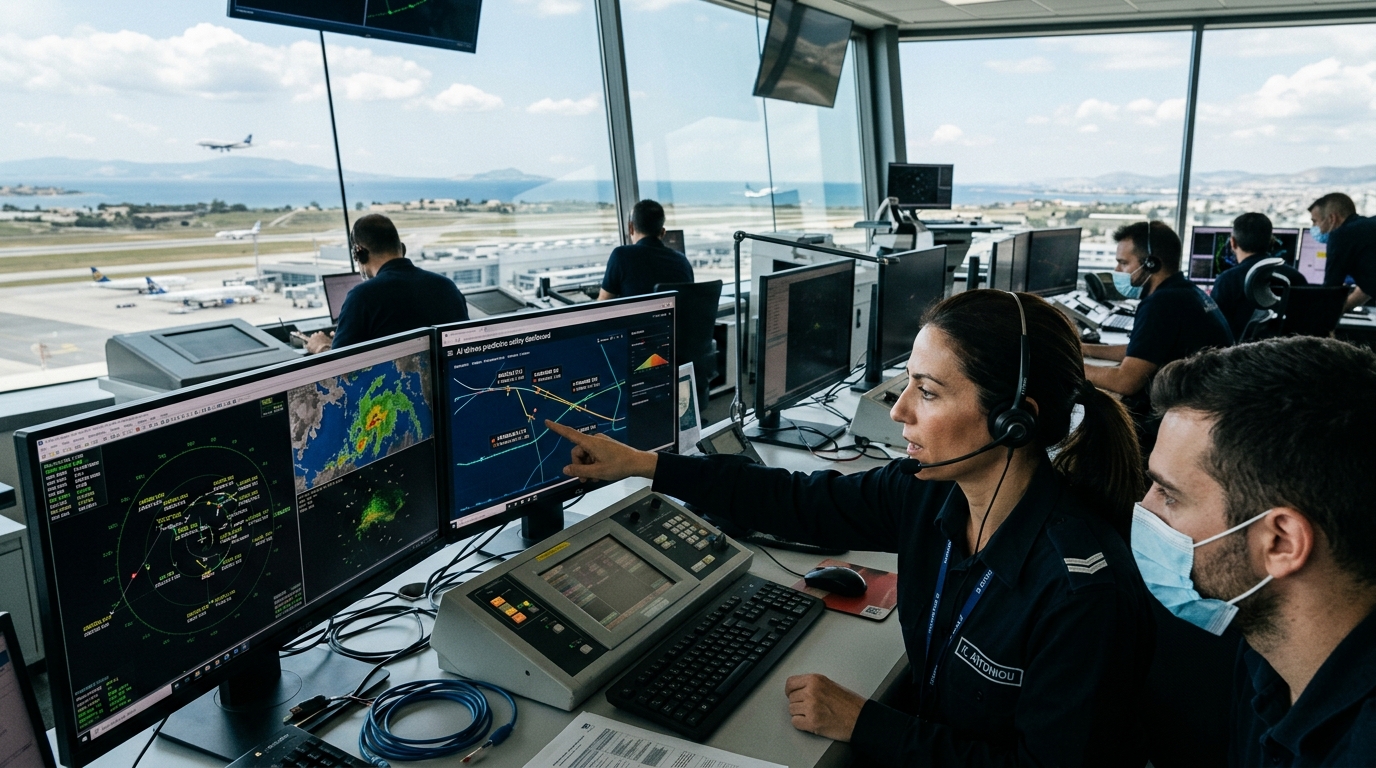
For decades, air traffic control has relied on the unparalleled ability of the human brain to process three-dimensional data in real-time under extreme pressure. However, as our skies become increasingly crowded, traditional systems are reaching their breaking point. The entry of Artificial Intelligence (AI) into Air Traffic Control (ATC) services is no longer a science fiction scenario, but a necessary evolution that is radically transforming the way we travel.
The Need for Digital Augmentation in the Skies
Global air traffic is expected to double over the next twenty years. Air traffic controllers are tasked with managing not only more passenger aircraft but also a new generation of flight vehicles, from delivery drones to flying taxis (eVTOLs). In this complex environment, AI offers the capability to process vast amounts of data far beyond human capacity. Systems like Project Bluebird in the UK or SESAR initiatives in Europe are already testing algorithms that can predict conflicts and suggest optimal routes minutes before a hazard arises.
The primary application of AI focuses on "strategic management." Instead of a controller reacting to a problem when it appears on the radar, AI analyzes flight plans, weather conditions, and traffic density hours in advance. This allows for the creation of "four-dimensional" (4D) trajectories, where time is the critical fourth dimension, ensuring that no aircraft needs to circle an airport waiting for a landing slot.
The Greek Context and Implementation Challenges
For a country like Greece, with its heavy tourist traffic and the complex geography of the Athens FIR, adopting such technologies is vital. Delays during the summer months are not just a matter of inconvenience; they carry enormous economic and environmental costs. The use of AI can optimize flows to regional airports, reducing fuel consumption and CO2 emissions as aircraft follow more direct routes.
However, the transition is not without obstacles. The Hellenic Civil Aviation Authority (HCAA) and international regulatory bodies face the problem of "explainability." In air traffic control, it is not enough for an algorithm to provide a correct instruction; the controller must understand *why* that instruction was given. If AI operates as a "black box," human trust is eroded, which could be fatal in moments of crisis.
Safety, Ethics, and the Future of the Profession
The big question looming over control towers is whether AI will replace humans. The prevailing view among experts is that the controller's role will evolve from a "tactical operator" to a "system manager." Humans will remain the final arbiters, but they will have tools at their disposal that eliminate human error resulting from fatigue or information overload.
- Conflict Prediction: Algorithms that identify potential risks 15-20 minutes earlier than current systems.
- Fuel Optimization: Dynamic adjustment of altitude and speed to minimize the environmental footprint.
- Automated Communication: AI systems that convert voice instructions into data, reducing radio misunderstandings.
In conclusion, artificial intelligence is not just conquering the skies; it is making them smarter and safer. The challenge for the next decade will be creating a rigorous regulatory framework that allows for innovation without sacrificing aviation's absolute priority: the safety of human life. The partnership between human and machine in the control tower will be the key to 21st-century aviation.