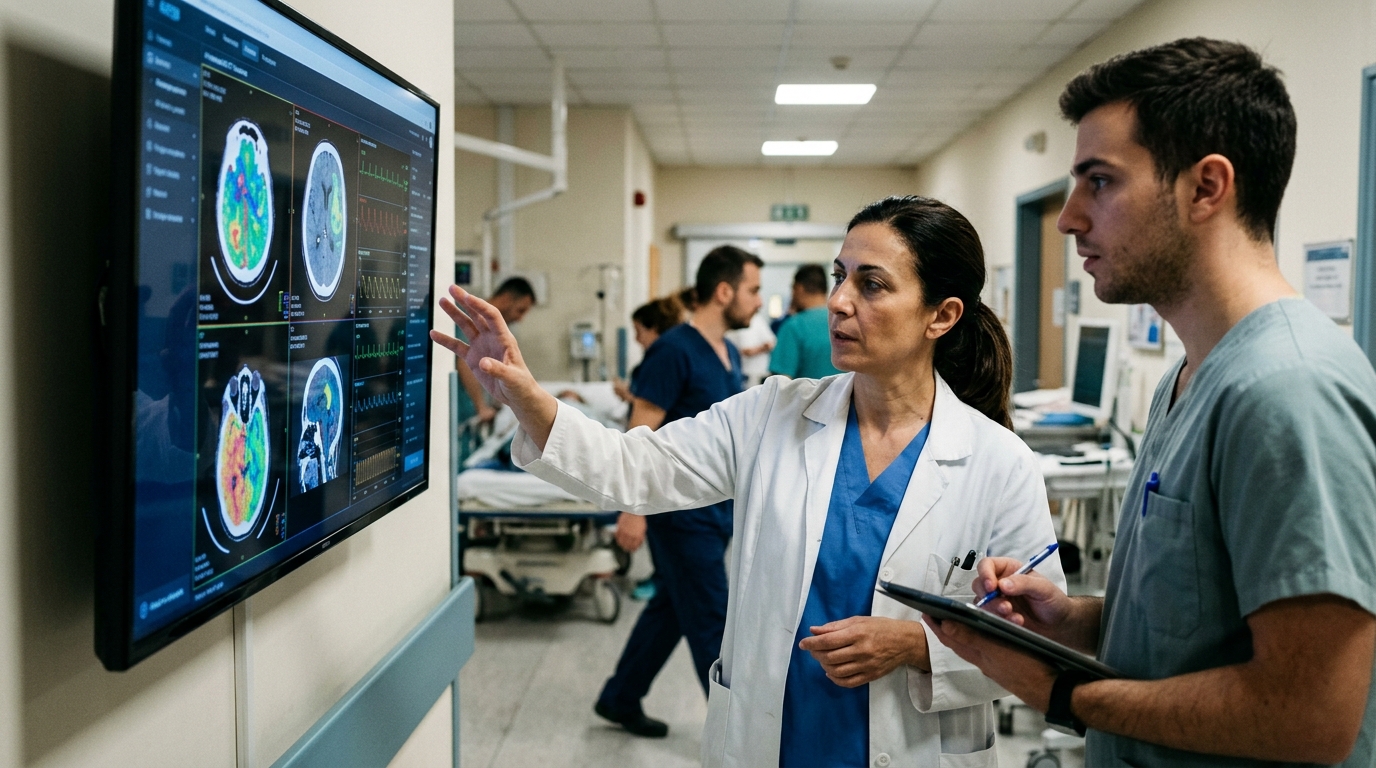
In the bustling corridors of Thessaloniki’s "AHEPA" University General Hospital, where time pressure and the criticality of cases are a daily reality, a quiet revolution is underway. The recent evaluation and implementation of Artificial Intelligence (AI) systems in the Emergency Department (ED) marks a new era for the Greek National Health System (NHS), promising to transform how we manage medical crises.
The Need for Speed at "Hour Zero"
An on-call shift at a major hospital like AHEPA is a test of endurance and precision. With hundreds of patients arriving during every shift, the triage of cases is the key to saving lives. This is exactly where Artificial Intelligence steps in. The systems evaluated focus primarily on radiodiagnostics, automatically analyzing CT scans and X-rays in real-time.
The AI software acts as a "vigilant assistant" that scans images seconds after they are captured. If it detects findings suggestive of cerebral hemorrhage, pulmonary embolism, or fractures, it immediately alerts the hospital's system. This allows doctors to prioritize patients who, although they may appear stable externally, carry life-threatening internal lesions.
From Theory to Clinical Practice
The evaluation at AHEPA was not limited to the technical proficiency of the algorithms but extended to their integration into the doctors' workflow. Clinicians found that the use of AI significantly reduces the waiting time for diagnosis in critical cases. In an environment where "time is brain," especially in stroke cases, saving even a few minutes can mean the difference between full recovery and permanent disability.
- Automated Triage: The system ranks exams based on risk, sending the most urgent ones to the top of the radiologist's list.
- Reduction of Human Error: Physician fatigue after 24-hour shifts is a real risk factor. AI acts as a safety net.
- Resource Optimization: With faster diagnosis, decisions for admission or discharge are made more quickly, decongesting the ED.
The Challenges of the Greek System
Despite the impressive results, the universal implementation of such technologies in the Greek NHS faces obstacles. Understaffing remains the primary issue. Artificial Intelligence cannot replace the doctor; it can only enhance them. However, to function effectively, it requires modern digital infrastructure at all levels – from RIS/PACS systems to high-speed interconnection between departments.
"AI technology at AHEPA is not a laboratory experiment, but a tool that is already saving time and lives on the battlefield of emergency care," sources from the medical staff report.
Furthermore, there is the issue of education. Greek doctors are called upon to become familiar with the use of these tools, understanding their capabilities as well as their limitations. Trust in the algorithm is built gradually, through the daily confirmation of its results by human experience.
The Future of Digital Health in Greece
The AHEPA initiative serves as a "pilot" for the broader digital health strategy in Greece, largely funded by the Recovery and Resilience Facility (RRF). The goal is to create a network of hospitals where information flows seamlessly and AI supports decision-making in every corner of the country, from large urban centers to remote islands.
The integration of AI also raises important questions about data governance and ethics. As these systems become more prevalent, the Greek health sector must ensure that patient data remains secure and that the final clinical decision always rests with the human expert. The AHEPA model shows that when technology is applied with a focus on clinical outcomes rather than just administrative efficiency, the benefits are tangible.
In conclusion, the evaluation of AI in AHEPA’s emergency department is a hopeful message. It shows that despite chronic systemic issues, the Greek medical community has the reflexes to adopt innovation. The challenge now shifts to political will to ensure the sustainability and equitable access to these technologies for all citizens.