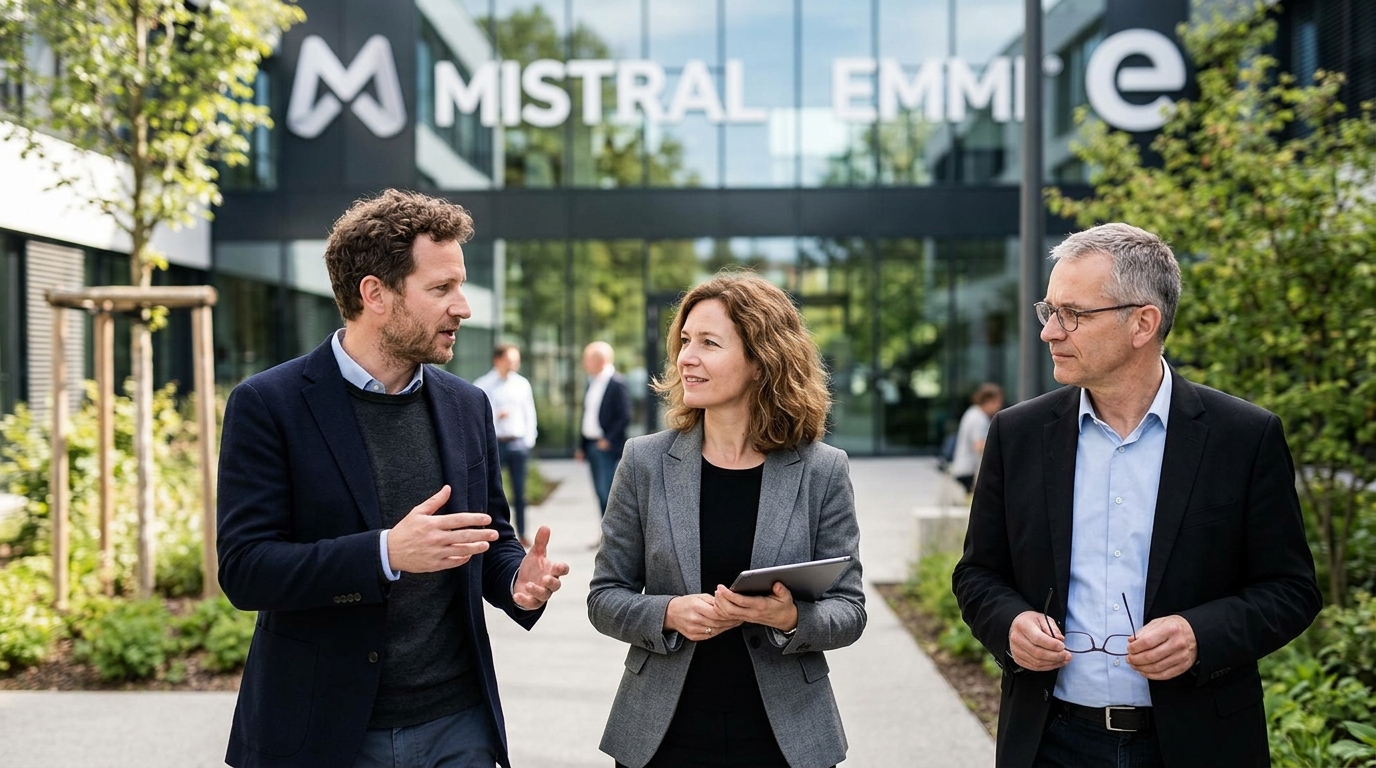
In the ever-shifting landscape of the global technology arena, France's Mistral AI continues to send shockwaves through the foundations of Silicon Valley. The recent news that Emmi is joining Mistral is not merely another corporate acquisition or partnership; it signals a fundamental shift toward what experts are calling an "AI-native" industry. This move underscores Mistral's ambition to transform from a provider of powerful Large Language Models (LLMs) into a comprehensive architect of digital ecosystems.
The Convergence of Infrastructure and Intelligence
Emmi, renowned for its expertise in developing platforms that enable the creation and management of AI agents, brings a critical piece of the puzzle to Mistral. To date, the use of artificial intelligence in business has been largely "additive": companies took existing processes and attempted to enhance them with a chatbot or a text summarization feature. The AI-native industry approach flips this model. It means designing processes from the ground up, where AI is not the tool, but the central nervous system of the operation.
By integrating Emmi's technology, Mistral AI aims to offer enterprises the capability to build autonomous systems that can make decisions, interact with other software, and execute complex tasks without constant human intervention. This "agentic workflow" is considered the next great frontier of productivity.
The European Response to American Dominance
Mistral AI has emerged as Europe's de facto champion in the field of artificial intelligence. At a time when the European Union is struggling to find the balance between stringent regulation (the AI Act) and innovation, Mistral proves that "digital sovereignty" is not just a political slogan, but a business reality. The absorption of Emmi strengthens this position, as it allows Mistral to offer solutions that are not only technically superior but also tailored to the needs of European industry for data security and localized infrastructure.
- Agent Autonomy: The ability of models to act as independent entities within operational environments.
- Cost Optimization: Moving to AI-native structures drastically reduces operating expenses in the long run.
- Flexibility: The capacity to adapt Mistral models to specialized industrial sectors, from heavy manufacturing to finance.
"Emmi joining the Mistral family isn't just about technology; it's about the vision of an industry that operates with the speed and precision of AI at its core," say sources close to the company.
Challenges and the Future of Work
Of course, the transition to an AI-native industry is not without its challenges. Integrating autonomous agents into critical infrastructure raises questions about reliability and ethical responsibility. Who is responsible if an AI agent makes a flawed decision in a supply chain? Mistral appears to be investing in models that are "transparent" (open weights), allowing developers to better understand how they function—a significant competitive advantage over the "closed" models of OpenAI or Google.
Furthermore, this move is expected to accelerate the transformation of the labor market. Jobs based on repetitive digital tasks will be the first to be impacted by Mistral-Emmi agents. However, the company argues that this will free up human capital for more creative and strategic activities, ultimately boosting the competitiveness of the European economy on a global scale.
Conclusion
Emmi joining Mistral AI is a statement of power. In the race for dominance in the AI era, Mistral is no longer content with just following developments. It is creating the conditions for a new industrial revolution, where intelligence is embedded, autonomous, and, above all, efficient. The bet for 2026 and beyond is whether this "native" approach will succeed in displacing the traditional software models that have dominated for decades.