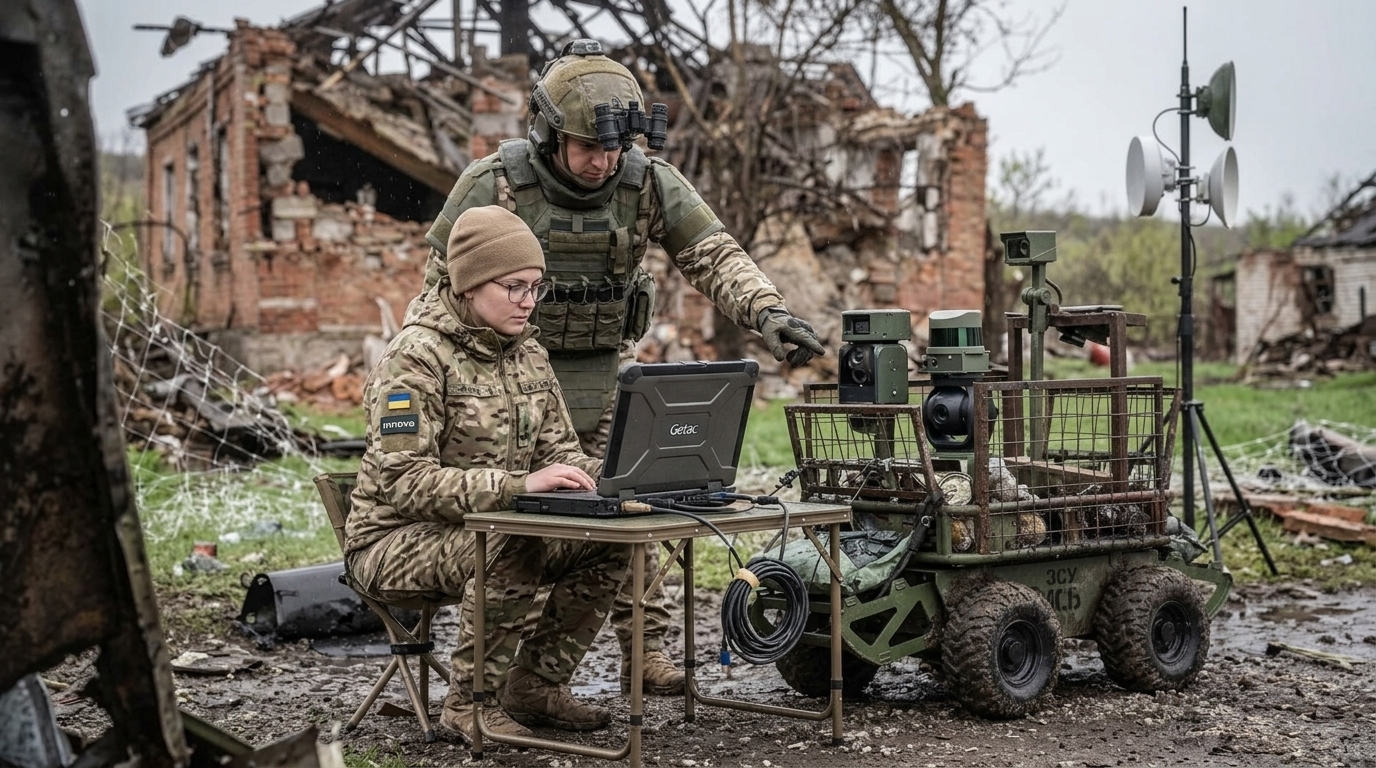
On the muddy battlefields of Ukraine, the face of war no longer resembles only the 20th-century conflicts of heavy tanks and massed artillery. Today, the real battle is fought in the invisible spectrum of radio frequencies and within the lines of code running on microscopic processors. A new generation of Ukrainian tech companies is transforming robotic systems—from drones to Unmanned Ground Vehicles (UGVs)—using a logic borrowed directly from Silicon Valley: rapid, Over-the-Air (OTA) software updates, much like a smartphone or a Tesla.
The Strategy of Rapid Iteration
Necessity is the mother of invention, and in Ukraine’s case, the need for survival has birthed an innovation cycle measured in weeks rather than years. Traditional Western defense industries often take decades to develop and certify a new weapons system. In contrast, Ukrainian startups, working closely with the Brave1 ecosystem, develop solutions that are tested in the field in the morning and improved via code by nightfall.
The key to this approach is agility. When Russian forces adapt their Electronic Warfare (EW) systems to jam Ukrainian drone frequencies, Ukrainian developers don’t wait for the next hardware shipment. Instead, they push a software update that allows drones to hop frequencies automatically or employ AI for target recognition without needing a link back to the operator.
Edge AI: Intelligence at the Frontline
The most significant upgrade involves system autonomy. With the increasing effectiveness of jamming, remote control often becomes impossible. This is where Edge AI steps in. Robots are being equipped with computer vision algorithms that allow them to "see" their environment and make split-second decisions locally.
- Autonomous Navigation: Using pre-loaded maps and visual odometry to move in GPS-denied environments.
- Target Recognition: Distinguishing between military vehicles and civilian infrastructure using neural networks.
- Mesh Networking: Robots communicating with each other to relay information and commands even if individual units are cut off from the control center.
"We aren't just building machines. We are building intelligent systems that learn from every second they spend on the front line," says an executive from a Ukrainian firm who requested anonymity for security reasons.
Geopolitical Implications and the Future
This "smartphonization" of warfare has profound geopolitical implications. Ukraine has become a global testbed for autonomous technology. Major world powers are watching closely, realizing that future dominance will not depend solely on the number of boots on the ground or tanks in the field, but on a nation's ability to produce and update code faster than its adversary.
However, this evolution also raises serious ethical questions. The ability of a robot to select and engage targets autonomously, without direct human-in-the-loop intervention, is both a holy grail of military efficiency and a nightmare for humanitarian organizations. As software becomes the primary weapon, the line between defensive technology and uncontrollable AI becomes increasingly blurred.
Conclusion
The Ukrainian approach proves that the era of "static" weaponry is over. In the warfare of 2026, victory is decided in bytes. The ability of a company to send a "patch" to thousands of drones simultaneously, nullifying an opponent's multi-billion dollar investment in jamming systems, is the new form of power. The question is no longer whether robots will dominate the battlefield, but who will write the software that controls them.