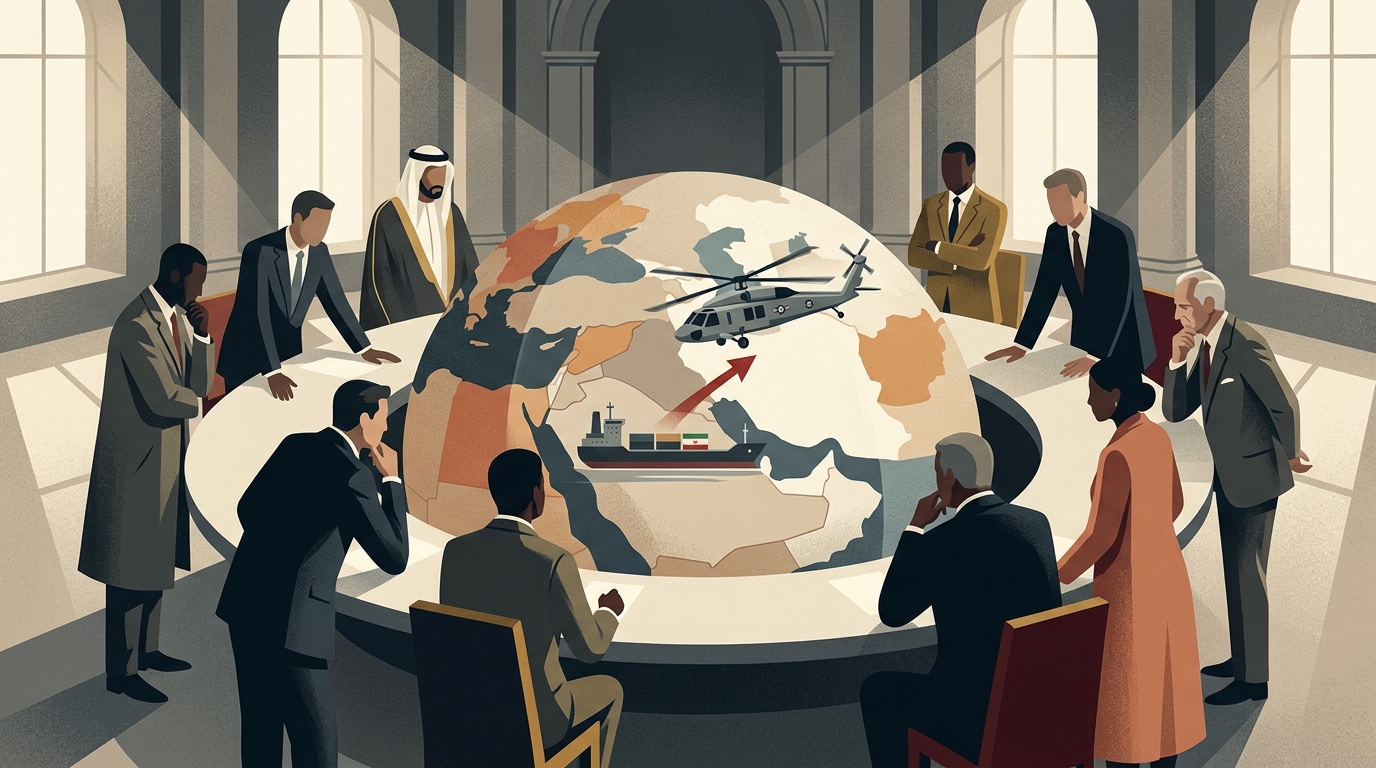
The announcement by U.S. President Donald Trump regarding a direct military intervention against an Iranian cargo vessel in the Gulf of Oman is not merely an isolated tactical episode; it marks the official commencement of a new, highly volatile phase in Washington-Tehran relations. The incident, occurring within the framework of a stringent naval blockade sought by the American administration, highlights the White House's intent to employ raw kinetic power to curb Iranian influence and its sanctioned exports.
According to preliminary reports, the Iranian ship attempted to breach exclusion zones established by the U.S. Navy, allegedly carrying cargo that Washington classifies as "prohibited" under current sanctions regimes. The intervention by U.S. Special Forces, described as both "surgical" and "decisive," sends a crystalline message to all regional stakeholders: freedom of navigation in the Gulf will henceforth be defined by terms dictated by Washington, directly challenging Iran's perceived hegemony over the Strait of Hormuz.
The Return of 'Maximum Pressure' 2.0
Donald Trump's strategy appears to be an amplified version of the 'Maximum Pressure' policy that defined his first term. However, the current iteration is markedly more militarized. While in the past, pressure was primarily exerted through economic sanctions and diplomatic isolation, today's move demonstrates that the White House is willing to risk direct military engagement to achieve its strategic objectives. The imposition of a naval blockade is, by its very nature, an act that skirts the boundaries of a declaration of war, and its practical application signals that diplomacy has been relegated to the sidelines.
Analysts point out that Trump is seeking to prove that the U.S. remains the undisputed guarantor of security in the region, despite the burgeoning influence of China and Russia in the Middle East. By making this move, Washington is daring Tehran to react, betting on the premise that Iran, despite its aggressive rhetoric, cannot sustain a generalized conflict with a superpower. Nonetheless, the risk of miscalculation remains perilously high, as the Revolutionary Guard has repeatedly demonstrated its capacity to inflict asymmetric damage on global shipping lanes.
Economic Fallout and the Shipping Industry
For the Greek shipping industry, which holds a dominant position in global energy transport, these developments are particularly alarming. The Gulf of Oman and the Strait of Hormuz are the most critical arteries for global energy supplies. Any military tension in the region automatically leads to a sharp spike in war risk premiums, inflating transportation costs and, consequently, crude oil prices on international markets.
- Immediate surge in Brent crude oil prices.
- Heightened alert status for merchant vessel crews transiting the area.
- Potential rerouting of shipments, increasing delivery times and overheads.
- Instability in global equity markets fueled by fears of escalation.
Market reaction was instantaneous, with oil prices jumping immediately following Trump's post. Investors fear that if Iran responds by attempting to close the Strait of Hormuz, the global economy could face an energy crisis reminiscent of the 1970s. Furthermore, intervening against a cargo ship sets a legal precedent that challenges the UN Convention on the Law of the Sea, creating an environment where might makes right over established international norms.
International Response and the Future of the Conflict
The international community is watching with bated breath. While Israel and certain Gulf monarchies appear to welcome Washington's decisiveness, the European Union has expressed grave concern regarding the potential for an uncontrollable conflagration. Brussels, which has historically advocated for a more diplomatic approach toward Iran, now finds itself in a precarious position, as U.S. military action undermines any remaining efforts to revive talks regarding Tehran's nuclear program.
"We do not seek war, but we will not allow Iran to violate our rules with impunity," stated a State Department source.
The question now is what Tehran's next move will be. Will it opt for a quiet retreat to avoid a devastating conflict, or will it respond with strikes via its regional proxies? History has shown that in such high-stakes scenarios, tension rarely dissipates without some form of retaliation. Trump is gambling on absolute U.S. superiority, but in the 21st century, asymmetric threats can often neutralize the technological advantages of conventional forces. The coming week will be pivotal in shaping the new security architecture of the Middle East.