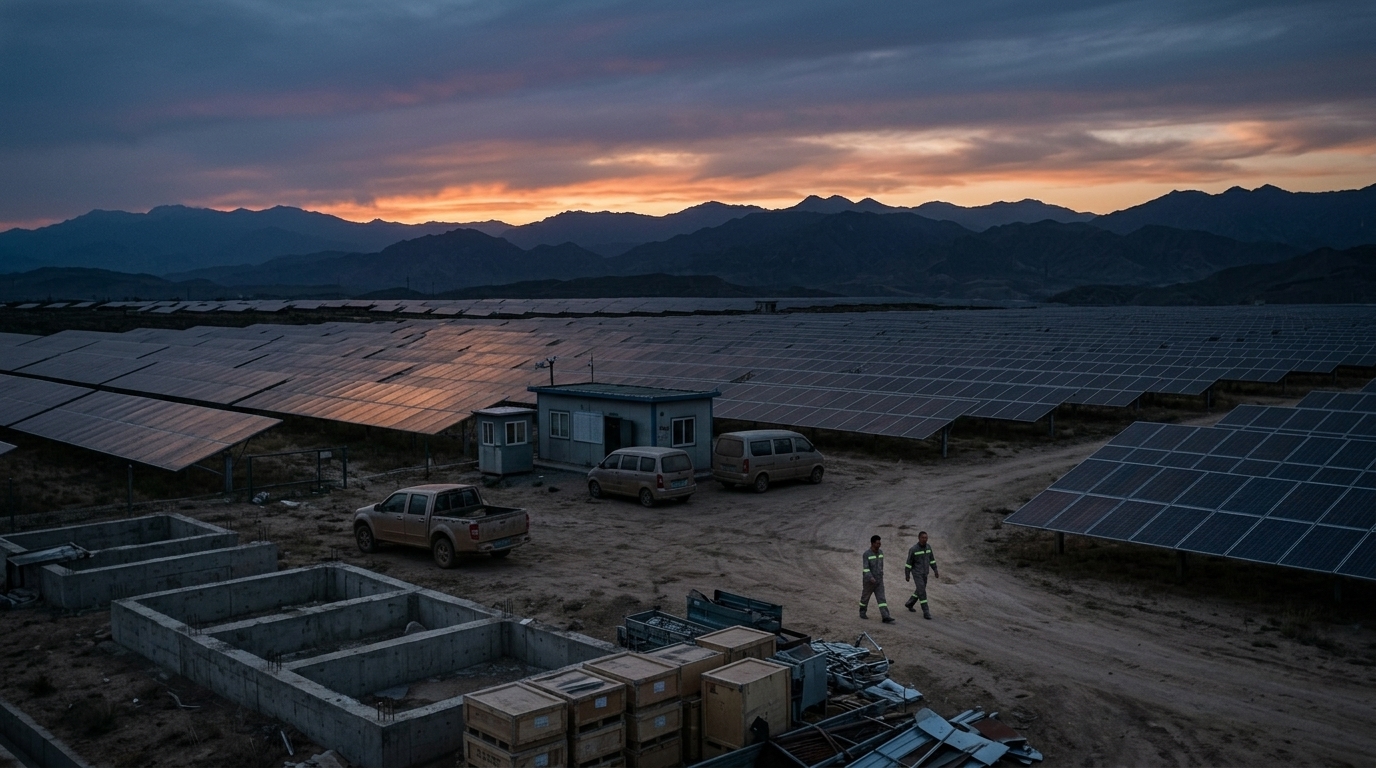
China, the undisputed hegemon of the global solar energy market, is facing a paradox that threatens the foundations of one of its most important industrial pillars. While the world hungers for renewable energy and geopolitical tensions in the Middle East heighten the need for energy independence from fossil fuels, the Chinese photovoltaic industry is sinking into a crisis that neither war nor the climate crisis seems capable of halting. The 'dark' side of this dominance is revealed through collapsing prices, ruthless domestic competition, and the rising walls of Western protectionism.
The Ghost of Overcapacity and Price Collapse
The core problem plaguing the industry is not a lack of demand, but an overwhelming excess of supply. In recent years, encouraged by Beijing and fueled by abundant subsidies, Chinese companies have undertaken an unprecedented expansion of their production capacity. The result has been the creation of a massive surplus that has sent solar panel prices into a freefall. According to market analysts, prices have dropped to levels that are often below production costs, forcing even industry giants to record significant losses.
This situation has created a vicious cycle. Companies, in an attempt to maintain market share and service their debts, continue to produce at full capacity, exacerbating the oversupply problem. China's domestic market, although the largest in the world, cannot absorb this volume, while exports are becoming increasingly difficult due to trade barriers.
Geopolitical Protectionism as an Insurmountable Obstacle
The West, recognizing its absolute dependence on the Chinese solar supply chain (China controls over 80% of global production at all stages), has begun to react forcefully. The United States, through the Inflation Reduction Act (IRA), is offering generous incentives for domestic production while simultaneously imposing strict tariffs on Chinese products, including those routed through third countries in Southeast Asia.
The European Union, though more hesitant due to its climate neutrality goals, is moving in a similar direction. Its 'de-risking' strategy aims to limit dependence on Beijing. This means the Chinese industry is losing access to profitable markets at the very moment when the war in Ukraine and tensions with Iran should normally be driving these countries faster toward Chinese panels. Instead, supply chain security is now prioritized over low prices.
The Technological Transition: A Costly Bet
Beyond economic and geopolitical issues, the industry is in the midst of a critical technological shift. The transition from traditional P-type cells to more efficient N-type cells requires massive investments in new equipment. Many companies that invested billions in old technology now find themselves with obsolete factories and without the necessary capital for modernization.
- The collapse in polysilicon prices has wiped out the profit margins of raw material suppliers.
- Smaller market players are being driven to bankruptcy, causing tremors in the financial systems of China's provinces.
- Innovation requires capital that is currently lacking in the sector due to continuous losses.
Why War Is Not Enough
In the past, every rise in oil or gas prices due to conflict acted as a catalyst for renewable energy. Today, however, the situation is different. High inflation rates and increased interest rates globally have made financing large-scale solar projects more expensive. Furthermore, the grid infrastructure in many countries is not ready to handle a sudden surge in solar power, creating a 'ceiling' on demand that is unrelated to the price of panels.
In conclusion, the Chinese solar panel industry stands at a critical crossroads. The 'growth at all costs' strategy pursued by Beijing led to a global dominance that is now proving fragile. The necessary consolidation of the industry will be painful, with many companies expected to close, while the geopolitical chessboard will continue to pose obstacles that low prices alone can no longer overcome.