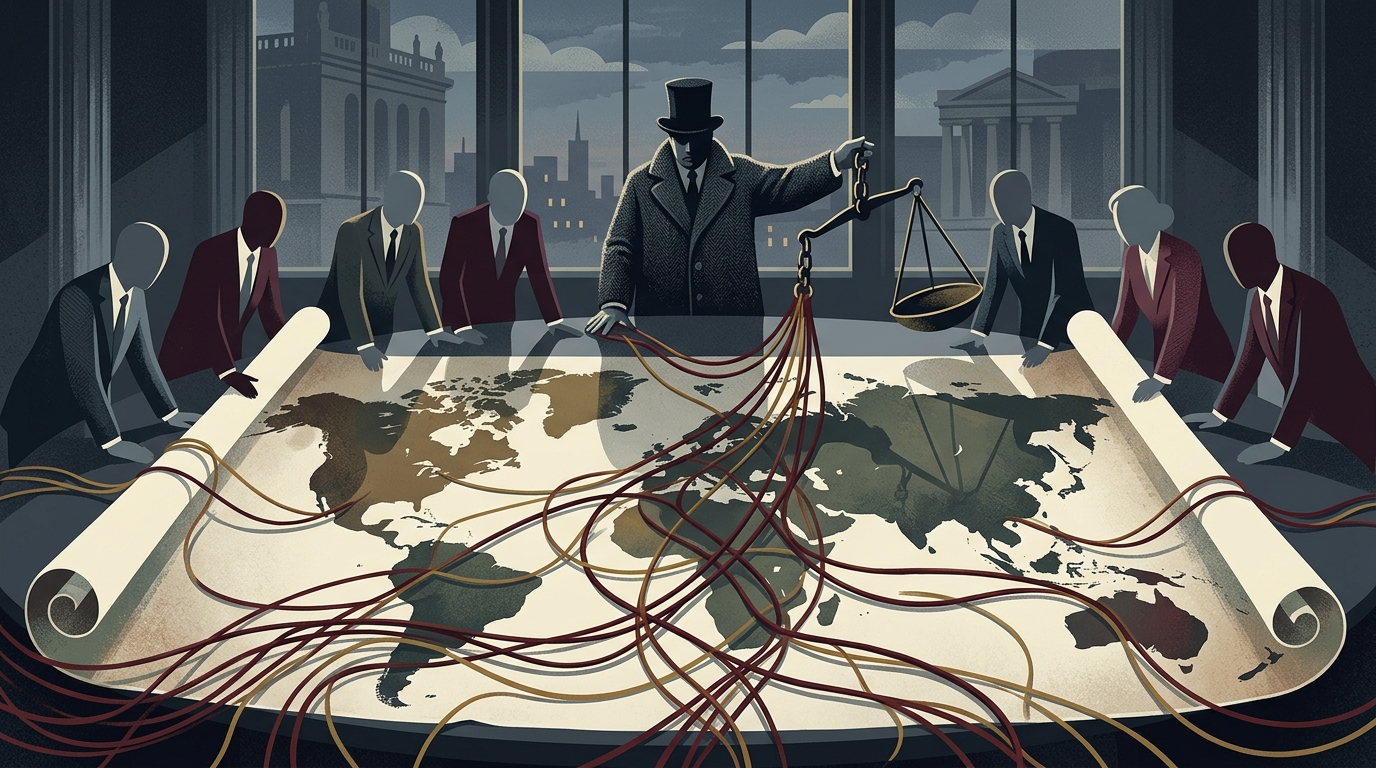
In the 21st century, the concept of national sovereignty is no longer defined solely by territory, borders, or traditional military prowess. Today, sovereignty is contested in semiconductor laboratories, data centers, and the lines of code within large language models. Artificial Intelligence (AI) has emerged as the 'general-purpose technology' that will dictate the economic supremacy and strategic autonomy of nations for decades to come. As we navigate 2026, the global stage is characterized by a relentless competition where technological superiority is synonymous with geopolitical survival.
Silicon as the New Oil
The foundation of technological sovereignty remains physical. Despite the intangible nature of AI, training models requires vast amounts of computational power. This has turned the semiconductor supply chain into the most critical 'chokepoint' of global politics. NVIDIA's dominance in design and TSMC's mastery in manufacturing have created an asymmetric dependency that major powers are now scrambling to mitigate. The United States, through the CHIPS Act, and the European Union, with its own equivalent program, are investing billions to reshore production. However, building a self-sufficient ecosystem is a process that requires time—a luxury that geopolitical urgency does not always afford.
China, conversely, is responding to U.S. export restrictions by investing heavily in domestic alternatives and imposing controls on critical raw materials such as gallium and germanium. This 'chip war' is not merely about corporate profits; it is about who holds the veto power over a rival's technological trajectory. Technological sovereignty, therefore, begins with a state's ability to secure access to the hardware that fuels digital intelligence. Without the chips, the most sophisticated algorithms remain dormant.
Sovereign AI: The Rise of National Models
Beyond hardware, we are witnessing the rise of 'Sovereign AI.' This is the trend of states developing their own large-scale models, trained on local data and aligned with national values and languages. France's Mistral AI and the United Arab Emirates' Falcon model are prime examples. The logic is straightforward: if a country relies exclusively on models from Silicon Valley, it tacitly accepts the cultural and political biases embedded in those systems. Furthermore, it exposes sensitive national data to foreign jurisdictions and legal frameworks.
The European Union is attempting to find a middle path through regulation. The AI Act represents the world's first serious effort to establish ethical guardrails. However, there is a lingering risk that Europe might end up as the 'world's regulator' without being the 'world's creator.' Strategic autonomy requires innovation, not just bureaucracy. The competition for talent is also a crucial part of this equation. Countries that successfully attract and retain top AI researchers will be the ones shaping the future of global governance and setting the standards for the rest of the world.
The Geopolitics of Surveillance and Defense
In the military domain, AI is fundamentally altering the nature of deterrence. Autonomous weapons systems and algorithmic decision-making on the battlefield reduce reaction times, creating a dangerous 'use it or lose it' dynamic. Here, technological sovereignty means the ability to protect national infrastructure from AI-enhanced cyberattacks while maintaining the capacity to project power. The asymmetry is striking: smaller nations or even non-state actors can now acquire capabilities previously reserved for superpowers by leveraging open-source tools and affordable cloud computing.
Finally, AI is being utilized as a tool of 'soft power.' The export of surveillance and social control technologies by authoritarian regimes to countries in the Global South is creating new blocs of influence. The world is fragmenting into digital spheres of influence, where technical standards become the new borders. The battle for technological sovereignty is not just a race for efficiency; it is an existential conflict over which vision for humanity—one of liberation or one of control—will prevail in the digital age. The choices made today regarding AI governance will echo through the corridors of power for generations.