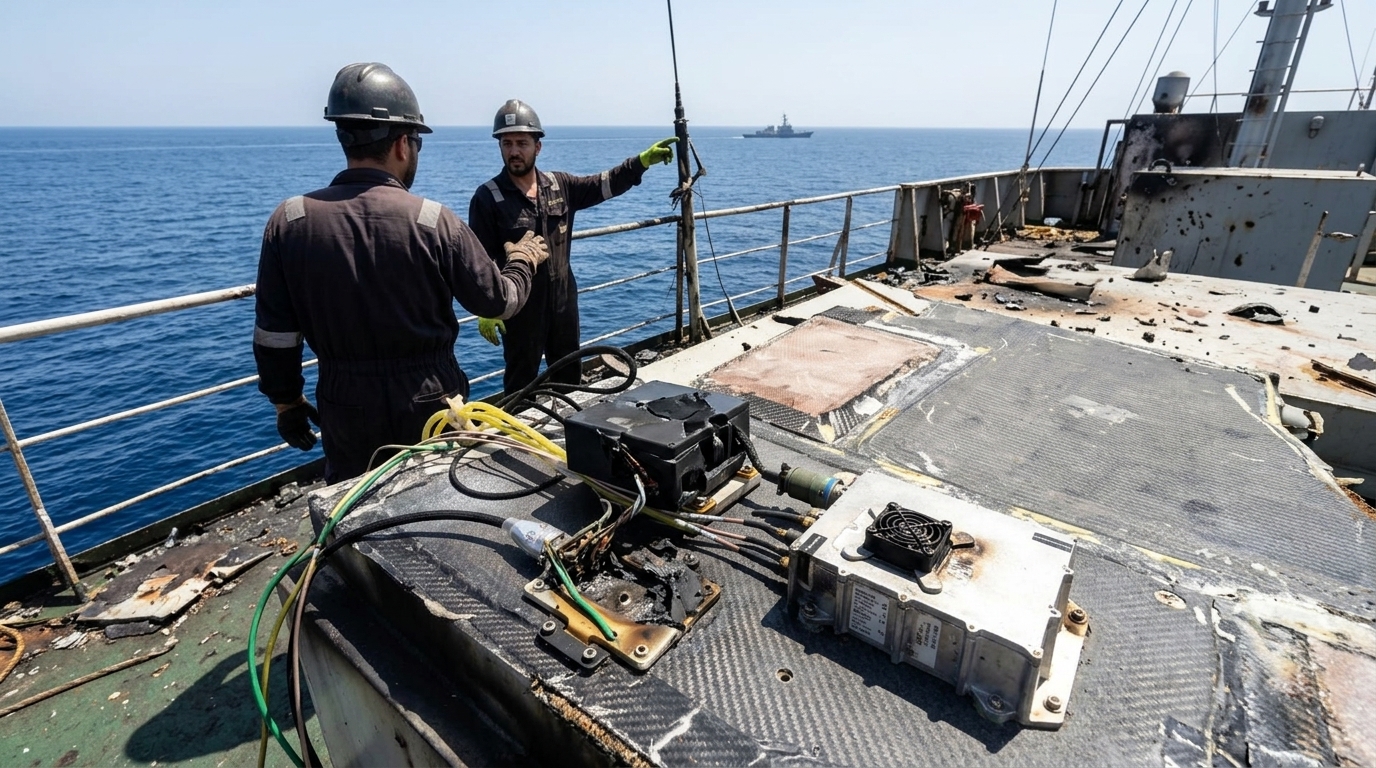
The heavy silence of the Gulf of Aden was shattered by the sharp, metallic thud of an impact that, mercifully, was not followed by the expected explosion. For the 18-member crew of a bulk carrier, this moment marked the beginning of a thriller that would last three agonizing days. A suicide drone, packed with high explosives, had slammed into the ship's funnel, transforming the vessel into a massive, floating deathtrap.
The Anatomy of a 72-Hour Standoff
The incident, as reported by Naftemporiki, highlights the terrifying new reality of maritime navigation in one of the world's most critical strategic corridors. The drone, likely launched from Houthi-controlled territories in Yemen, failed to detonate upon contact. Instead, it became wedged within the metal structure of the funnel, remaining live and potentially sensitive to the slightest vibration or thermal shift from the engines.
For 72 hours, the 18 seafarers lived in a state of suspended animation. Engine operations had to be kept to a bare minimum to prevent heat buildup in the funnel, while the crew retreated to designated safe zones, waiting for specialized EOD (Explosive Ordnance Disposal) teams to navigate a war zone to reach them. The psychological toll of knowing a bomb is lodged just meters above your head—with no way to dislodge it—represents one of the most extreme forms of occupational trauma in modern maritime history.
Asymmetric Warfare and the Technology of Terror
The deployment of loitering munitions, commonly known as suicide drones, has fundamentally rewritten the rules of engagement in the Middle East. While global naval powers deploy multi-billion dollar destroyers, the Houthi rebels utilize technology costing a few thousand dollars to inflict global economic disruption. These drones are often constructed from low-cost materials, possess a minimal radar cross-section, and are guided by simple GPS or camera systems, making them incredibly difficult to intercept until the final seconds.
- Cost vs. Impact: A $20,000 drone can disable a $50 million vessel and force global markets to reroute entire fleets.
- Psychological Attrition: The objective is often not to sink the ship, but to create a climate of pervasive fear that drives up insurance premiums and freight costs.
- The Deterrence Gap: Despite operations like 'Prosperity Guardian' and the EU's 'Aspides', attacks persist, proving that traditional naval doctrine struggles against swarms of cheap, expendable tech.
Geopolitical and Economic Implications
This attack is not an isolated event but a calculated move in a broader geopolitical strategy linking regional conflicts to global trade. The Gulf of Aden and the Red Sea serve as the primary artery connecting Asian manufacturing to European markets via the Suez Canal. Every incident of this nature nudges more shipping giants toward the decision to bypass the region entirely, opting for the lengthy and expensive journey around the Cape of Good Hope.
"Shipping is under siege. This is no longer about piracy for ransom; it is an ideological and geopolitical offensive that uses seafarers as expendable pawns in a global power game," states a maritime security analyst.
The maritime industry, particularly the Greek-owned fleet which dominates global shipping, is on the front lines. The necessity for enhanced defensive measures—such as AI-driven anti-drone systems and specialized private security—is becoming an operational standard. However, the case of the "dud" drone in the funnel proves that no measure is 100% effective against the chaotic variables of asymmetric warfare.
The Future of Maritime Security
Addressing this threat requires a paradigm shift that integrates Artificial Intelligence with traditional seamanship. AI systems capable of identifying the acoustic and visual signatures of drones in real-time, even in adverse weather, are currently being accelerated into deployment. Simultaneously, the international community faces a dilemma: continue with passive defense and escort missions, or move toward neutralizing the launch sites and command centers of these unmanned threats.
For the 18 sailors who survived those 72 hours, the return to normalcy will be arduous. Post-Traumatic Stress Disorder (PTSD) is the silent epidemic of the shipping industry, and such incidents underscore that the bravery of seafarers today is tested not just by the elements of nature, but by the relentless evolution of technological brutality.