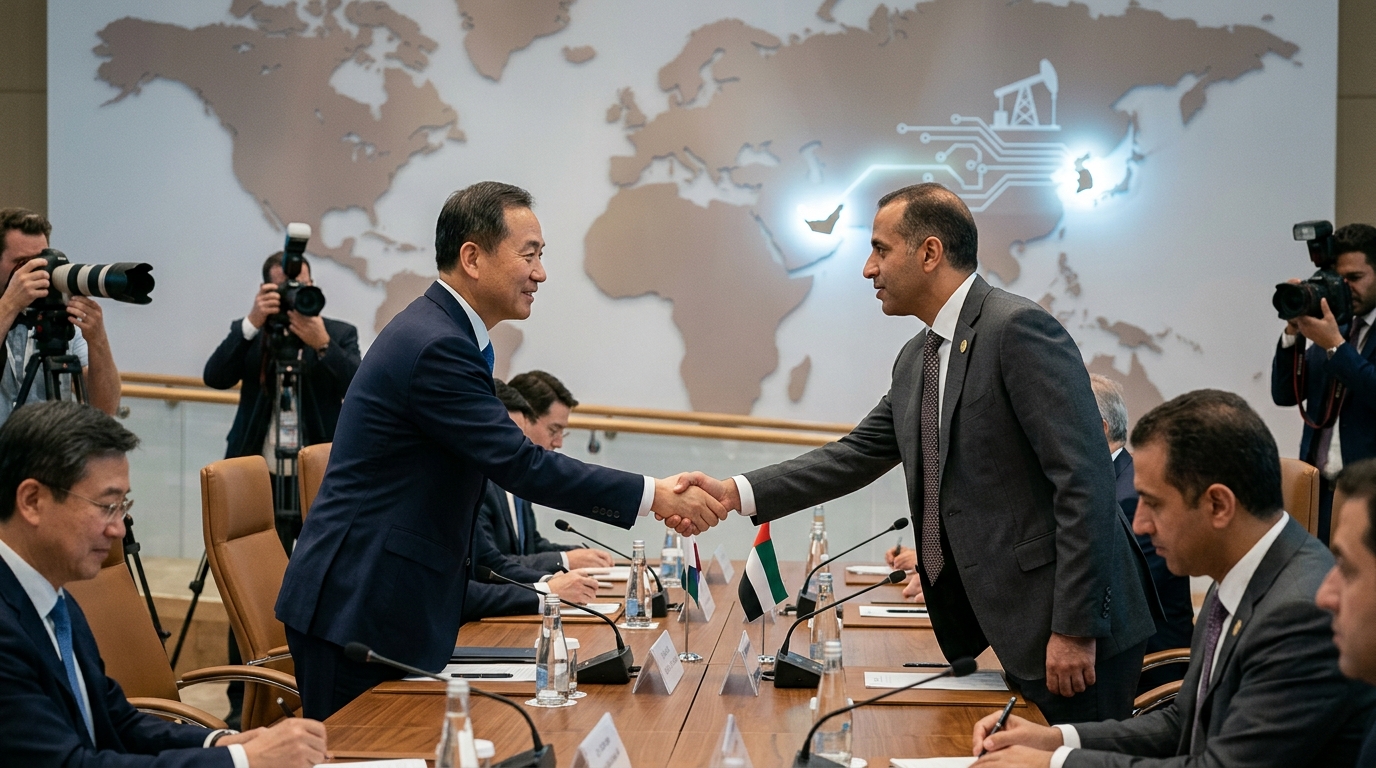
In an era where Artificial Intelligence (AI) is no longer merely a technological tool but the new frontier of geopolitical power, South Korea and the United Arab Emirates (UAE) are forging a historic convergence. The recent announcement of a deepened alliance in AI infrastructure signals the birth of a new axis that aims to offer an alternative to the bipolar dominance of the United States and China. This partnership is not just about exchanging expertise; it is about creating a comprehensive supply chain that marries Seoul’s semiconductor prowess with the Gulf’s capital and energy resources.
The Synergy of Capital and Silicon
The foundation of this collaboration rests on a complementarity rarely seen on the international stage. On one side, South Korea, home to giants like Samsung Electronics and SK Hynix, holds the keys to manufacturing high-performance semiconductors essential for training large language models (LLMs). On the other, the UAE, through investment vehicles like MGX and G42, possesses the liquidity and the vision to transform itself into a global data hub.
This strategic move comes at a time when the demand for data centers has skyrocketed, causing shortages in both hardware and energy. The UAE offers South Korea something it desperately needs: abundant and relatively cheap energy (including nuclear power from the Barakah plant, built by Korean firms) and vast tracts of land for infrastructure. In turn, Seoul provides the technological backbone that will allow the Emirates to diversify away from an oil-based economy.
Geopolitical Autonomy in a Polarized World
Perhaps the most significant dimension of this alliance is geopolitical. As the US tightens technology export controls and China responds with its own restrictions, "middle powers" are seeking ways to ensure their technological sovereignty. South Korea, pressured to balance between its largest trading partner (China) and its primary security ally (the US), finds in the UAE a partner that does not impose the same political constraints.
- Establishment of joint investment funds for AI startups.
- Collaboration on developing specialized AI chips (ASICs).
- Talent exchange programs and academic cooperation between leading universities.
- Integration of Korean AI solutions into UAE’s smart government frameworks.
However, this rapprochement is not without risks. Washington closely monitors the Emirates' ties with China, and any leakage of sensitive Korean (and by extension, Western) technology to Beijing via Abu Dhabi could strain Seoul’s relations with the US. The recent Microsoft-G42 deal, which included strict conditions for removing Chinese equipment, serves as the template that the Korean side will likely have to follow.
Energy: The Hidden Catalyst for AI Scaling
There can be no AI without massive amounts of electricity. South Korea has recognized that its domestic energy production is insufficient to support its ambition of becoming an "AI G3" power. The partnership with the UAE in nuclear energy and renewables is the bedrock upon which tomorrow’s data centers will be built. The UAE’s ability to provide stable, clean energy at scale is the competitive advantage that could attract even more global players to the region, turning the desert into a digital fortress.
"Our partnership with the UAE is not just a commercial agreement. It is a strategic choice for the future of our national security and economic prosperity," stated a high-ranking official from Seoul.
In conclusion, the South Korea-UAE alliance is a bold experiment. If successful, it will prove that technological progress in the 21st century requires not only intelligence and code but also a new form of diplomacy that bridges East Asia and the Middle East, creating a new pole of attraction on the global tech map.