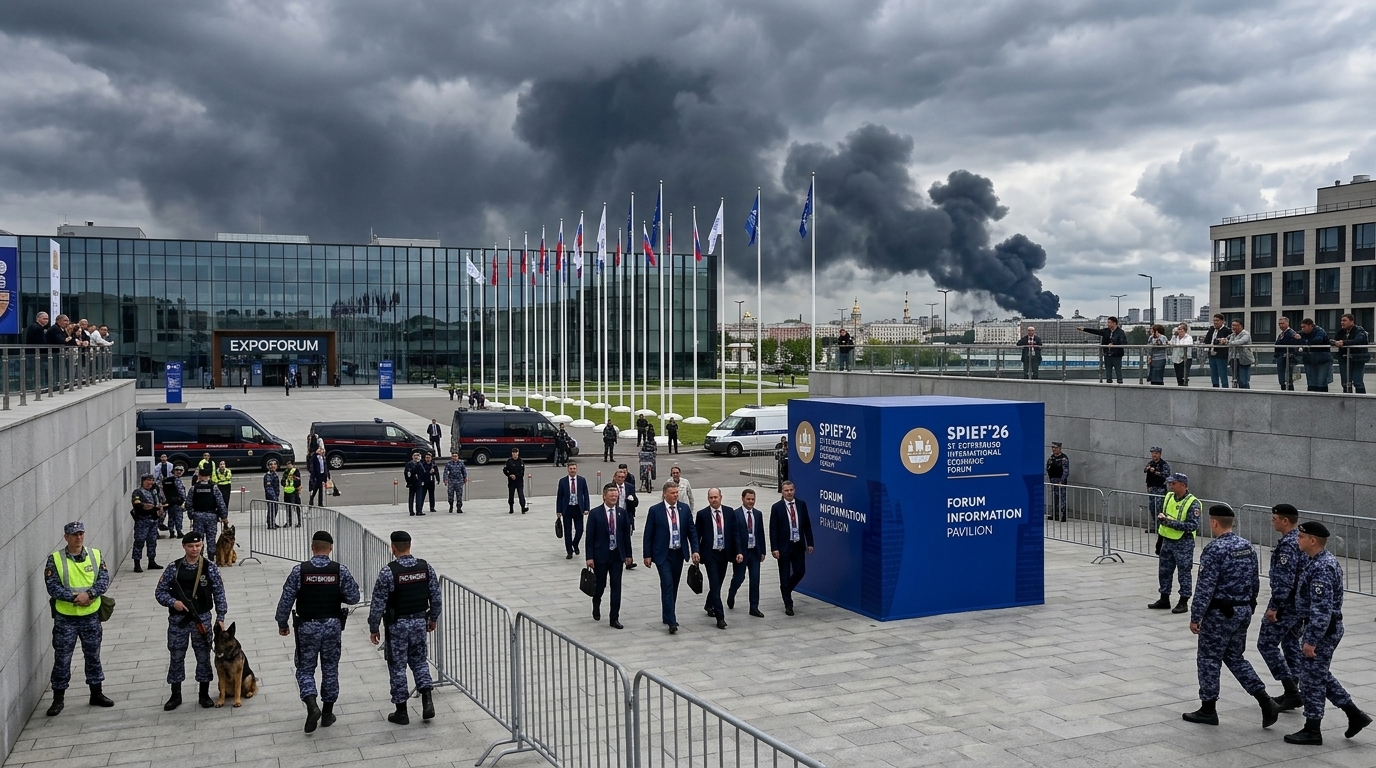
Saint Petersburg, Russia's imperial capital and the birthplace of Vladimir Putin, found itself at the center of a major drone offensive in the early hours of this morning, raising serious questions about the security of the nation's strategic infrastructure. The attack was far from coincidental, timed precisely to coincide with the official opening of the St. Petersburg International Economic Forum (SPIEF), an event that once attracted the global business elite and now serves as a symbol of the Kremlin's efforts to project economic resilience amidst crushing sanctions.
Strategic Asymmetry and the Blow to Prestige
According to field reports and local media, Ukrainian drones managed to travel a distance exceeding 1,000 kilometers from the Ukrainian border, successfully bypassing the Russian Federation's multi-layered air defense systems. The targets included a major oil depot and military installations in the Leningrad region. Footage circulating on social media showed plumes of thick black smoke rising over the industrial zone, while residents reported powerful explosions that rattled windows across the city.
Kyiv, following its established operational security protocol, did not issue a formal claim of responsibility. However, sources within the Ukrainian Intelligence Services (SBU) hinted that the operation aimed to disrupt the logistics chain supporting the Russian military effort. This strike carries immense symbolic weight. Saint Petersburg was previously considered a 'safe haven,' insulated from the horrors of the front line. The fact that Ukraine can now strike Putin’s 'backyard' while he hosts foreign delegations is a stark warning of shifting battlefield dynamics.
The Forum of Isolation: From Davos to 'Inward-Looking'
SPIEF 2026, which Russian propaganda often dubs the 'Davos of the North,' has undergone a radical transformation. Instead of Fortune 500 CEOs and European heads of state, this year's attendees are primarily from BRICS nations, Central Asia, and Africa. The forum’s agenda is heavily focused on 'data sovereignty,' de-dollarization, and the development of new trade routes that bypass Western influence.
- Efforts to attract investment from China and India to replace Western capital flight.
- Showcasing new technologies in domestic microchip production despite sanction-induced shortages.
- Discussions on expanding the Northern Sea Route as a viable alternative to the Suez Canal.
However, the sound of explosions and the smell of burning oil provided a dystopian contrast to the gilded halls of the Expoforum. Analysts suggest that Russia is now forced to divert significant resources to protect its internal infrastructure, drawing critical assets away from the front lines in Ukraine.
The Technological Evolution of Ukrainian Long-Range Drones
Ukraine's ability to strike at such depth is the result of a rapid evolution in its domestic defense industry. The drones utilized, likely 'Lyutyi' class models, feature advanced navigation systems that use terrain mapping and visual recognition to circumvent electronic warfare jamming. This technological leap has turned the conflict into a continuous endurance test for Russian air defenses, which are tasked with covering a vast and porous territory.
"These are no longer isolated incidents, but a systematic campaign to weaken the Russian war machine at its source," noted a Brussels-based military analyst.
Moscow, for its part, attempted to downplay the incident. The Ministry of Defense claimed the interception of 'all hostile targets,' a statement contradicted by geolocated footage showing direct hits. The Kremlin's response is expected to be forceful, with potential retaliatory strikes on Ukrainian energy grids, furthering a cycle of escalation that shows no signs of abating as we move further into 2026.