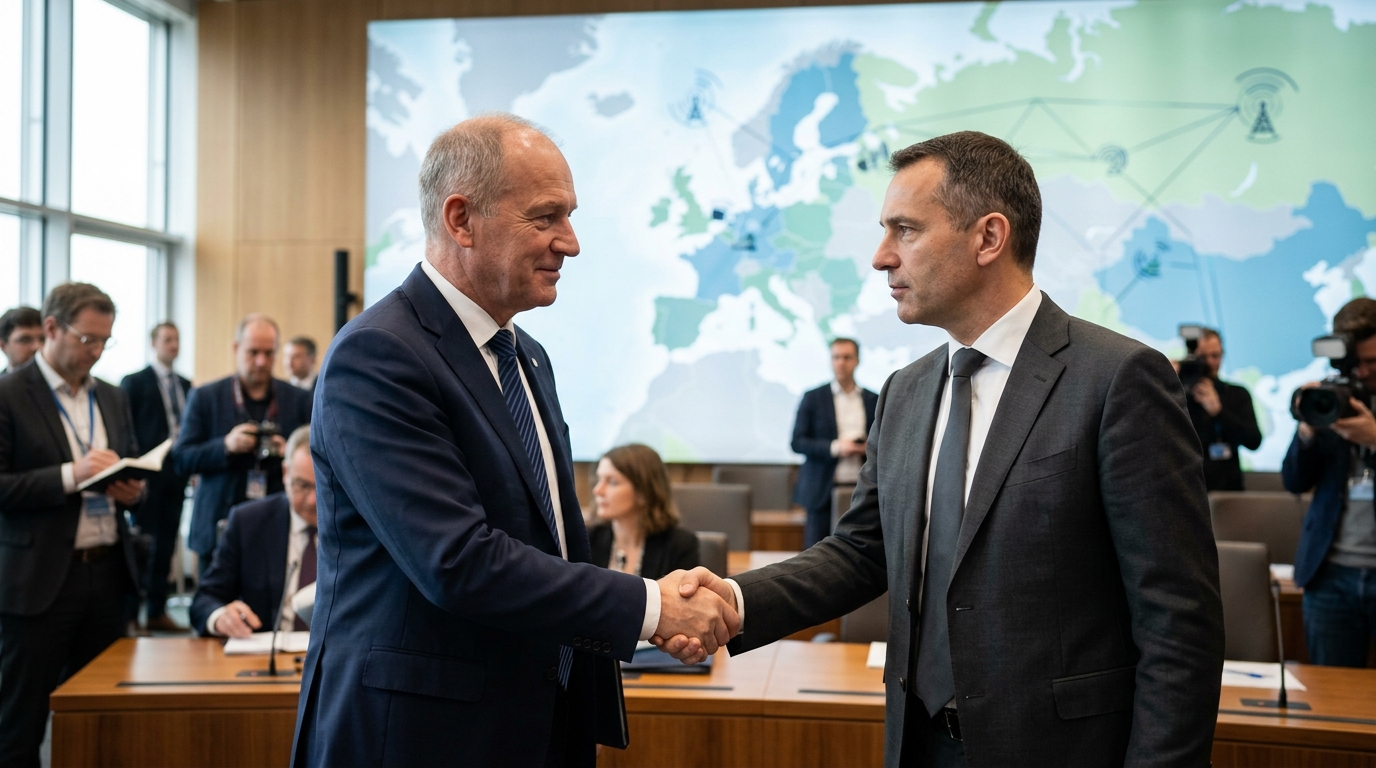
In a move that fundamentally reshapes the national security landscape in the heart of Europe, Rheinmetall AG and Deutsche Telekom AG have announced a strategic partnership to develop a comprehensive defense system against unmanned aerial vehicles (UAVs). This initiative, emerging amidst heightened geopolitical tensions and hybrid threats, aims to fortify Germany’s critical infrastructure—ranging from power plants and data centers to ports and industrial hubs.
The convergence of heavy defense industry and telecommunications technology is no coincidence. As the war in Ukraine and recent sabotage incidents on European soil have highlighted the vulnerability of domestic networks, the need for an "intelligent" protective umbrella has become imperative. The new "Drone Shield" will not rely solely on traditional interception weapons but will leverage Deutsche Telekom’s extensive 5G and 6G network as a massive detection sensor.
The Convergence of Connectivity and Combat
This collaboration represents the pinnacle of Germany’s "Zeitenwende" (historical turning point) strategy. Rheinmetall, renowned for its Skynex and Skyranger anti-aircraft systems, brings "hard" power to the table: radar systems, electronic jammers, and kinetic neutralization means. On the other hand, Deutsche Telekom provides the digital backbone. Utilizing mobile phone towers to detect tiny objects flying at low altitudes is a game-changer for situational awareness.
"The security of our infrastructure is no longer just a matter of physical fences, but a matter of digital sovereignty and early warning," a consortium executive stated during the presentation in Berlin.
The system will employ advanced Artificial Intelligence algorithms to distinguish between a commercial drone used for photography and an armed UAV or surveillance craft. The ability to process vast amounts of data in real-time through Telekom’s network allows for responses within seconds, which is critical for thwarting "drone swarms"—a tactic increasingly seen in modern conflicts.
Protecting Critical Infrastructure: The New Priority
The focus of the partnership lies in the so-called KRITIS (Kritische Infrastrukturen). In Germany, the discussion regarding the security of gas networks, electrical substations, and railway hubs has taken on existential proportions. Recent reports of suspicious drone flights over military bases and industrial parks have alarmed security authorities.
- Energy Security: Protecting wind farms and nuclear plants (in decommissioning or storage phases) from sabotage.
- Supply Chain: Ensuring the operation of the ports of Hamburg and Bremen against aerial threats.
- Digital Infrastructure: Shielding the data centers that form the heart of the European economy.
The Drone Shield will operate on multiple levels. The first level is passive detection via radio frequencies and acoustic sensors. The second level is visual confirmation using high-resolution cameras enhanced with AI. The third level, if deemed necessary, is active intervention, which can range from "blinding" the drone's sensors to neutralizing it in designated safe zones.
Geopolitical Implications and European Autonomy
This move sends a clear signal to Germany’s partners and adversaries alike. The country is no longer relying exclusively on American or foreign technology for its internal security. The creation of a German solution (Made in Germany) for countering drones bolsters the push for European strategic autonomy. Furthermore, this partnership is expected to serve as a blueprint for other EU member states, as the drone threat is inherently transboundary.
However, the implementation of such a surveillance network raises questions regarding privacy and civil liberties. Deutsche Telekom assures that the technology focuses exclusively on detecting unmanned devices and not on monitoring citizens. Nevertheless, the fine line between security and surveillance will remain at the center of public discourse in Germany for years to come.
In conclusion, the Rheinmetall-Deutsche Telekom alliance is a pragmatic response to 21st-century challenges. By combining kinetic force with digital intelligence, Germany is attempting to create an "impenetrable" wall tailored to the requirements of hybrid warfare. Whether this system can neutralize threats without altering the character of an open society remains to be seen in practice.