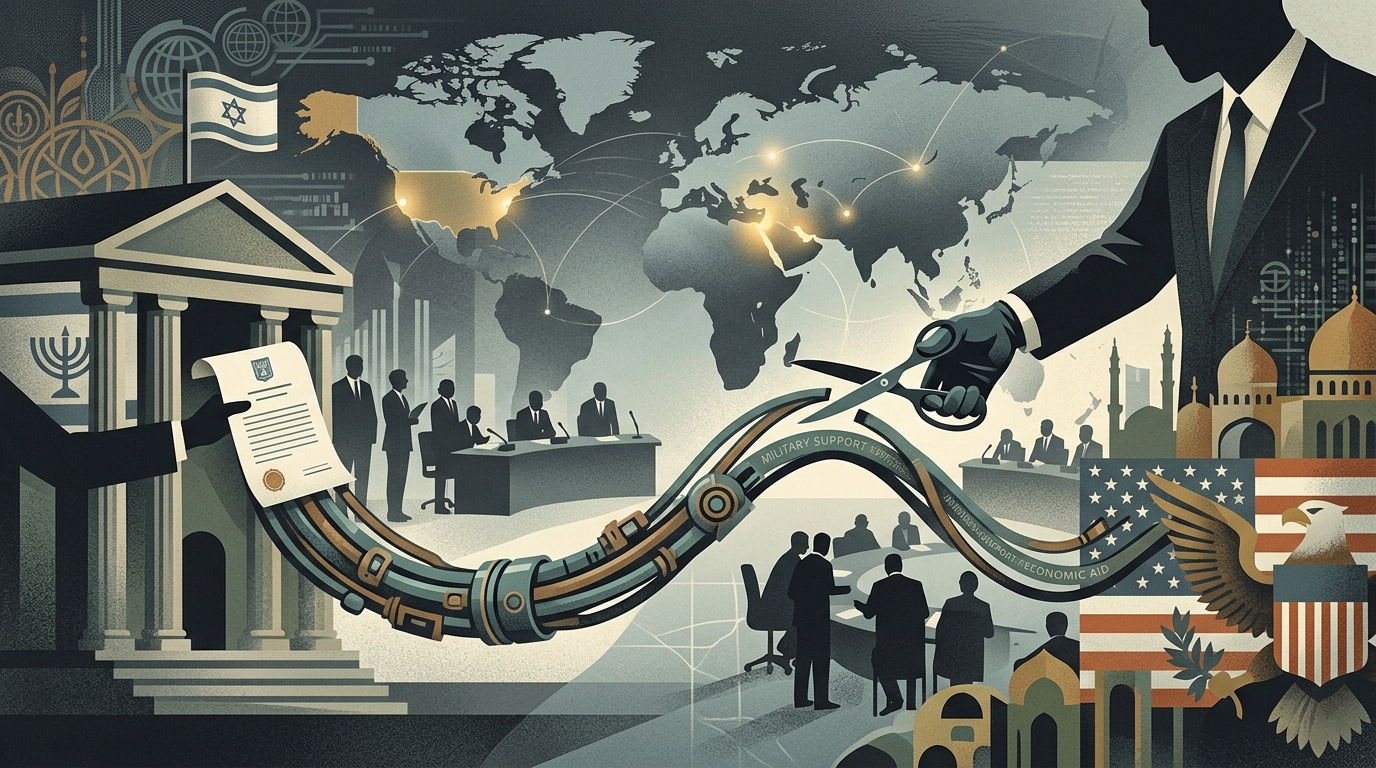
In a move that has sent ripples through the diplomatic corridors of Washington and Jerusalem, Israeli Prime Minister Benjamin Netanyahu has set an ambitious, if not provocative, goal: the complete elimination of American military aid to Israel within the next decade. This declaration, coming at a time of intense geopolitical volatility in the Middle East, is not merely a financial proposal but a radical re-evaluation of the "special relationship" that has bound the two nations since the aftermath of the Yom Kippur War.
The Policy of Strategic Autonomy
For decades, US aid—currently amounting to approximately $3.8 billion annually under the existing Memorandum of Understanding (MOU)—has been the cornerstone of Israeli security. However, Netanyahu argues that this dependence has begun to act as a constraint. In his analysis, financial support from Washington is inevitably accompanied by political conditions and "red lines" that often clash with Israel's national interests, as defined by the current administration.
The pursuit of zeroing out aid reflects a desire for "freedom of action." When Israel utilizes American resources, Washington retains oversight on the deployment of weapon systems, the intensity of military operations, and diplomatic cover. By decoupling, Netanyahu aims to transform Israel from a "client state" into an equal strategic partner, capable of making security decisions without requiring the explicit nod from the State Department or Congress.
The Ascent of the Israeli Defense Industry
A central pillar of this plan is the explosive growth of the domestic defense industry. Companies such as Rafael, Elbit Systems, and Israel Aerospace Industries (IAI) no longer just supply the Israel Defense Forces (IDF); they have evolved into global leaders in exporting cutting-edge technology, ranging from missile defense systems (Iron Dome, Arrow) to sophisticated UAVs and cyber-warfare tools.
Israel's economic resilience, despite the challenges of recent conflicts, allows the government to contemplate funding its procurement programs through national resources. Analysts suggest that a gradual reduction in aid could further stimulate domestic production, as Israel would no longer be bound by the Obama-era requirement to spend a vast majority of US funds exclusively on American defense firms—a condition that has previously stifled the growth of certain sectors within the Israeli market.
Geopolitical Risks and the Washington Response
Despite the allure of autonomy, the risks are immense. US aid is not just financial; it is a potent symbol of the American commitment to Israel's security, serving as a deterrent against Iran and its regional proxies. A total cessation of funding could be interpreted by Israel's adversaries as a rift in the alliance, potentially weakening Israel's posture in the regional power struggle.
Furthermore, in Washington, Netanyahu's proposal is met with skepticism. While some "isolationist" voices in Congress might welcome the multi-billion dollar savings, strategic planners warn that without the aid, the US would lose its primary lever of influence to restrain Israel from actions that could further destabilize the region. The relationship could become less predictable, with Israel potentially seeking new alliances or acting in ways that diverge from American interests in the Eastern Mediterranean.
Conclusion: Reality or Political Maneuvering?
Many observers wonder whether Netanyahu's goal is realistic or a tactical maneuver. At a time when American public opinion is increasingly polarized regarding support for Israel, the Prime Minister may be attempting to stay ahead of the curve. By stating that Israel *wants* to end the aid, he preemptively removes a powerful bargaining chip from those in Washington who threaten funding cuts to force policy changes.
In any case, the discussion regarding the "end of aid" signals the maturation of the Israeli economy and the desire of a nation-state to determine its destiny without external stewardship. Whether Israel can bear the true cost of this freedom remains to be seen over the coming decade.