

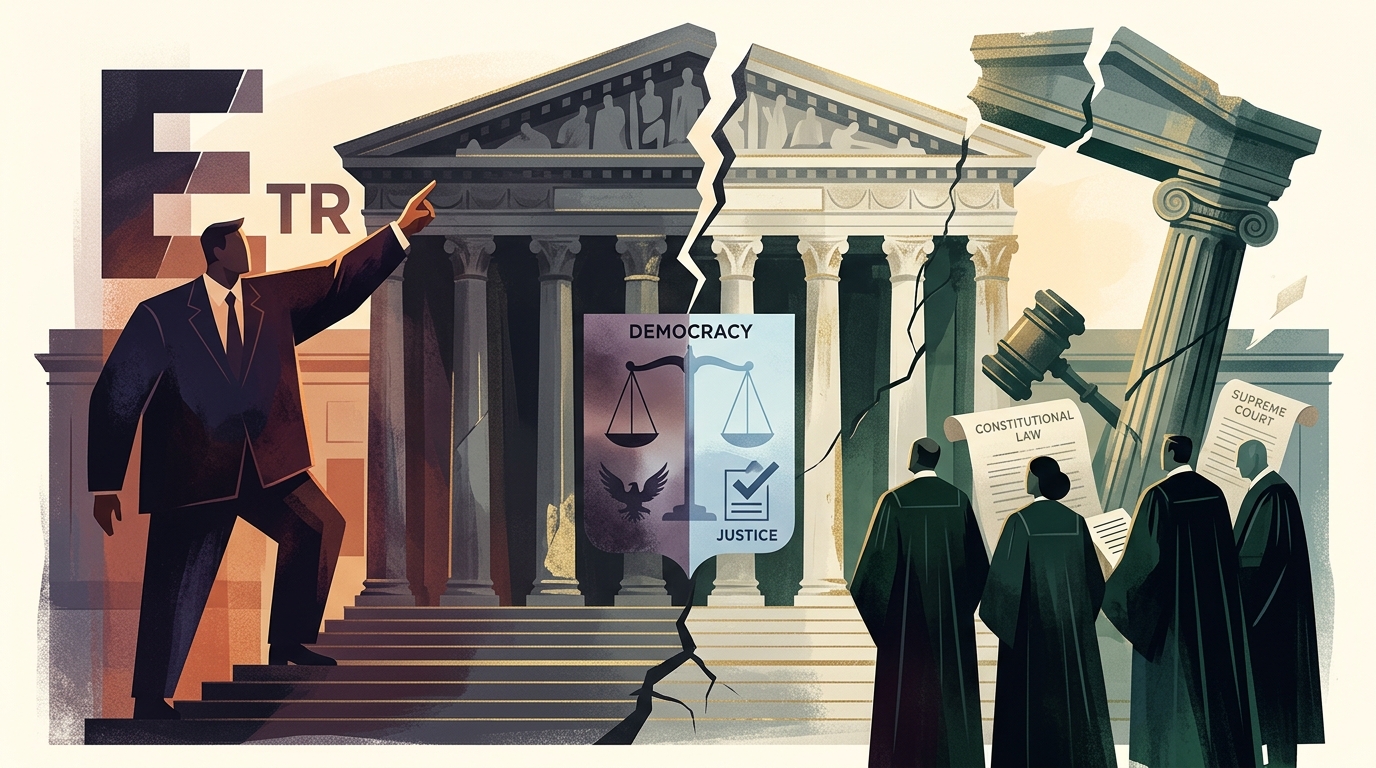
In an era where political polarization in the United States appears to have reached its nadir, Donald Trump’s recent public intervention regarding the U.S. Supreme Court marks a new, perilous turn in the relationship between the executive and judicial branches. The rhetoric of "don't block my policy" is not merely a request but a direct challenge to the independence of the justices—many of whom he appointed—raising the question of whether justice can remain above political expediency.
Executive Ambition vs. Judicial Restraint
At the heart of the conflict lie two pillars of the Trump agenda: a hardline immigration policy and the aggressive imposition of tariffs. The former president and current contender (or incumbent, depending on the 2026 political context) argues that judicial rulings delaying or overturning his executive orders are an "obstacle to the will of the people." Immigration, in particular, has become a legal minefield, with appeals against mass deportations reaching the highest levels of the judiciary.
On the other hand, tariffs—which Trump utilizes as a tool of geopolitical leverage—raise serious questions about the powers granted by the Constitution to the President regarding trade. The Supreme Court is being asked to decide whether invoking "national security" to impose economic sanctions is lawful or constitutes an abuse of power. Trump's pressure aims to preempt these decisions, creating an environment where justices feel accountable not to the Constitution, but to the President's political base.
The Institutional Paradox of the Roberts Court
The paradox of the current situation lies in the fact that the Supreme Court holds a solid 6-3 conservative majority, with three justices appointed by Trump himself. Nevertheless, the judiciary has repeatedly demonstrated that it is not willing to serve as a "rubber stamp" for the White House's desires. Chief Justice John Roberts has sought to maintain an image of neutrality, famously stating that "we do not have Obama judges or Trump judges."
However, Trump’s rhetoric undermines this very effort. By publicly calling on the justices to "do the right thing," he implies that any decision against him is a product of political bias or "betrayal." This places the justices in an impossible position: if they agree with him, they are accused of subservience; if they disagree, they become targets of verbal attacks that shake public confidence in the institution. History has shown that when justice becomes so heavily politicized, restoring its credibility takes decades.
Implications for the Rule of Law
This conflict transcends individuals and specific policies. It is a fundamental test of the system of checks and balances that forms the backbone of American democracy. If the President succeeds in intimidating the Supreme Court into approving controversial policies, then the rule of law retreats before the arbitrariness of executive power.
Furthermore, the international implications are equally grave. Allies and adversaries alike are closely watching to see if American institutions can withstand the pressure. A country where the leader can dictate judicial outcomes loses its moral high ground and its ability to champion human rights and democracy globally. The next two years will be decisive in determining whether the Supreme Court will remain the final bastion of constitutional legality or be swept away by the tide of populism.
"The judiciary must remain the 'least dangerous branch' by sticking to the law, not the polls or the tweets of the executive." — Legal Analyst Perspective





