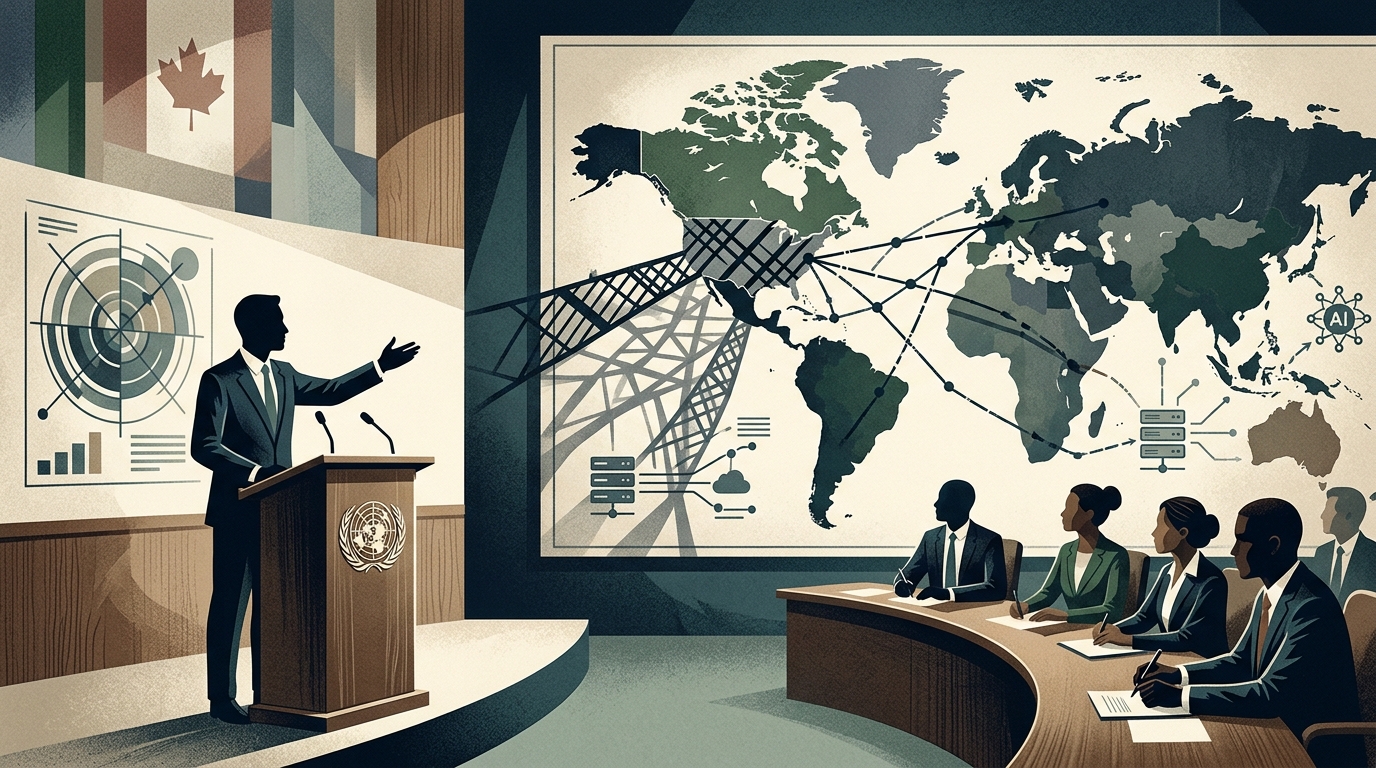
In a speech that marks a significant pivot in transatlantic relations, Canadian Prime Minister Mark Carney warned that increasing US restrictions on the export and use of Artificial Intelligence (AI) technologies serve as a wake-up call for nations relying on American infrastructure. Speaking from Ottawa, Carney—who ascended to the nation's leadership bringing his extensive central banking experience—emphasized that "digital sovereignty" is no longer a theoretical concept, but a national security imperative.
The End of Digital Naivety
For decades, Canada and the US enjoyed a nearly seamless exchange of technological resources. However, Washington's recent move to tighten controls around advanced NVIDIA chips and Large Language Models (LLMs), citing national security concerns regarding China, has had collateral effects on its closest allies. Carney argued that when access to cutting-edge technology becomes a tool of foreign policy, allies must re-evaluate their position.
"We cannot build a 21st-century economy on foundations controlled entirely by another jurisdiction, no matter how close our friendship," Carney stated. His concern centers on the fact that the US might use its AI dominance to impose standards, pricing, or even access restrictions that could put Canadian businesses at a disadvantage.
The Canadian Strategy for "Sovereign AI"
Canada is no minor player in the AI field. Home to pioneers like Geoffrey Hinton and Yoshua Bengio, the country was the cradle of deep learning. Despite this, the compute power required to train modern models remains concentrated in the hands of a few American giants, such as Microsoft, Google, and Amazon.
Carney announced a new "Sovereign Compute Initiative," which includes government subsidies for the creation of domestic data centers equipped with the latest hardware. The goal is to ensure that Canadian startups and researchers have access to resources that are not subject to the whims of US export laws.
- A $4 billion investment in domestic AI infrastructure.
- Tax incentives for companies developing "open" AI models.
- The creation of a cross-border framework with the EU for sharing compute resources.
Geopolitical Implications and the Five Eyes
Carney’s stance is causing ripples within the Five Eyes intelligence alliance. While the US pushes for a united front against China's technological rise, Canada appears to be adopting a more "European" approach, emphasizing regulatory autonomy. Analysts point out that Carney's move is an attempt to insulate Canada from a potential return of protectionism in the US, regardless of who occupies the White House.
"Artificial Intelligence is the electricity of our time. No sovereign state would accept having its power switch controlled by a foreign capital," the Prime Minister noted.
This statement reflects a broader global trend. From France to Japan, governments are realizing that owning AI intellectual property and infrastructure is as vital as oil reserves or food production. The challenge for Carney will be to balance this pursuit of autonomy without alienating Canada's most important trading partner.
Conclusion: A Multipolar Digital World
Mark Carney’s intervention suggests that the era of borderless, globalized technology is coming to an end. In its place, a world of digital blocs is emerging, where power is measured in teraflops and model parameters. For Canada, this transition is existential. If it can leverage its intellectual capital and pair it with infrastructure, it can remain a global leader. If it fails, it risks becoming a mere "digital tenant" on its own land.