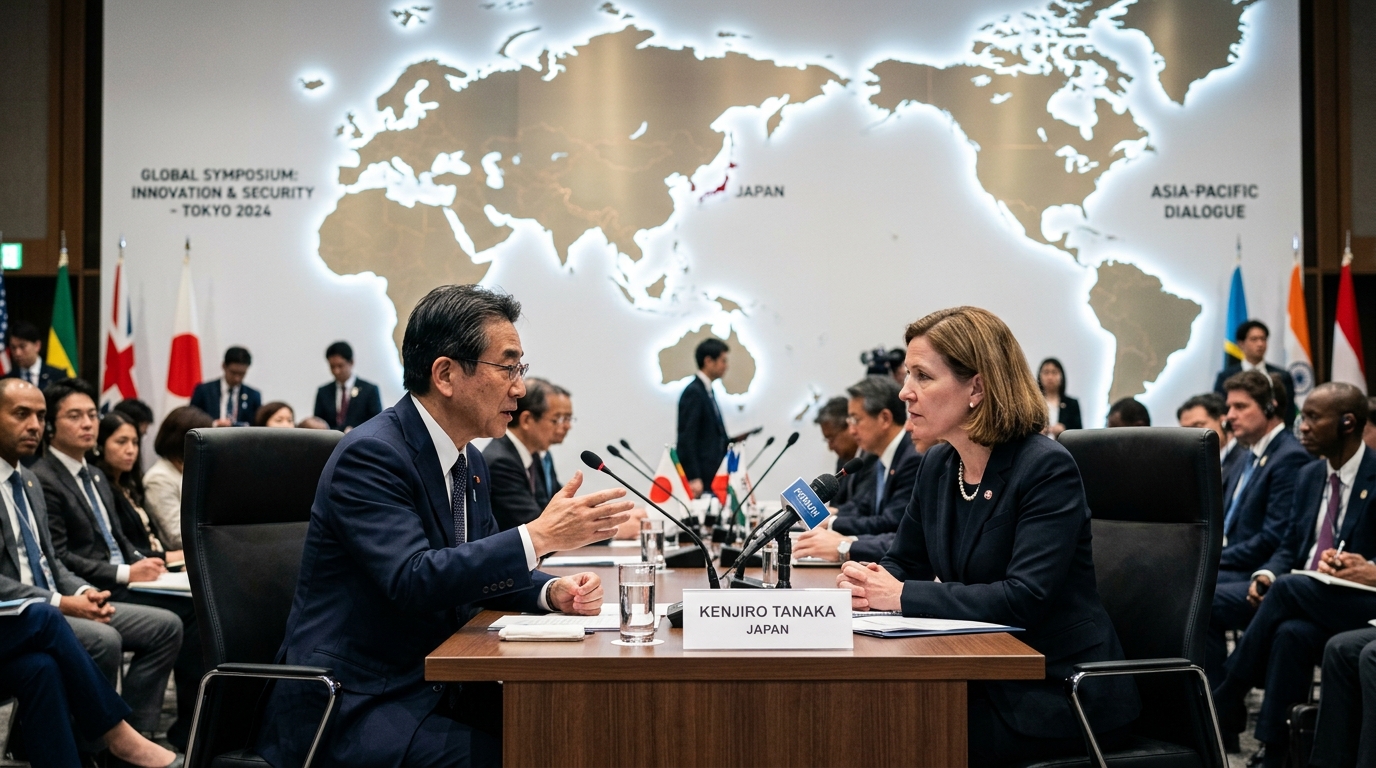
The Land of the Rising Sun is currently facing an existential challenge that transcends the boundaries of mere technological adaptation. As the global race for Artificial Intelligence (AI) supremacy accelerates, Japan is called upon to manage what analysts term the 'dual challenges': on one hand, the acute labor shortage due to demographic aging, and on the other, the need to regain lost ground in the global digital economy while reducing dependence on American and Chinese tech giants.
The Demographic Time Bomb and AI as a Necessity
For Japan, Artificial Intelligence is not just a tool for increasing productivity; it is a biological necessity. With a population shrinking and aging faster than any other developed economy, the country faces gaps in critical sectors, from elderly care to heavy industry. The first major challenge is integrating AI in a way that compensates for millions of lost jobs without disrupting social cohesion.
Unlike the West, where the fear of machines replacing workers dominates public discourse, Japan’s reception of AI is often more positive. The country’s cultural heritage, which views machines as partners (a remnant of Shinto beliefs regarding the animistic nature of objects), offers a unique advantage. However, the challenge remains: how will an aging population be trained to use these tools, and how can it be ensured that 'digital replacement' does not lead to economic inequality?
Technological Sovereignty and the Specter of Dependence
The second challenge is purely geopolitical and economic. Despite its historical dominance in hardware and robotics, Japan lagged behind in the software and cloud revolution. Today, the Japanese government, under Prime Minister Fumio Kishida, is investing billions of yen into the development of 'Sovereign AI.' The goal is to create Large Language Models (LLMs) tailored to the Japanese language and culture, avoiding the cultural and linguistic biases often embedded in Silicon Valley models.
- Investments in Rapidus for next-generation semiconductor production.
- Strategic partnerships with NVIDIA and Microsoft to build supercomputing infrastructure.
- Initiatives to implement AI in the public sector to combat bureaucracy.
Dependence on the US is a double-edged sword. While Japan remains Washington's closest ally in Asia, its economic security requires its own autonomous AI base. This is the key to preventing the country from turning into a mere 'consumer' of technology and instead remaining a global player that sets standards.
AI International Diplomacy: The Hiroshima Process
Japan has taken a leading role in international AI governance through the 'Hiroshima AI Process,' a G7 initiative. The challenge here is balancing innovation and regulation. The Japanese approach is traditionally more 'innovation-friendly' compared to the European Union's strict regulation, seeking to attract investment while setting ethical boundaries.
"Artificial Intelligence is not just a technological evolution; it is Japan's last chance to maintain its position as a global power in the 21st century," says an analyst from the Nomura Research Institute.
In conclusion, Japan's success will depend on whether it can turn its demographic weakness into technological strength. If AI can bridge the labor gap while simultaneously bolstering national sovereignty, Japan could serve as a global blueprint for how a mature society adapts to the digital age. If it fails, it risks sliding into permanent technological and economic marginalization.